Arabian Oud — Ghroob
Essence
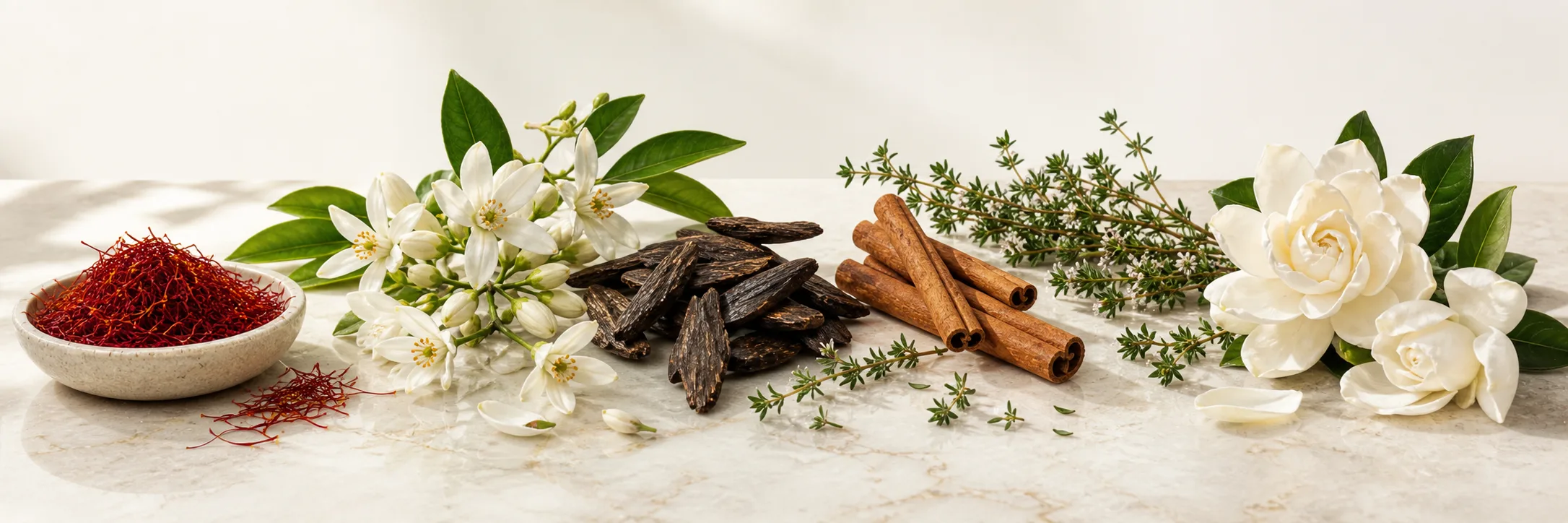
Ghroob (Arabic for “sunset,” also transliterated Ghoroob or Mokhalat Al Ghoroob) is a floral - oriental oud composition from Arabian Oud, the large and prolific Saudi house. Its defining feature is an enormous, almost overwhelming orange - blossom note set over saffron, soft spices, a mild non - skanky oud, and a creamy sandalwood - amber - musk base. It exists as both a concentrated perfume oil (the form most enthusiasts prize and discuss) and an EDP spray (the catalog subject).
Scent Profile
The opening is dominated by a powerful, syrupy, sometimes “screechy” orange blossom - frequently called one of the most intense orange - blossom blasts in any fragrance - with saffron and a touch of cinnamon spice riding alongside. Some wearers read a dark, indolic, slightly leathery/smoky underside to the blossom in the first minutes, almost camphorous; others read it as juicy “orange marmalade” with cinnamon. The listed marjoram and thyme are largely submerged, contributing at most a faint herbal lift.
Performance
Performance reports are favorable but skin - dependent. Listings describe its projection and longevity as above average, and individual wearers report roughly 8 - 10+ hours, with several noting big sillage for a concentrated oil and persistent oriental projection; the oil reportedly “lasts forever on clothes.” A dissenting minority report poor longevity (“no longevity so to speak”), again pointing to skin variability and to the oil - vs - spray difference. The oil is dabbed, not sprayed. As a warm, sweet oriental it suits cool weather and evenings; in heat the syrupy orange blossom can become heady. Apply sparingly - wearers stress “a little goes a long way.”
Wearing Context
Best as a cool - weather, evening or special - occasion scent given its sweet, rich, oriental character; a small dab is plenty. It leans to the feminine side of unisex on most skin (the sweet orange blossom and vanilla), though it’s marketed and worn unisex and the oud/amber base gives enough heft for men who like florals. It shines for lovers of intense white - floral orientals and Middle - Eastern - style perfumery; it falls flat for anyone expecting a smoky/animalic oud (the oud is mild and supportive) or anyone averse to sweet, indolic orange blossom. It’s a “compliment”/aura scent in wearer anecdotes rather than a discreet office wear.
Comparisons & DNA
Comparison material is sparse, and for an artisanal - leaning Arabian oil like this, Western “clones” essentially do not exist - so this section is necessarily lighter than for the designer/niche entries. Within Arabian Oud’s own range, Kalemat (their well - known amber oriental) is the house reference point most often discussed in the West, and Ghroob is positioned as the floral - oud counterpart; Arabian Oud’s Woody (dry rose - saffron - oud) and Misty Wood (ambered oud) are sister scents. Among wearers, one user characterized the Ghroob oil simply as “oud, rose, musk semi sweet” and “good for layering.” Suggested comparison clusters associate it with Arabian Oud Majestic Special Oud / Majestic Woody Intense, Tauer L’Air du Désert Marocain, and Guerlain Samsara - useful as loose genre neighbors (sweet/spicy/woody orientals) rather than true matches. For the orange - blossom - meets - dark - base character, the closest mainstream touchpoint named by a wearer is a warmer, sweeter take on the indolic - white - floral idea of Caron Narcisse Noir. No designer dupe is documented, and wearers repeatedly note how little Western information exists on Arabian Oud’s individual blends.
Reception
Wearer reviews are few and skew to raves - “beautiful,” “gorgeous,” “wonderful,” with particular love for the orange blossom and the oil version; recurring caveats are that it’s not a true oud scent and that it can read as juicy/sweet (“juicy fruit chewing gum” to one detractor). In specialist oud circles, Ghroob appears only in passing as a recent purchase, with mild skepticism that Arabian Oud’s “mukhallat” oils use pure oud; the more useful framing is Ghroob as a blended attar/mukhallat rather than a pure - oud product. Blind buy? Reasonable and low - risk if you love intense sweet orange blossom and Middle Eastern orientals and buy the oil in a small size - but sample first if you expect a real oud, because the oud is mild.
Versions & Reformulation
Ghroob exists in at least two distinct forms that wear differently - a critical buying distinction. The concentrated perfume oil (CPO/attar, dabbed, commonly 25 ml) is the form most enthusiasts prize; it’s reported as richer, sweeter, denser and longer - lasting, with some noting almond/salty - caramel facets. The EDP spray (the catalog subject, sold in sizes such as 75 ml) is reported as a brighter, more straightforward orange - blossom - over - musk reading. Arabian Oud’s own note list differs slightly from the catalog notes (the house lists oud, saffron, cinnamon, orange blossom / jasmine, gardenia, Bulgarian rose / sandalwood, white amber, Cambodian oud, musk). One wearer statement claims Ghroob was discontinued, which conflicts with other production-status references and should be treated as unverified.
Acquisition Notes
Pricing sits in an accessible - to - mid range for Middle Eastern perfumery - wearers repeatedly call the oil a “steal” for the quality and note “a little goes a long way,” so a small bottle lasts. Common formats: 25 ml concentrated oil and EDP spray (e.g., 75 ml).
Notable Facts & Lore
- “Ghroob” means sunset in Arabic, fitting the warm, golden, fading - light character of the scent.
- The most relevant cultural - context point is that Arabian Oud is among the largest and most prestigious perfume houses in the Arab world, yet few of its individual blends are discussed in the West - Ghroob included - which is itself the defining “lore” of this fragrance for an English - speaking audience: a well - loved regional release that remains under - documented internationally.
- It is also sometimes sold as part of a Ghroob “set” pairing the perfume with matching bakhoor (incense), reflecting the traditional Gulf layering culture it comes from.