Byredo — Pulp
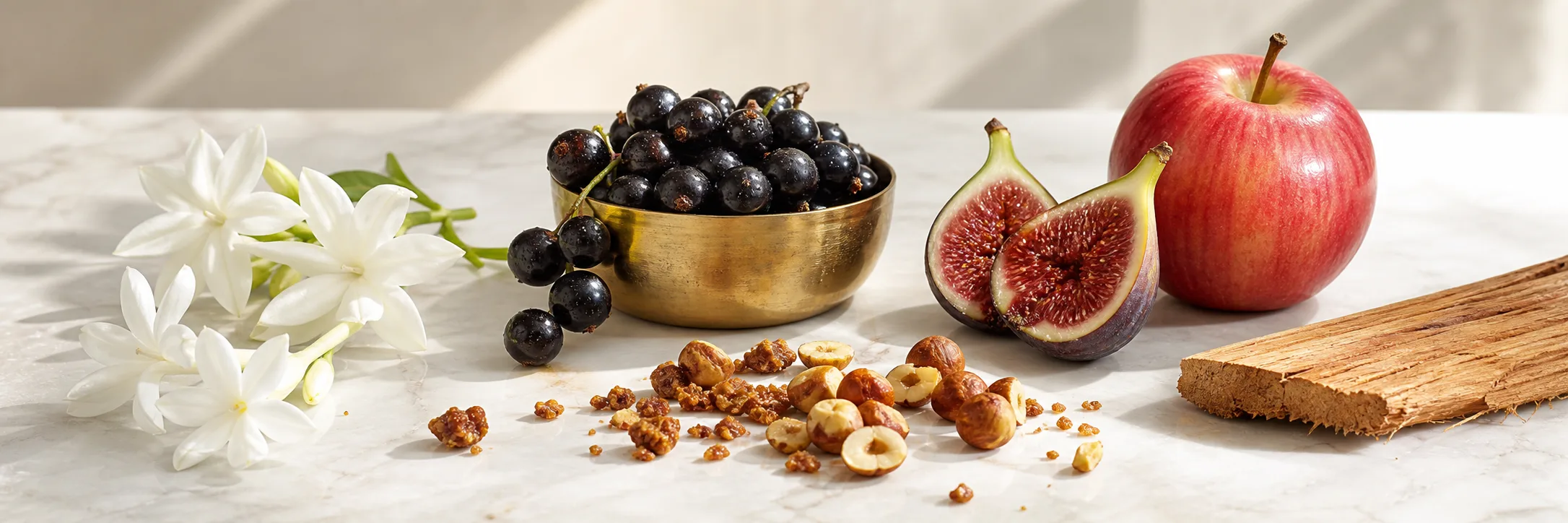
Essence
Pulp is one of the best-known examples of an overripe-fruit niche perfume that refuses to behave like a polished fruity floral. Robin at Now Smell This called it something most new niche lines lack—fun—and described it as a huge, juicy, fizzy, tart-sweet fruit blast that stays wildly fruity for an unusually long time. wearers wearers have spent years arguing over whether that excess reads as brilliant, feral, sangria-like abundance or as fruit tipping toward rot, fermentation, shampoo, compost, or acetone. That argument is the fragrance’s identity.
Scent Profile
The formal structure is straightforward—blackcurrant, bergamot, and cardamom into fig, red apple, and tiare, over praline, peach blossom, and cedar—but the lived impression is anything but straightforward. Now Smell This reads it as juicy berries, green fig, peach, and tart rhubarb-like acidity; wearer reports reviewers more often emphasize apple and overripe fig, sometimes drifting into shampoo, soap, or acetone territory; wearer reports reviews broaden the picture further into salsa vegetables, bitter orange, frozen berries, marmalade, sangria, and fruit sitting in hot sun a day too long. What remains consistent is that Pulp is fruit first, fruit second, and fruit almost to the end: even when the drydown gets calmer, drier, woodier, or a little more fig-heavy, it rarely stops smelling like concentrated fruit matter. Several reviewers call it fairly linear despite the note list, because the opening idea—densely saturated ripe fruit with tart green edges—dominates the entire wear.
Performance
Byredo’s reputation for weak performance does not really apply here. wearer reports’s aggregate scores put longevity at 7.6 and sillage at 7.2, while wearer reports and wearer reports users repeatedly call Pulp potent, persistent, and something to spray carefully. Reported wear spans roughly six hours of strong outward effect into a later skin scent for one reviewer, up to ten to twelve hours for others, with more than one comment warning that two sprays can already be plenty and that overspraying becomes headache territory. Even people who dislike the scent often concede that it projects and lasts unusually well for the brand.
Wearing Context
Pulp seems to perform best when the environment tolerates eccentricity and heat. Some wearers specifically love it in hot or humid weather, describing it as a hot summer night scent, a fruity summer statement, or something that clicked in humid Thailand; others still reserve it for summer because the aggressive fruit saturation feels too much in colder, enclosed settings. Context matters more than season, though: this is an artsy, playful, attention-catching perfume that can absolutely work if you want to smell strange-in-a-good-way, but it is not a safe office reach unless you use a tiny amount and know how your skin translates the fruit. The strongest contextual consensus is not “summer only” but “sample it, wear it for a full day, and see whether your version of overripe reads delicious or unbearable.”
Comparisons & DNA
The comparisons that actually hold are conceptual more than exact. wearer reports offers Loewe Paula’s Ibiza as a muted version of Pulp without the tartness, and another reviewer says Pulp could almost pass as an eccentric member of Hermès’s Un Jardin series. wearer reports comparisons within the house are also useful: against Sundazed, Pulp is the darker and stickier sibling—less cotton-candy sunshine, more warm sticky fruit at dusk. All of that points to its real DNA: not generic fruity floral, but hyper-saturated fruit with green sharpness, tartness, and a slightly uncanny “too ripe” realism that makes it feel closer to beverage, compote, or fruit bowl than to shampoo-ad sweetness, even when some noses read exactly that shampoo effect.
Reception
Reception is intensely polarized and that polarization is stable across whitelisted sources. Admirers describe Pulp as juicy, clever, comforting, addictive, warm, cheerful, and unlike anything else; detractors call it rotten apples, moldy oranges, plastic, frozen old berries, mall-air-freshener fruit, or straight-up nausea. The sharpest line of disagreement is semantic but important: many defenders accept “overripe” while resisting “rotten,” arguing that Pulp smells like fruit at peak ripeness and maybe the earliest edge of fermentation, not putridity. The blind-buy verdict is emphatically no. Even supporters usually admit that it is strange, chemically vivid, and potentially exhausting; this is one of the classic sample-first niche fragrances.
Versions & Reformulation
The version story is murky rather than settled. wearer reports lists Pulp as a 2008 release and notes that it “was last marketed by Puig,” which already suggests catalog ambiguity. wearer reports comments in 2024–2026 add further uncertainty: some users say it became an online exclusive only, some say discontinuation chatter makes sense, others insist it is still on the brand site, and wearers members disagree on whether later bottles smell clearly different from earlier ones. One wearer specifically reports a marked difference between 2010 and 2020 bottles, while another says four bottles across years showed no reformulation at all. The sober conclusion is that reformulation and discontinuation talk exists, but there is no clean whitelisted consensus on final status.
Acquisition Notes
Now Smell This recorded Pulp at $195 for 100 ml back in 2008, which places it from the start in the full-bottle-niche bracket rather than the casual-fruit bracket. Current whitelisted acquisition signal is less tidy: recent wearer reports comments suggest periods of online-exclusive availability, often only in 100 ml, along with discontinuation rumors and boutique stock scarcity. Given both the price and the polarizing scent profile, decants, travel sizes, or at least a serious sample session remain the most rational route. No whitelisted evidence surfaced on counterfeits or batch-code decoding.
Notable Facts & Lore
- The most significant documented fact is critical rather than promotional: Now Smell This singled Pulp out as a rare niche release that actually brought genuine fun to a crowded market, and later included it among fragrances every perfumista should smell.
- Its cultural “lore” now rests on being one of the canonical overripe-fruit perfumes—the fragrance people invoke when they mean ripe almost to the point of spoilage.