Carolina Herrera — Good Girl
Essence
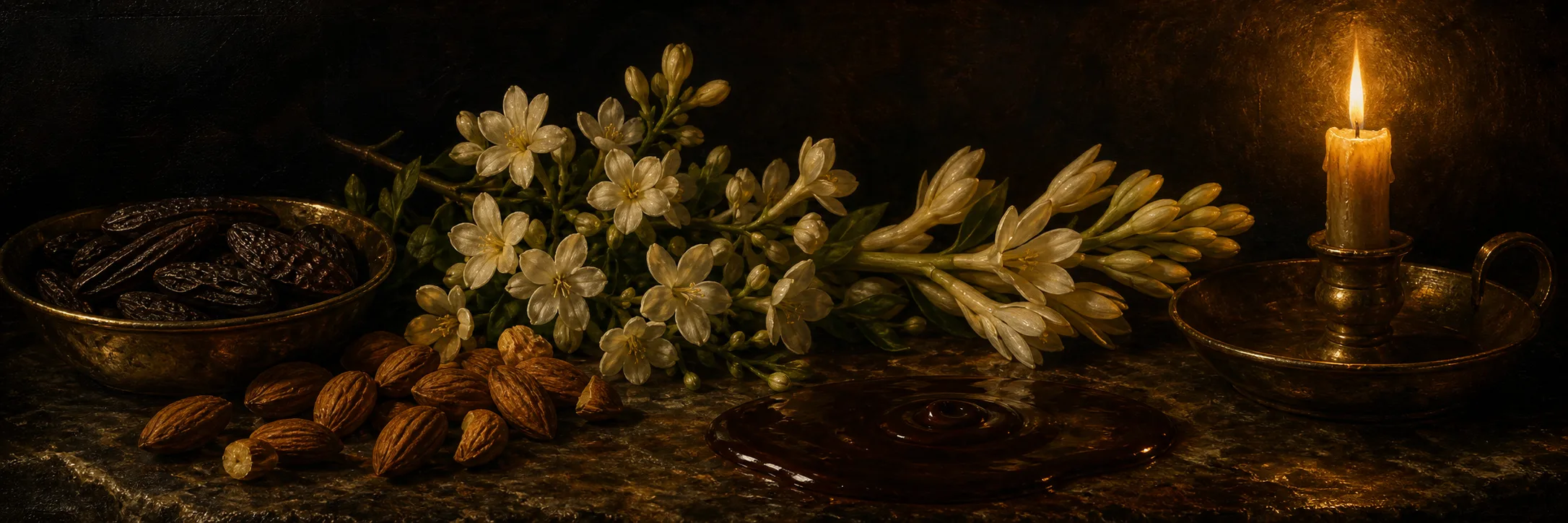
Good Girl is a glossy floral gourmand designed around contrast: bright white flowers against almond, coffee, tonka, cocoa, and a dark woody-musky base. The black stiletto bottle is not just packaging; it is part of the fragrance’s deliberately theatrical identity.
Scent Profile
Almond leads the opening, with coffee acting more as a dark suggestion than a literal brewed note. A brief citrus sparkle keeps the start from becoming immediately dense. The composition soon turns to its white-floral core of tuberose and jasmine sambac. Those flowers are creamy and polished rather than animalic, and they meet a sweet base of tonka, cocoa, vanilla-like warmth, musks, and woods. The coffee-and-cocoa idea gives the perfume shadow, but its main impression is a sweet, glamorous floral over amber-gourmand materials. It is built for impact, not quiet intricacy.
Performance
Good Girl usually offers strong projection at the beginning and above-average persistence through the day. It can remain on fabric after the skin wear has softened. Apply with restraint when a smaller scent radius is wanted; its natural style is visible rather than intimate.
Wearing Context
Cooler weather, night outings, dates, and dressed-up social settings bring out the best in its sweet floral depth. It can be made work-friendly with a lighter application. The primary question is whether almond, tuberose, and sugary tonka feel inviting or excessive on the wearer.
Comparisons & DNA
Yves Saint Laurent Black Opium occupies a similar coffee-touched evening lane, but Good Girl is more white-floral and almond-forward. Dior Hypnotic Poison shares a creamy almond-gourmand sensuality; Good Girl is brighter, less marzipan-heavy, and more tuberose-jasmine focused. The comparison to J’Adore describes its broad, modern white-floral appeal, though Good Girl wraps that floral center in a much sweeter, darker base.
Reception
It is both a major commercial success and a source of predictable disagreement. Supporters find it sexy, dramatic, polished, and reliably compliment-friendly. Detractors object to synthetic sweetness, its familiar designer formula, and a coffee theme that can feel more advertised than smelled. The price is justified for people seeking a high-impact mainstream signature, not for those who want subtlety.
Versions & Reformulation
The original Eau de Parfum dates to 2016 and has generated a large family of flankers, formats, and collector bottles. No major reformulation of the original is documented. Credit is most consistently attached to Louise Turner, with Quentin Bisch also widely co-credited.
Acquisition Notes
The original format range includes 30 ml, 50 ml, and 80 ml bottles. It is widely available, so established purchase channels are preferable to uncertain early-batch or secondhand claims. A sample is sensible for anyone uncertain about sweet tuberose or high projection.
Notable Facts & Lore
- The stiletto was positioned as a symbol of duality and feminine power.
- Karlie Kloss was the face of the original campaign.
- The fragrance’s commercial impact helped turn the bottle into a durable house icon.