Histoires de Parfums — Tubereuse 3 Animale
Essence
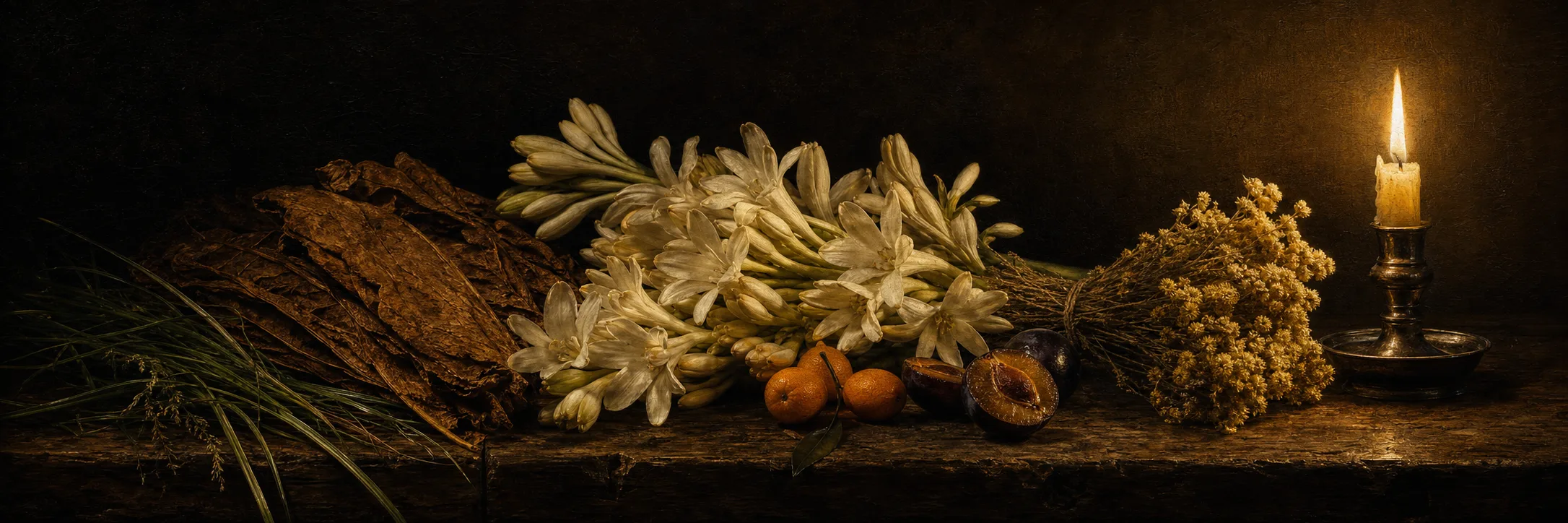
Tubereuse 3 Animale is the dark entry in Histoires de Parfums’ “An Ode to Tuberose” trilogy. It is not a bright white-floral soliflore; it is a smoky, honeyed, fruity-tobacco floral amber where tuberose is wrapped in immortelle, plum, grass, tobacco, woods, and resin. The result is moody, warm, and surprisingly unisex despite its feminine marketing.
Scent Profile
The opening moves fast. Tuberose appears with neroli and kumquat, giving a citrus-fruit lift, while the flower also flashes camphor, rubber, bubblegum, and cola-candy facets. This early brightness can feel strange or synthetic before the darker materials take over. The heart is the signature. Immortelle floods the composition with honeyed, fenugreek-like warmth, while plum or prune adds dark fruit and dry grass brings an earthy green edge. Tuberose stays present but smothered, more sultry and ambered than creamy or bridal. Blond tobacco begins to smoke through the floral sweetness. The drydown is resinous, sweet-smoky, and golden. Tobacco, immortelle, pruned fruit, hay, and woods dominate, with a faintly animalic honeyed undertone. Leather is more an impression than a listed note, and the animalic aspect is subtler than the name suggests.
Performance
Performance is strong. The first hour or two can project assertively, then the scent settles into a large warm cloud. Many wearers report all-day longevity and next-day traces on fabric. A light hand is best around work, food, or confined spaces. Heat amplifies the honeyed and slightly urinous facets, so cold weather suits it especially well.
Wearing Context
This is a fall and winter fragrance, ideal for evening, date, cozy, and statement wear. It can feel seductive, vintage, and dramatic, but it is not office-safe in the open-plan sense. Although marketed feminine, it wears broadly unisex and is often recommended to men or to people who usually dislike tuberose.
Comparisons & DNA
The closest internal relative is Histoires de Parfums 1740 Marquis de Sade: both use dark fruit, tobacco, smoky resin, and leathery sweetness, but Tubereuse 3 replaces the darker patchouli emphasis with floral tuberose. Within the trilogy, Tubereuse 1 Capricieuse is gourmand-powdery, Tubereuse 2 Virginale is prettier and fruitier, and Tubereuse 3 is the dark honeyed one. Against famous tuberoses, it is warmer and smokier than Serge Lutens Tubereuse Criminelle, less proud and floral than Robert Piguet Fracas, and less green than Frederic Malle Carnal Flower.
Reception
Tubereuse 3 Animale has cult appeal. Praise focuses on uniqueness, honeyed tobacco richness, moody glamour, and powerful performance. The main objections are syrupy sweetness, immortelle’s fenugreek or body-odor associations, the bubblegum-cola opening, and the fact that the name promises more animalic dirt than the scent actually delivers. Scarcity makes blind buying riskier than the scent profile alone would.
Versions & Reformulation
The fragrance is a single Eau de Parfum from 2010, historically available in 120ml, 60ml, and travel or coffret formats tied to the tuberose trilogy. It is now widely treated as discontinued or out of production, with active sourcing focused on remaining stock, decants, swaps, and secondary-market bottles. No formal reformulation or concentration variant is documented. Perfumer attribution is not fully settled across sources.
Acquisition Notes
Tubereuse 3 Animale is niche-priced and increasingly scarcity-priced. Remaining bottles and decants should be approached with provenance in mind, since discontinued desirability raises secondary-market risk. Samples are the smart entry point because the immortelle, sweetness, and animalic-honeyed undertone are divisive.
Notable Facts & Lore
- It is the darkest member of the house’s three-part tuberose trilogy.
- The trilogy frames tuberose as gourmand, pretty, and animalic across three separate scents.
- The “Animale” name refers more to honeyed, lived-in darkness than to a literal dirty-animalic effect.
- The fragrance is often described as a male-friendly or tuberose-skeptic tuberose.
- Discontinuation has turned it into a recurring bottle-hunt scent.
- Wearer imagery often leans toward smoky vintage glamour rather than clean modern floral style.