issey-miyake — L'Eau d'Issey
Essence
L’Eau d’Issey is the 1992 Jacques Cavallier Belletrud composition that turned transparent water-florals into a defining 1990s style. Built around Calone, lotus, rose, lily, clean musk, and pale woods, it is both minimalist and historically loud: a quiet scent that changed the room.
Scent Profile
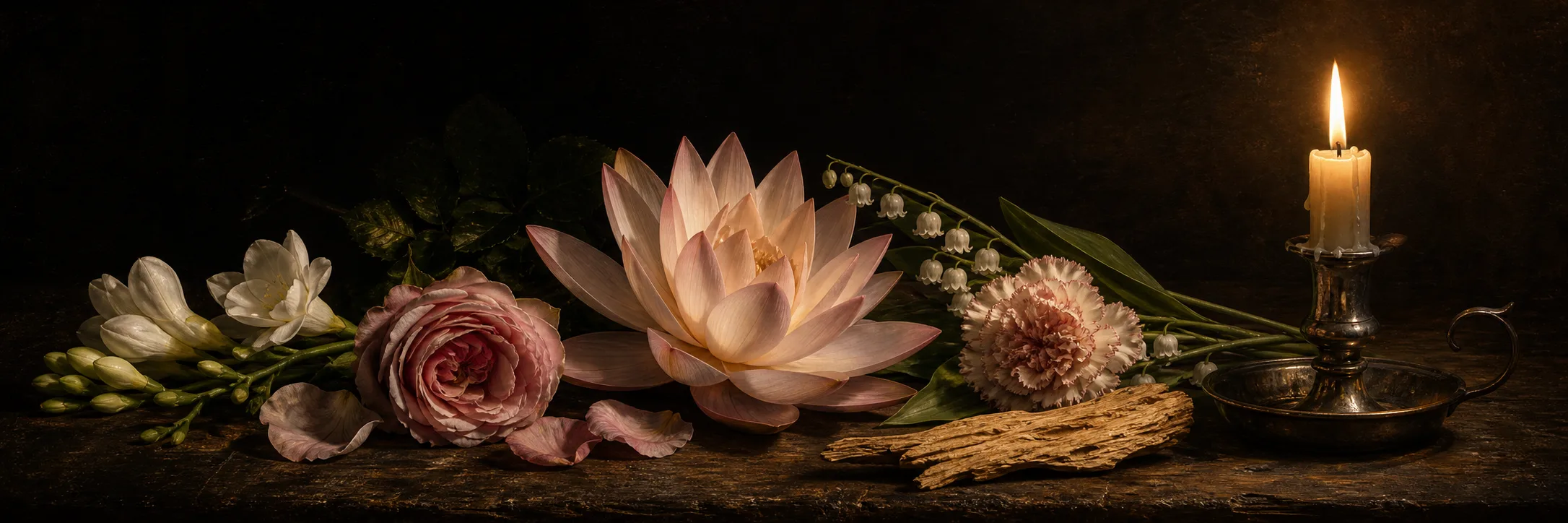
The opening is a glassy rush of watery melon, lotus, freesia, cyclamen, rose water, and Calone. It reads as waterfall spray rather than sea breeze: mineral, dewy, slightly green, and almost cucumber-cool. That synthetic-water clarity is the make-or-break feature. Admirers hear spring water and wet petals; skeptics hear something too sterile. The heart gives the perfume its floral body. Lily-of-the-valley, lily, water peony, and a light carnation edge form a clean white-floral accord, translucent rather than creamy. A green stemminess runs through the center and keeps the flowers taut. The drydown is sheer but durable: clean musk, pale cedar-like woods, sandalwood, amber, osmanthus, and a trace of tuberose. The lasting impression is aquatic-floral, not marine. It is water over flowers and woods, more polished surface than ocean air.
Performance
For an EDT with such a transparent profile, it performs better than its delicacy suggests. Expect moderate projection and long wear for a fresh floral, especially in warm weather. It can be applied generously, but heavy spraying emphasizes the Calone edge that divides wearers.
Wearing Context
This is a spring and summer daytime fragrance first: office, clean casual wear, hot climates, and any setting where clarity matters more than sensual weight. Marketed feminine, it often reads unisex in practice because the watery structure is so abstract. It is less convincing as a winter comfort scent or dramatic evening fragrance.
Comparisons & DNA
Calvin Klein Escape is the closest predecessor in the Calone timeline, but L’Eau d’Issey is the composition that made watery florals feel like the future. Escape is fruitier and more overtly early-1990s; Issey is cooler, cleaner, and more architectural. CK One and Tommy Girl share the same decade’s clean, technological freshness, though CK One is more unisex-citrus and Tommy Girl more tea-floral. L’Eau d’Issey is more floral and more watery than both. Light Blue and Acqua di Gioia belong to the later clean-aquatic family that benefited from Issey’s success. Light Blue is citrus-woody and breezier; Acqua di Gioia is greener and more minty. Issey remains the more abstract water-floral template. L’Eau d’Issey Pour Homme is the masculine sibling: yuzu, spice, and milky woods where the original uses lotus, lily, and rose. Le Feu d’Issey is the house’s cult counterpoint, a strange spicy-milky-woody composition that shows how far Miyake could move away from the water signature.
Reception
Reception is respectful and polarized. The fragrance is widely treated as a classic because its influence is undeniable, but the same Calone-water accord that made it famous is the main objection. Praise centers on its clarity, restraint, and genre-defining freshness. Criticism centers on sterility, sharpness, and a clean-product association. Luca Turin’s take captures that split: he recognized the green floral and melon-aquatic construction while warning that the drydown can resemble glass cleaner. The broader consensus is similar: historically essential, beautifully engineered to some noses, too synthetic to others.
Versions & Reformulation
Vintage discussion usually divides bottles into pre-2000, 2000s white-cap, early-2010s silver-cap, and recent production. Older bottles are often described as stronger, muskier, and more intensely Calone-driven. Modern bottles keep the recognizable structure but are often described as cleaner, more citric, and less distinctive. Very old aquatic bottles are risky because this style can degrade.
Acquisition Notes
Current EDT bottles are widely available in mainstream sizes and remain the practical choice for daily wear. Vintage hunting only makes sense for collectors who specifically want the denser early profile and can verify era and condition. For most wearers, the current version gives the essential water-floral experience without the uncertainty of aged stock.
Notable Facts & Lore
- The name means “the water of Issey” and also echoes “odyssey.”
- Miyake wanted a scent as clear as spring water.
- The bottle was designed around the image of a suspended drop of water.
- The spherical cap is often linked to the moon over the Eiffel Tower.
- Jacques Cavallier Belletrud composed both this fragrance and the 1994 Pour Homme.
- Its success helped make clean aquatic florals one of the dominant styles of the 1990s.