Maison Francis Kurkdjian — Oud
Essence
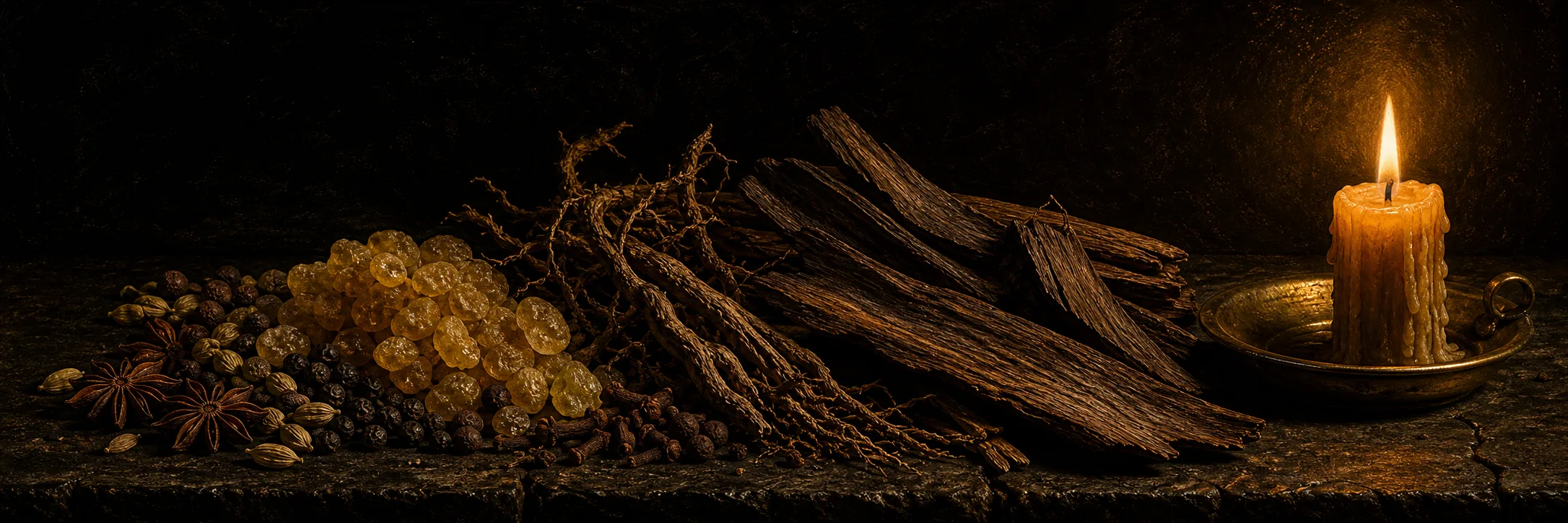
Maison Francis Kurkdjian Oud (2012) is the inaugural agarwood statement from Francis Kurkdjian’s own house and the structural blueprint for everything labeled “Oud” or “Oud… Mood” that followed it. It is a deliberately Westernised, polished take on a polarising raw material: dry, slightly peppery, faintly medicinal Laotian oud framed by saffron, elemi resin, Atlas cedar and a transparent patchouli, with virtually no animalic skank.
Scent Profile
The opening is metallic, dry, and slightly austere-a single sharp note from synthetic saffronal (Kurkdjian’s preferred reconstitution since natural safrol is restricted) crossed with the citrusy-resinous lift of elemi. There is no juicy top, no rose syrup, no incense smoke; the first ten minutes feel almost laboratory-clean, with a peppery prickle that some wearers (critical commentary, wearer discussion’s user reports) describe as petrol-like and others as “rubber band-aid.” Within fifteen to twenty minutes the saffron rounds out, and the so-called “Laotian oud” accord rises-leathery, dry-woody, with a faint waxy/honeyed undertone but stripped of the fecal-barnyard register typical of Hindi agarwood. By the one-hour mark the heart settles into its signature accord: oud + dry cedar + a transparent, Hermes-style green patchouli. Victoria Frolova’s analysis (archived via wearer discussion) frames it well-Kurkdjian “treated oud like any other centerpiece note in western traditional perfumery,” pairing it not with rose or honey but with patchouli, because “oud’s rubber band-aid note and patchouli’s camphorous chill” behave similarly. The result smells, in her phrase, “of shoe polish + lipstick + floor wax. It is cool to the touch and reserved.” There is also a quiet musky-floral haze in the heart that the official notes don’t list; Frolova reads it as an implied woody-floral.
Performance
Light-to-moderate projection on the EDP-roughly arm’s-length for the first hour, dropping to a close skin scent by hour three. Sillage is conservative for an “oud” priced this high; this is not a room-filler in the Montale Black Aoud or Initio Oud for Greatness sense. Longevity is reliably 7 - 9 hours on skin per consistent wearer discussion/wearer discussion reporting (one wearer discussion wearer pinpointed “all of maybe 7 hours with middling performance”), and 24+ hours on wool, scarves, and cotton. Behaviour is best in cool, dry air-the saffron and cedar sharpen, the dry-woods read crisp.
Wearing Context
Cold-weather, cool-skin, indoor-evening territory above all. Fall and winter are this perfume’s natural habitat; spring transitional weather works if the wearer is going indoors. Summer use is technically possible because of the moderate sillage, but the saffron-cedar-oud spine reads heavy and slightly synthetic in heat. Time of day skews evening-the dry, semi-medicinal facet feels purposeful at dinner, the theatre, or a cocktail bar, awkward at brunch.
Comparisons & DNA
Within the MFK Oud collection this is the parent, and the contrast with its descendants is the easiest way to place it. Oud Satin Mood (2015) is its rose-violet-vanilla pivot; same Laotian oud base, far sweeter, far more feminine, exponentially more popular. Oud Silk Mood Extrait (2013) / EDP (2018) is the rose-chamomile-papyrus interpretation, drier and greener than Satin. Oud Cashmere Mood (2013) and Oud Velvet Mood (2013) - both extraits, both pulled from third-party retail around 2019 - 2020-went in the opposite direction: more medicinal, more leathery, less wearable.
Reception
Wearer consensus is divided along a quality-vs-value axis. Scent quality is broadly respected-critical commentary called it “a landmark creation” representing “a successful attempt to place agar wood within European olfactory codes without compromising its identity.” Mark Behnke at Cafleurebon named it among his best of 2012 and wrote that “by choosing the right source of oud and finding a unique way to present it, Maison Francis Kurkdjian Oud is something to be enjoyed by any fragrance lover no matter which end of the oud spectrum you inhabit.” Victoria Frolova’s framing-that Kurkdjian “approaches oud as a material rather than a genre” - is the most-cited line in serious discussions. Common criticism centres on (a) value-multiple wearer discussion critics describe it as feeling thin for its price bracket, with one influential wearer arguing “I’ve smelled better synthetic oud takes than this at $20”; (b) perceived linearity-the perfume’s slow dim rather than evolution; and (c) a lack of “real” oud character, with several oud purists arguing the agarwood here is functionally a saffron-cedar-norlimbanol accord wearing an oud nameplate. Polarisation runs roughly along Western-niche-collector vs Middle-Eastern-oud-purist lines.
Versions & Reformulation
Original 2012 release: Eau de Parfum, 70 ml only at launch, with later additions of 35 ml and 200 ml flacons. The 2018 Oud Extrait de Parfum is a distinct composition-not a higher-concentration retread but a reformulation with added vanilla, ambrettolide musk, and a different cedar (Moroccan/Atlas vs Virginian in some retailer note lists), launched coinciding with the LVMH-era line restructuring after the March 20, 2017 acquisition. wearer discussion suggests the EDP itself was tweaked around 2018 - 2019 (slightly less elemi sparkle, slightly more rounded base), but there is no formally announced reformulation; ingredient lists on the box have been “regularly updated” per MFK’s own boilerplate. Vintage 2012 - 2016 bottles are reported to read sharper and more saffron-driven; post-2019 bottles slightly creamier.
Acquisition Notes
Luxury-niche bracket. Current MFK boutique pricing (2025 - 2026): EDP 70 ml EUR 255, 35 ml EUR 165, 200 ml EUR 495, 3x11 ml travel set EUR 165; Oud Extrait de Parfum 70 ml around EUR 360.
Notable Facts & Lore
- Francis Kurkdjian has spoken on the record about this specific fragrance more than any other in his Oud line.
- In MFK’s own published essay “In the intimacy of Oud,” he writes: “In 2012, I initiated my olfactory dialogue with oud by comparing different samples from suppliers.
- I chose an oud that met my requirements and aesthetic criteria: a fruity facet reminiscent of peach, a saffron accent, a dry, waxy side, the famous animal note, and potency.” He also told critical commentary in interview that working with oud “was basically an alternative to me of using the animalic notes that I love, which are more and more forbidden in perfumery” - a direct statement that his oud is intentionally a synthetic-musk-and-norlimbanol surrogate for the dirty animalics IFRA had been restricting through the 2000s.
- He has specified Laotian oud as his preferred origin for cultural and aesthetic reasons (less fecal than Hindi, more nuanced than the cheaper Cambodian commercial grades) and has framed its sourcing as fair-trade/sustainable on MFK’s site.