Montale — Black Aoud
Essence
Black Aoud is the rose-oud benchmark of Western niche perfumery - a dark, dramatic, nuclear-strength dark-rose-and-synthetic-oud composition by house founder Pierre Montale, and one of the fragrances most responsible for popularizing the rose/oud genre for Western consumers in the mid-2000s. It pairs a heavy, sometimes “shrieking” dark rose with Montale’s signature medicinal/synthetic oud accord and dry patchouli, producing a scent simultaneously revered as a genre-defining classic and notorious as a polarizing, room-clearing powerhouse. Its distinction is historical and olfactory: it set a template - dark rose + medicinal oud + patchouli - that countless later releases (some far more expensive) would follow.
Scent Profile
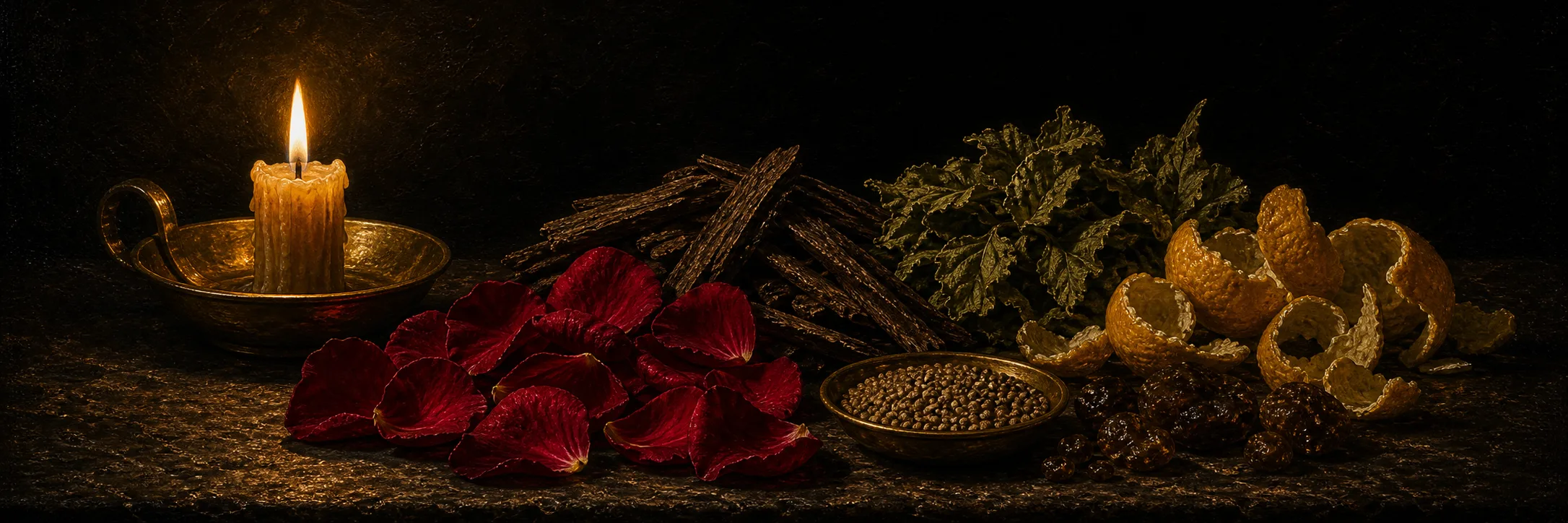
Using the listed mandarin top, rose-petals/Cambodian-oud heart, and patchouli-leaves/musk/labdanum base, the wear experience is famously front-loaded and near-linear. The mandarin is “brief and almost unnoticeable,” an ephemeral spark at application. Almost immediately the composition becomes a confrontation between a big, dark rose and the Montale oud accord - and the opening is the most polarizing phase: widely described as harsh, medicinal, “shrieking rose,” with a “bitter medicinal haze (rather like medicated bandages)” and, to some, an almost acrid, “bug spray”/rubbery or geranium-leaning edge. Now Smell This notes the early minutes are joined by “heavy leather” (from labdanum) and can be “rather hard to take” unless you love leather. Give it 30 - 60 minutes and consensus is that it “settles into a sophisticated, rosy oud scent… very velvety and soft” - a “dark, murky rose” over dry patchouli and musk. ” Perceptible: dark rose (dominant throughout), medicinal/synthetic oud, dry patchouli, leathery labdanum. Submerged/contested: actual agarwood quality (widely regarded as a synthetic oud accord built on aromachemicals like Iso E Super; the brand markets it as oud), and mandarin.
Performance
Strongest wearer consensus: Black Aoud is a beast. ” Application strategy is unanimous and emphatic: spray sparingly - one to two sprays maximum; multiple reviewers say over-spraying (more than one spray) induces headaches in wearer and bystanders alike and can be cloying. There is a notable dissent: a subset report weaker performance from recent batches (one cites a “2020 version” that “doesn’t even last 2 hours”) and some critics note below-average longevity (~5 hours) on their skin - suggesting batch variation or skin-chemistry dependence. ” Net: plan for monster projection and longevity, apply minimally, be cautious in confined spaces.
Wearing Context
Best in cool weather - fall and especially winter - and for evening or anytime you want a bold, attention-commanding statement. It is explicitly not a versatile crowd-pleaser: one detailed reviewer lists it as “not for the office, not for clubbing, not for the first five dates, not for formal events, not for drinks with friends” - concluding it’s a winter scent for confident wear where you don’t mind dominating the room. Social-perception skew is genuinely split by culture and gender: marketed for men, it reads strongly unisex-to-feminine to many Western noses (a documented sources critic felt it leaned feminine), while in parts of the Gulf the rosy-oud profile reads as mature/formal to some. It’s a scent for the wearer who wants drama, darkness, and presence - “a perfume bad ass,” as one documented sources reviewer put it - and a poor choice for anyone seeking inoffensive or close-wearing. Practical reading: cool-season, evening, high-confidence, low-spray.
Comparisons & DNA
Black Aoud is the reference point the entire Western rose-oud genre is measured against, so comparisons are abundant:
Reception
Consensus: a polarizing modern classic - respected as a genre pillar, but with a love-it-or-recoil opening and a “synthetic oud” caveat. Cafleurebon’s review (with contributor Sebastian Jara, via EIC Michelyn Camen) frames it as one of the first niche houses to use aoud and a rose-oud that “takes Rose-Oud fragrances to another level with the use of dry patchouli,” with Jara calling it the best rose-oud he’d smelled. Now Smell This praises its dark, raw, sexy, “undomesticated” character. documented sources critics admire the materials-and-proportions execution while noting it “smells good… doesn’t smell expensive but doesn’t smell cheap” and is excellent value. Common praise: bold, dramatic, beautiful dark-rose drydown, monster performance, low price for niche, genre-defining.
Versions & Reformulation
Officially, Montale states its formulas are unchanged; in practice the wearers widely perceives reformulation/batch variation. ” Documented variants/related releases: Intense Black Aoud (2017), an amplified, denser, more rose-and-oud-forward flanker explicitly suggested by the house as a layering “base” to boost the projection of other Montale scents; and regional/distribution differences - wearers lore distinguishes French/EU bottles (more synthetic and concentrated) from UAE-market bottles (said to use more natural ingredients and read more animalic), plus older “ID”-coded vs. “Paris” bottles. Packaging has shifted (screw-cap vs. magnetic-cap metal bottles).
Acquisition Notes
Pricing tier: relatively affordable niche - frequently praised as cheap for what it delivers. Now Smell This historically listed roughly $150 for 50ml and $210 for 100ml EDP; Cafleurebon referenced ~$170/100ml; street/discounter prices are often lower. Common sizes: 50ml and 100ml EDP in Montale’s signature aluminum spray cans (with a 20ml also seen). Decants are widely available and frequently recommended given the divisive opening - sampling before a full bottle is standard advice.
Notable Facts & Lore
- Black Aoud is central to the origin story of Montale and the Western oud craze.
- Pierre Montale - who, per house lore and multiple critic write-ups, spent years crafting bespoke perfumes for Saudi/Gulf royalty before returning to Paris and founding Montale in 2003 - built the brand on bringing oud to Western perfumery, and Black Aoud (2006) is the release that “put him on the map” and “set a standard which other Western houses would follow” (documented sources).
- It remains the house’s top-seller and is widely cited as the recommended starting point for the Montale/Mancera universe.
- A defining piece of lore is the perfumer’s dual-house structure: Montale (metal sprayers, more Eastern themes) and Mancera (glass flacons, more Western themes) are run by the same Pierre Montale, which is why Black Aoud and Mancera’s Black to Black are so often called near-identical.
- The fragrance’s reputation as a “beast mode” benchmark and rite-of-passage rose-oud is itself the cultural phenomenon, and the recurring “synthetic vs.
- real oud” debate around it is a long-running wearers talking point.