Perfumer's Workshop — Tea Rose
Essence
Tea Rose is the archetypal photorealistic rose soliflore and one of the most famous “cheapie” fragrances in perfumery. First offered at Perfumer’s Workshop’s bespoke-blending counters in 1972 and relaunched as a mass-market ready-made in 1977 (catalog year), it was, per Luca Turin, “in many ways the first niche fragrance.” Turin credits it as the debut composition of the now-celebrated perfumer Annie Buzantian (later of Estée Lauder Pleasures). Its entire proposition is fidelity to nature: a huge, green, dewy, true-to-life rosebush captured in a bottle and sold at drugstore prices. It is a certified classic — a Fragrances of the World “American Legend” — that has sold tens of millions of bottles and remains in production essentially unchanged.
Scent Profile
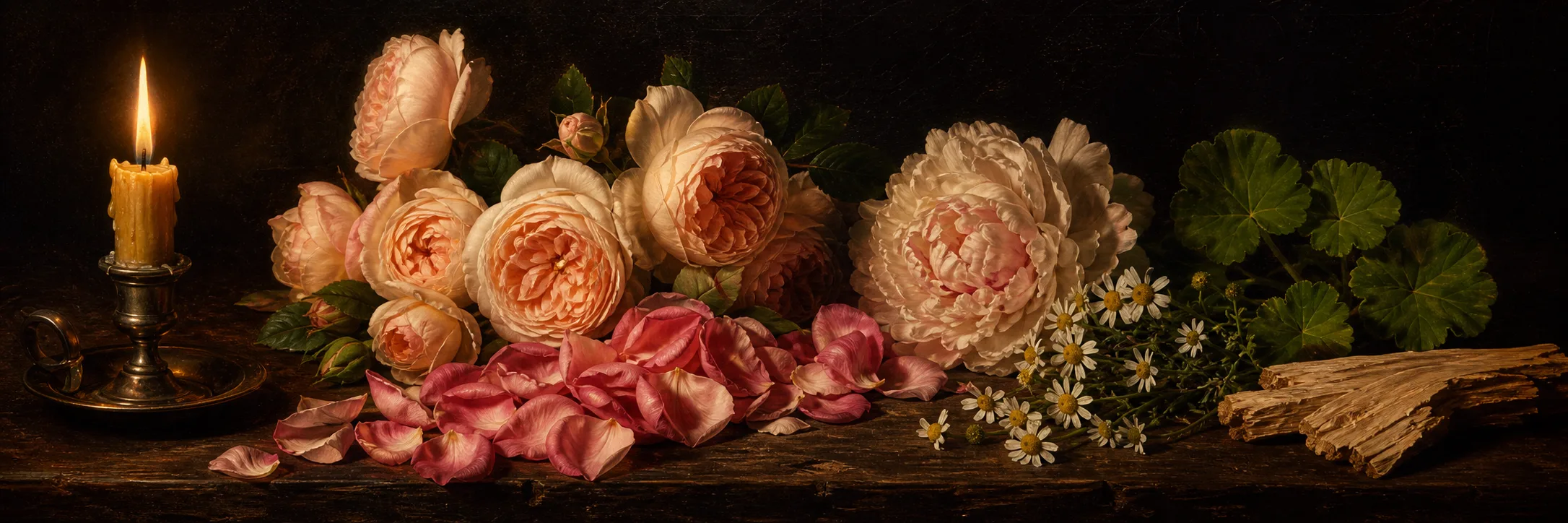
Tea Rose is famous for one thing done extremely well: a capital-R Rose that smells like burying your face in a fresh-cut bouquet — petals, green stems, leaves, and dewdrops all rendered in literal detail. The catalog pyramid (top: peony, chamomile; heart: Bulgarian rose, damask rose, tea rose; base: geranium, violet leaf, cedarwood) reflects the brand’s official note list; wearers historically listed a different set (bergamot, rose, lily, tuberose, sandalwood, amber, cedar, rosewood), and there is genuine disagreement about whether it’s a true soliflore or a slightly fuller floral — a discrepancy the chat agent should flag. In practice, the wearers and critics agree it wears as effectively linear and rose-dominant: green, fresh, dewy rose from open to close, with a faint woody/ambery, slightly musky drydown on some skins (Luca Turin classifies it a “green rose”). Perceptible: overwhelmingly rose, with green stem/leaf freshness. Submerged/variable: nearly everything else — the peony, chamomile, violet leaf and cedar register as supporting texture rather than distinct notes. The defining trait is intensity: reviewers repeatedly warn it is “nuclear,” a powerhouse where a single spray is plenty and over-application tips it into “potpourri” or “air freshener” territory. A minority perceive a sharp metallic/“chlorinated” or plasticky off-note; a few find it soapy (compared to Camay soap). Signature accord: hyper-realistic green rosebush.
Performance
Performance is, by broad wearers consensus, enormous for the price and concentration. Reviewers repeatedly describe it as a “powerhouse” whose EDT “longevity literally outperforms my Montales,” with strong sillage and all-day (into-the-night) persistence; many use it as a room/linen spray because it’s so potent and cheap. It reportedly stains clothing, so caution is advised on fabric. Application strategy is the recurring theme: “one spritz max,” or spray and walk through the cloud, because it is easy to overwhelm a room; a light hand yields a beautiful realistic rose, a heavy hand yields “potpourri.” Countervailing reports exist of it fading faster on some skins or in hot weather (retail/wearers reports of 3–6 hours), and a couple of users find the EDT lighter than expected — so there is skin/heat variance, but the dominant signal is unusually strong projection and longevity for a budget EDT. Cooler weather is said to bring out its dewy freshness.
Wearing Context
As a soliflore, its “context” is largely binary — you either want to smell like roses or you don’t. Within that, wearers reads suggest it flatters cooler weather (dewy freshness emerges) but is genuinely worn year-round; it is versatile across day and night and occasions given its simplicity. It is marketed feminine but is widely worn as a layering base and is arguably ageless/unisex for rose lovers. It shines as an inexpensive, honest rose for casual daily wear and for layering to add a realistic rose facet to other scents; it can feel “old-school”/nostalgic (reviewers invoke grandmothers, 1970s teen years, “Sunday church ladies”) and, because of its power and literalism, can feel like walking rose air-freshener if over-applied or in tight professional spaces. Social skew: nostalgic, unpretentious, instantly recognizable.
Comparisons & DNA
DNA family: green rose soliflore. The canonical critical comparison comes from Turin/Sanchez and is echoed by wearers reviewers who line Tea Rose up against Frédéric Malle Une Rose (Ropion) — one wearers reviewer’s memorable framing: Tea Rose and Une Rose are “country and city cousins, both utterly gorgeous, one rich, one poor,” with Tea Rose the “wearable, beautifully realistic quite woody, ambery rose” versus Une Rose’s darker ISO-Super-y wine-lees rose — and concludes Une Rose is not worth 25x the price. Frédéric Malle himself reportedly called Tea Rose “the most classic example of a rose scent that smells fresh from nature…rich but not overpowering.” wearers-named adjacencies for the realistic-rose lane include Paul Smith Rose (softer, “walk under a garden arbor” vs. Tea Rose’s “trip to the florist”), Parfums de Marly Delina (softer pink rose, more modern/expensive), and dry citrus-rose Montale/Mancera roses (Tea Rose matches their realism at a fraction of the cost). Guerlain’s Rosa Verde is offered by one wearers reviewer as a softer, more modern green rose alternative. It is itself the template others are measured against — the “mother of all” perfumery roses per one reviewer.
Reception
Reception is polarized in a very specific way: near-universal respect for its realism and value, split only by whether the individual likes a loud, literal rose. Luca Turin awarded it four stars, calling it a soliflore that “illustrates how complex a composition must be before it can actually claim to smell of rose… The rose it depicts is huge, painted in watercolor, and has the species name written below it in cursive.” wearers praise: astonishing realism (“this IS rose”), massive longevity/sillage, and an almost comically low price (“the best rose I’ve ever smelled and it cost less than my lunch”). Common criticism: it can be overwhelming/“nuclear,” some detect an artificial metallic or plasticky facet, and detractors find it potpourri- or air-freshener-like or “old-fashioned.” Blind-buy verdict: an easy yes for rose lovers given the trivial price and iconic status — with the standard caveat to spray sparingly. It is one of the most-reviewed fragrances on wearers, underscoring its enduring cultural footprint.
Versions & Reformulation
Multiple concentrations and flankers exist. The core is the EDT (catalog subject), sold most commonly in a large 120ml/4oz bottle plus smaller sizes. There is also an Eau de Parfum “Parfum Tea Rose” (launched 2014, stronger/longer-lasting, same note structure) and a richer concentrated Parfum version praised in a wearers editorial. Flankers include Tea Rose Jasmin (a natural jasmine/tuberose soliflore) and Tea Rose Mesk, plus a “Tea Rose Pink.” On reformulation, sources conflict: the brand states “the Tea Rose formula has remained unchanged for 50 years,” yet a wearers interview with the company (founder-side) acknowledged that since 1977 it has “undergone some reformulation due to regulations,” with a modification slated around 2015 that they expected to be imperceptible. Net: minor IFRA-driven tweaks are likely, but the scent is regarded as remarkably stable. There is also date ambiguity — wearers/catalog cite 1977, wearers cites 1972 (the original counter-blend debut), and some retail copy says 1975; the 1972 counter / 1977 mass-market relaunch timeline reconciles these.
Acquisition Notes
Pricing tier is rock-bottom/budget — one of the great value propositions in fragrance. The EDT is routinely available for well under $15 (frequently ~$8–$14 at discounters for the 120ml), making backups and household use guilt-free. Common sizes: 120ml/4oz EDT (most common), plus 1oz/28ml and other formats; the EDP/Parfum versions cost somewhat more. Decants are hardly necessary given the price, but samples circulate. Because it’s cheap, sold widely, and long-running, counterfeiting is not a notable wearers concern, though a few buyers report weak/scentless bottles (possibly old stock or spoilage) — buy from reputable sellers and check freshness. No formal batch-code decoding guidance was found on whitelisted sources. Authentic buying channels include the brand’s own site and mainstream retailers/discounters.
Notable Facts & Lore
- Tea Rose is dense with lore. It was the first fragrance signed by Annie Buzantian (per Turin) and, in Turin’s framing, effectively the first “niche” fragrance — from a house (founded by Donald and Gun Bauchner) that pioneered on-site bespoke blending at department-store prices before shifting to ready-made distribution in the late 1970s. It became an instant classic with a famously illustrious fan base repeatedly cited across wearers and critical sources — per Perfumer’s Workshop (quoted via Now Smell This and Scents and Sensibilities): “Princess Grace of Monaco… Catherine Deneuve… Princess Diana…Nicole Kidman – the list of Tea Rose adoring fans is endless” (Kidman reportedly said she has worn it since age 14). The brand’s own estimate, quoted in the same coverage: “Perfumer’s Workshop has lost count, but probably 55-60 million bottles of Tea Rose have been sold.” It also holds a place in fragrance-wearers history via Katie Puckrik’s influential YouTube coverage, which introduced many enthusiasts to it. Its cultural identity — an honest, egalitarian, gorgeous rose that democratized “smelling expensive” — is the through-line of its enduring legend.