Tabac Original — Tabac
Essence
Tabac is a 1959 German barbershop classic: an aromatic fougere of aldehydic citrus, lavender, carnation spice, powder, moss, musk, and tobacco-colored warmth. It is interesting because its name promises tobacco, yet its real subject is the ritual of mid-century grooming: soap, aftershave, pressed fabric, and a white glass bottle that has outlived most of its peers.
Scent Profile
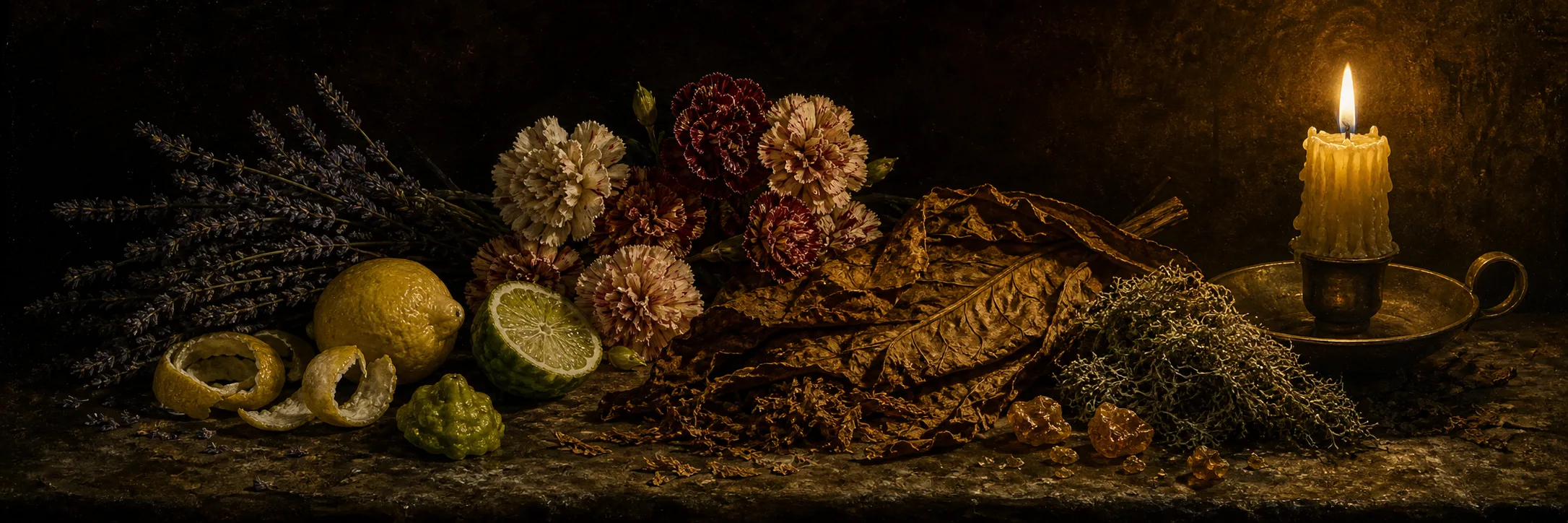
The opening is brisk and unmistakably old-school. Aldehydes, lemon, bergamot, neroli, and lavender give a fizzy, soapy citrus flash, with a little pepper and orange-flower creaminess around the edges. It feels more like a barbershop counter than a modern fresh fragrance: bright, clean, and slightly stern rather than watery or sporty. Carnation is the hinge of the composition. Its clove-like spice links the floral heart to the powdery character of orris, rose, jasmine, sandalwood, pine needles, and oakmoss. Geranium and lavender reinforce the fougere profile, while the flowers remain dry and tailored rather than sweet. This middle stage is why Tabac reads as both floral and masculine in a way that now feels distinctly period-specific. The base is warm but restrained. Tobacco, amber, musk, tonka, vanilla, and oakmoss suggest a dry masculine atmosphere rather than a literal humidor accord. Leather shadow, vetiver smoke, woods, and coumarin deepen the effect. The result moves from bright soap to spicy powder, then to mossy, musky, ambered comfort.
Performance
Performance depends on format. The Eau de Cologne is close-wearing but can last around six hours, an unexpectedly durable result for a classic splash. The Eau de Toilette is heavier and more assertive, while the aftershave can also persist well. The dry musky powder may outlast its projection on clothing. Tabac benefits from restraint. Worn lightly, it stays comforting and polished; overspraying can sharpen the soap, floral powder, and animalic edges into a more divisive effect. A traditional layering approach uses EDC first and EDT over it for a richer, smokier, longer-lasting version.
Wearing Context
Tabac suits cool-weather daytime use, especially after shaving, on casual errands, or whenever a familiar grooming scent is more appealing than a contemporary fresh fragrance. It carries associations with barbershops, pharmacy shelves, pressed uniforms, fathers, grandfathers, and the quiet routine of soap and aftershave. Its character is mature and deliberately nostalgic. The EDT can work as a soapy-clean daily option, but neither format is designed for sleek minimalism or formal-evening drama. Tabac makes the most sense for someone who enjoys its retro masculine assurance rather than someone looking for a transparent, modern profile.
Comparisons & DNA
Old Spice is the useful starting point. Tabac shares its historic masculine-spice atmosphere but is more carnation-powdered, mossy, floral-spicy, and distinctly German in its barbershop presentation. Its tobacco note is similarly atmospheric rather than a dense leaf accord. Aramis is another helpful reference, especially for the dry, old-fashioned masculine posture, but Tabac is softer and more grooming-line approachable. Paco Rabanne Pour Homme helps locate its fougere side: Tabac is less green, more powdered, and more floral. Against Kouros, it is fresher and far less animalic, keeping its leather and musk as shadow rather than spectacle. The composition also touches the worlds of Clubman Pinaud, Brut, Quorum, and Caron Pour Un Homme. None replaces it exactly. Tabac’s own signature is the aldehydic-carnation barbershop accord softened by amber, moss, musk, and tobacco-colored warmth.
Reception
Tabac’s reception is affectionate but divided. Its strongest qualities are value, the enduring white glass bottle, and the way a whole coordinated grooming line preserves a recognizable mid-century masculine ritual. The EDC is often favored for its fuller, softer, more classical presentation. The fault line is concentration and expectation. Some find the EDT sharper, thinner, or too floral-soapy; others find the dated quality exactly what makes the fragrance comforting. A heavy application can emphasize a harsh powdery or urine-like edge. It is best understood as a classic with a strong point of view, not as a universal modern fresh scent.
Versions & Reformulation
Tabac began as soap in 1938, with the Eau de Cologne becoming the key fragrance in 1959. The line has since expanded to EDC, EDT, aftershave, shaving products, deodorant, shower products, and modern flankers. Those formats do not smell identical: EDC is the classic reference, EDT is more forceful and often more divisive, and aftershave can read creamier and more animalic. The EDT was introduced or relaunched around 2014 and received a 55th-anniversary redesign. Vintage and current EDC are not radically different, though older bottles are often described as slightly more tobacco-led and newer ones as more aldehydic. Collectors look for pre-2000 diagonal Tabac script, the sawtooth emblem, and a blue stripe below Original.
Acquisition Notes
Tabac remains a low-price classic, usually available in large bottles and across the full grooming range. The EDC is the most direct route to the historical scent, while the EDT is stronger and more polarizing. Its accessible price makes sampling straightforward before committing to the soap, aftershave, or matching formats. Vintage collectors may seek bottles with the diagonal script, sawtooth logo, and blue-stripe details. Current production is still easy to find and preserves the core aldehydic-carnation identity, so rare sourcing is not necessary to understand the fragrance.
Notable Facts & Lore
- Maurer & Wirtz began as a Stolberg soapworks in 1845.
- Tabac first appeared as soap in 1938 before the 1959 Eau de Cologne established the enduring scent profile.
- The white frosted-glass bottle and broad grooming line made Tabac a multi-generational German household constant.
- Arturo Jordi-Pey created a fragrance that joins Old Spice-like appeal to a dry leather-chypre structure.
- The George Harrison association remains unverified lore rather than documented history.
- Older bottles with diagonal Tabac script, a sawtooth logo, and a blue stripe are collector markers.