Tom Ford — Tobacco Oud
Essence
Tobacco Oud is Olivier Gillotin’s darker second take on tobacco-as-luxury - the dry, smoky, ashy counterpart to his own Tobacco Vanille. Where the earlier fragrance is sweet pipe tobacco wrapped in vanilla, this one pivots toward an austere, resinous, incense-heavy composition inspired by Arabic dokha tobacco. Released in 2013, it is the most divisive of the Tom Ford Private Blend tobaccos and the one with the strongest house stamp: dark, brooding, expensive-smelling in a way that signals serious intent rather than mass appeal.
Scent Profile
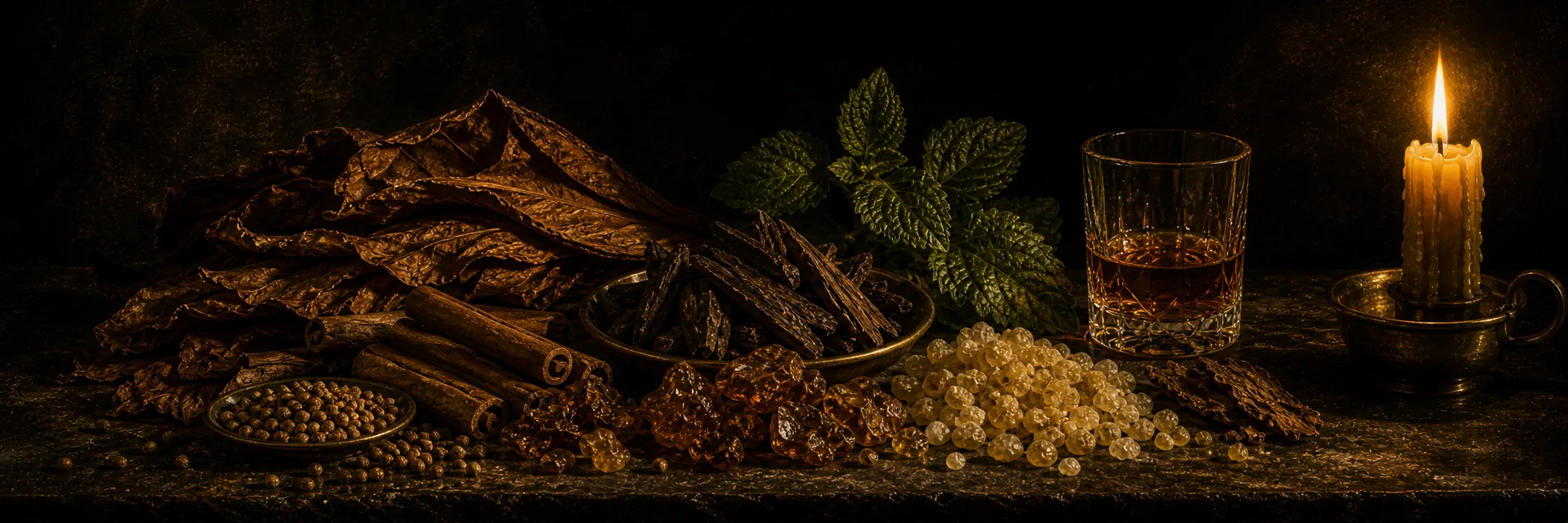
The opening is striking and immediately polarizing. A boozy whiskey note hits first - peaty and slightly malted, somewhere between an aged single malt and a generic spirit accord - landing on an ashy, faintly medicinal tobacco. There is no citrus, no aromatic herbs, no traditional lift; the whiskey is the most original move in the composition and the note that splits opinion most sharply. Within ten minutes the spices register: cinnamon and coriander form a warm halo, with the cinnamon reading as the dry, woody-bark variant rather than a sweet pastry spice. By the twenty-to-thirty-minute mark the heart emerges. The tobacco is dominant, but it is ashy, cold-cigarette tobacco rather than the honeyed Latakia of Tobacco Vanille - a “burnt-out ashtray” quality some find addictive and others find offensive. Incense and frankincense build underneath for a churchy, resinous depth, while benzoin softens the smoke and sandalwood and patchouli lay a creamy-earthy floor. From roughly the two-hour mark the base locks in: tobacco, incense, sandalwood, patchouli and cedar form a dry, smoky, resinous accord, with vanilla and benzoin adding just enough sweetness to keep it from being purely austere. Notably, agarwood is almost absent as a literal material - the “oud” here functions more as a marketing handle than a perceptible note, with cedar and patchouli doing the structural work. The drydown is long, dry, and remarkably linear: a smoky amber-tobacco skin scent that is essentially still itself eight hours in, only quieter.
Performance
This is one of the strongest performers in the Private Blend catalog, on par with Tobacco Vanille and Tuscan Leather. Projection is strong for the first three hours - easily a three-to-five-foot radius - then moderate through hour six, then close to skin afterward, with heavy sillage that lingers in rooms after the wearer leaves. Longevity on skin is commonly eight to twelve hours, and on fabric it can persist a full day or more. Heat amplifies the boozy smoke and can push it into “too much” territory, so this is fundamentally a cold-weather scent. Restraint is essential: one to two sprays is the consensus, since three or more risks reading as a smoke room rather than perfume.
Wearing Context
Autumn and winter are its strongest seasons, and it lives mostly at night. It excels at formal evening events, serious dinners, cold-weather travel, and settings already steeped in smoke or warm woods - whiskey bars, cigar lounges, fireside rooms - and pairs naturally with wool, leather and dark tailoring. It falls flat in summer heat, daytime casual wear, shared close quarters, and anywhere demanding restraint. Socially it reads mature, serious, and slightly intimidating rather than flirty or approachable; despite the unisex framing it skews heavily masculine in wear, because the smoky-leather-tobacco profile is coded that way regardless of who wears it.
Comparisons & DNA
The most direct relative is Tom Ford Tobacco Vanille - same perfumer, both built on tobacco and tonka, but Tobacco Oud strips out the vanilla-cherry sweetness and substitutes incense, an oud accord and ashy darkness; Tobacco Vanille is the comfort food, Tobacco Oud the austere statement. Within the house, Persolaise tied it to Sahara Noir for its frankincense richness and to Tuscan Leather for its leathery smoke. In the broader market, Maison Francis Kurkdjian Oud Satin Mood is the most-cited near-equivalent - smoother, more rose-forward, less ashy - while Serge Lutens Fumerie Turque reads as an older, more complex antecedent of the style. At designer pricing, Atelier Cologne Tobacco Nuit is the usual budget pointer.
Reception
Consensus splits cleanly: admirers treat Tobacco Oud as a Private Blend high point, prized for its distinctive whiskey-ashy tobacco accord, exceptional longevity, and “winter king” stature; detractors call it linear, a remixed greatest-hits exercise, or simply too ashy to wear. The ashy-cigarette opening is the single most polarizing feature, dividing austere-smoke lovers from sweet-gourmand buyers. Persolaise found it “more overtly Ford-esque” than its siblings; a Now Smell This review summed it up as cold-ashtray cigarette tobacco, essentially Oud Wood and Tobacco Vanille shaken with the contents of an ashtray. On value, the recurring note is that the price is steep for a one-effect fragrance, though its limited availability has only deepened its aura. Sampling before buying is near-universal advice.
Versions & Reformulation
Two main versions exist. The 2013 original EDP is the primary composition. Tobacco Oud Intense (2017), a Gillotin and Yann Vasnier collaboration, softened the smoke, added raspberry and a higher-grade frankincense, and shifted toward a toastier tonka-and-labdanum base; Mark Behnke described the two as “kissing cousins” rather than one being a stronger version, and the Intense was a limited edition that is itself functionally discontinued. Tom Ford has never issued a formal discontinuation statement, leaving the original’s status ambiguous: US availability thinned around 2022-2023 while UK and EU production appears to have continued, with newer batch codes still surfacing in some markets.
Acquisition Notes
This is luxury-tier pricing, with secondary-market premiums on top. Original retail was roughly $210 for 50 ml in 2013, climbing toward $325-$400 at boutique level by the early 2020s; the 100 ml format was discontinued earliest, leaving 50 ml as the standard retail size. Out-of-stock has been the more common condition since 2022, and the ambiguous discontinuation status has made counterfeits more prevalent - sample first, and buy from sellers who can vouch for authenticity.
Notable Facts & Lore
- The name comes from “dokha,” an Arabic herb-and-spice tobacco smoked through a small pipe called a midwakh; the word translates roughly as “dizziness.”
- Tom Ford’s launch copy named dokha directly, framing the fragrance as a more “authentic” Arabic companion to Oud Wood’s gentler Western take.
- It launched in the 2013 “Oud Collection” alongside Oud Fleur and London - a release many critics see as the pivot point where Private Blend turned toward remixing its own hits.
- The agarwood is essentially conceptual: multiple critics, Persolaise included, note the “oud” reads as a marketing handle more than a perceptible material.
- It became a cult winter signature for older male enthusiasts, frequently alternated with Tuscan Leather in cold weather.
- Its on-again, off-again availability spawned forum threads running hundreds of pages and persistent calls for an affordable Signature-line reissue.