Blend Oud — Sana
Essence
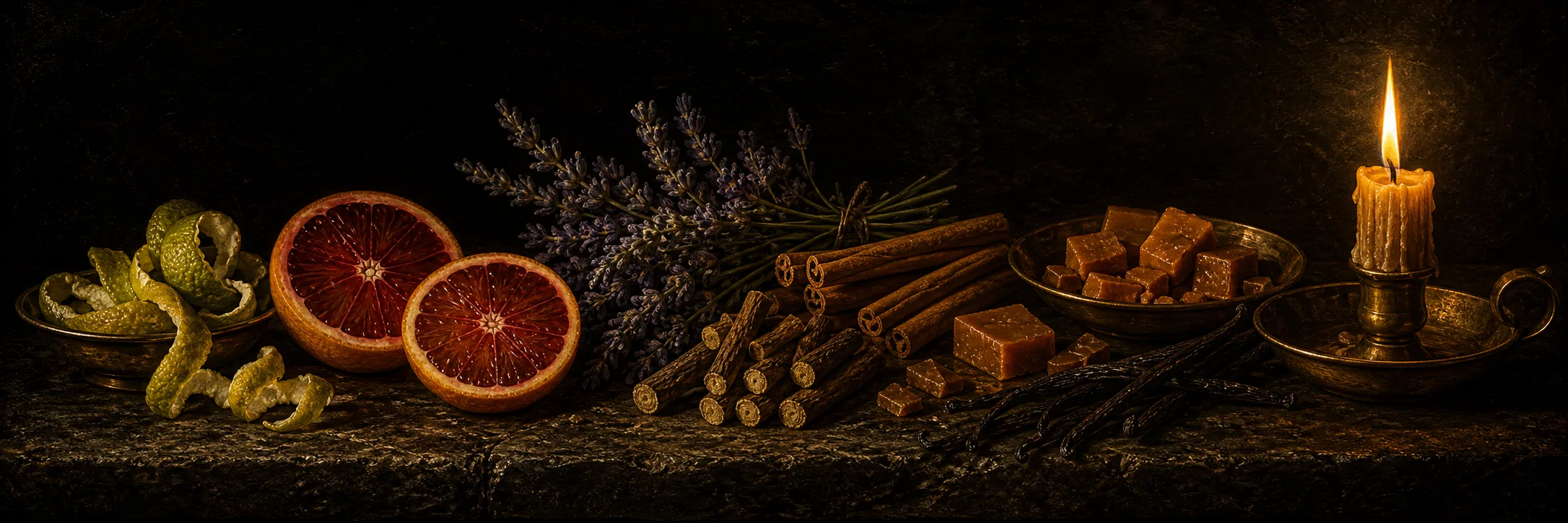
Sana is a citrus-gourmand by the UAE niche house Blend Oud (2016, Private Collection), and despite the house name there is no oud in it. It is widely understood in the wearers as a near-identical, cheaper rendition of Xerjoff Casamorati Lira: blood orange and bergamot over a creamy caramel-vanilla base, with cinnamon and licorice adding faint spice. Think lemon-and-orange sponge cake lifted by citrus, soft and comforting rather than complex. Its distinguishing trait is value-versus-Lira, with the trade-off being weaker performance.
Scent Profile
The published blood-orange/lavender/bergamot top is, in wear, overwhelmingly a citrus event: blood orange leads, bergamot brightens, and the listed lavender is essentially submerged - multiple wearers report not detecting it at all, though it likely contributes a soft “licorice” impression some pick up (a known lavender-plus-sweetness illusion). The opening reads as sweet orange and lemon zest over an already-present creamy sweetness; within 2-3 minutes the fragrance “lands in a creamy-sweet gourmand,” in one wearer accounts wearer’s words, rather than evolving through distinct stages. The heart’s cinnamon, licorice and jasmine are mostly textural. Cinnamon gives a faint warm-spicy edge that some find “trapped” under the caramel; jasmine is, per wearers consensus, bland to absent; licorice mostly reads as part of the lavender-sweet ambiguity. What actually dominates the 1-3 hour window is the caramel-vanilla accord with the blood orange still glowing on top - a “vanilla sponge cake” or “lemon pound cake” effect that wearers repeatedly describe as not cloying because the citrus keeps lifting it. The drydown is caramel, vanilla and clean musk: a soft, sweet, slightly powdery skin scent. The signature accord is candied blood-orange over creamy caramel custard - gourmand but citrus-bright. Sana is essentially linear: one wearer wears it specifically because “I can fully enjoy the deliciously sweet blood orange note throughout the day.” The most perceptible listed notes are blood orange, caramel, vanilla and bergamot; cinnamon is a whisper; lavender, licorice and jasmine are largely submerged. Note that some retailer listings circulate a completely different (and incorrect) note set including saffron, rose, cashmeran and oud - ignore that; the genuine pyramid is the citrus-gourmand one.
Performance
Below-average to moderate, and this is the fragrance’s central weakness in wearer discussion. Projection is light and intimate; this sits close to the skin with a small scent bubble rather than throwing a wake. Multiple credible wearers report it becoming a skin scent or nearly vanishing fast: one wearer, after generous application of 5-6 sprays to skin and clothing, “can hardly smell anything” 30-60 minutes later; a wearer accounts wearer says it “doesn’t last on me more than half an hour.” Others get longer, in the range of several hours of soft, close sweetness; the wearers wear estimates summary’s “6-8 hours” sits at the optimistic end and conflicts with the dominant wearers experience of mediocre longevity. Realistically expect light projection, 3-6 hours on skin for most, and noticeably longer on clothing (gourmand citrus-vanilla tends to cling to fabric). Best strategy per wearers: spray generously and consider layering - one wearer accounts user layers it with Gyokuro by The Merchant of Venice, both being skin scents. Warmer days seem to help the blood orange shine (“especially bright during warmer winter days,” per one wearer), so dry warmth flatters it.
Wearing Context
A fall/winter and cool-weather gourmand by wearers consensus, though its citrus brightness also makes it pleasant on warmer winter days and in spring. It is a daytime-friendly, crowd-pleasing comfort scent - office, casual outings, cozy settings, easy social wear - and is genuinely unisex despite the brand’s “warrior woman” marketing framing. It shines as an inoffensive, edible, easy-to-like sweet citrus; it falls flat where you need projection or presence - formal evening settings, large rooms, anywhere you want to be noticed from across the room - because it simply doesn’t broadcast. It is also not a “serious”/complex composition, so enthusiasts seeking evolution or depth will find it one-dimensional. No meaningful social-perception skew beyond “smells like dessert,” which a couple of wearers flag as the only hesitation (“I am not sure I want to smell like vanilla pound cake”).
Comparisons & DNA
Sana exists almost entirely in the shadow of Xerjoff Casamorati Lira (2011, perfumer Chris Maurice; Luckyscent lists Lira EDP at $330 for 100ml), which shares a virtually identical published note set (blood orange, bergamot, lavender / cinnamon, jasmine, rose / caramel, vanilla, musk). wearers verdict is split but clustered: many call Sana a straight “dupe” or “copy” of Lira; a vocal minority insists it is NOT a true dupe - “Lira is so light and airy and perfectly rounded… while Sana feels like a cheaper, basic body spray rendition.” Deltas that recur: Sana reads more orange, Lira more lemony/bergamot-forward; Lira is generally better blended and longer-lasting (though Lira itself is infamous for weak longevity); some actually prefer Sana, finding Lira’s citrus opening “sharper and a bit headache inducing.” Lira is the far pricier original (~$330/100ml vs. Sana’s ~$97/60ml); Sana is the budget play. Beyond that pairing, wearers cross-reference Ex Idolo Love & Crime (similar gourmand-citrus, “nuclear” longevity - the performance Sana lacks), Dolce & Gabbana Devotion (lemony-sweet, less sweet overall), Nishane Ani, and Royal Crown Sultan (one wearer prefers Sultan). The whole cluster descends from the modern sweet citrus-gourmand lineage Lira helped popularize. Dedicated Lira “dupe” clone-oils exist abundantly (The Dua Brand “Caramel Delight,” Zoha Aroma “Delight,” Oil Perfumery’s impression) - but note these target Lira, and Sana is itself essentially the budget alternative in that conversation. There is no separate clone ecosystem for Sana specifically; if you want the profile cheaper than Lira, Sana is the alternative.
Reception
available critical discussion is thin to nonexistent - no blog (Bois de Jasmin, NST, Cafleurebon, Colognoisseur, Persolaise) reviewed Sana, which is typical for a Middle Eastern niche release of this range. Consensus therefore rests on wearers wearer sentiment (wearer accounts, wearer accounts). That sentiment is broadly positive on smell and broadly disappointed on performance. Common praise: a delicious, well-balanced, non-cloying gourmand citrus; “creamy-sweet,” “lemon sponge cake,” genuinely comforting; good value relative to Lira. Common criticism, near-universal: weak longevity and projection - repeatedly called a “skin scent” that can fade within 30-60 minutes. The main axis of polarization is the Lira comparison: dupe vs. inferior-imitation vs. actually-preferable. One wearer downgraded it over time from 9 to 8, ultimately finding it “so unremarkable that I wouldn’t buy it again.” Blind-buy verdict: reasonable for a cheap sample/decant if you love the sweet-citrus profile and don’t need power; do not blind-buy a full bottle expecting Xerjoff-level performance or distinctiveness.
Versions & Reformulation
Single composition, no known reformulations. It is sold as an EDP in the Blend Oud Private Collection; no concentration variants (EDT/parfum/extrait) are documented.
Acquisition Notes
pricing range: affordable niche / borderline designer. Commonly sold in a 60ml EDP bottle, with online retailer pricing typically around $97-98 (FragranceNet, Maxaroma) - i.e., far below Xerjoff Lira’s $330/100ml range. Decant ecosystem is healthy: Scent Split, Scent Decant, DecantX, Scents Angel and ScentBox all carry Sana in sample/decant sizes (1ml-10ml), which is the smart way to test given the polarized performance reports. No widely documented Authentic full bottles via Blend Oud’s own channels and established niche retailers.
Notable Facts & Lore
- No documented perfumer statement about Sana specifically (the perfumer is unlisted).
- The house’s own framing is unusually pointed: Blend Oud dedicates Sana to “a warrior of our times: an independent and combative woman, able to use both her sweetness and character as weapons to defeat the enemies of our society: intolerance, prejudice, hypocrisy” - explicitly positioning it against “the past model of a damsel in distress.” That is marketing copy, quoted here only because the gendered “warrior woman” concept is unusually specific for what is, in the bottle, a unisex sweet-citrus gourmand.
- The dominant piece of wearers “lore” is simply its identity as the affordable Lira alternative - that single comparison drives essentially every discussion of the fragrance.
- Blend Oud is a UAE house whose name and oud-heritage branding sit oddly with this oud-free dessert scent, a mild running irony in wearers threads.