Chopard — Chopard Rose Malaki
Essence
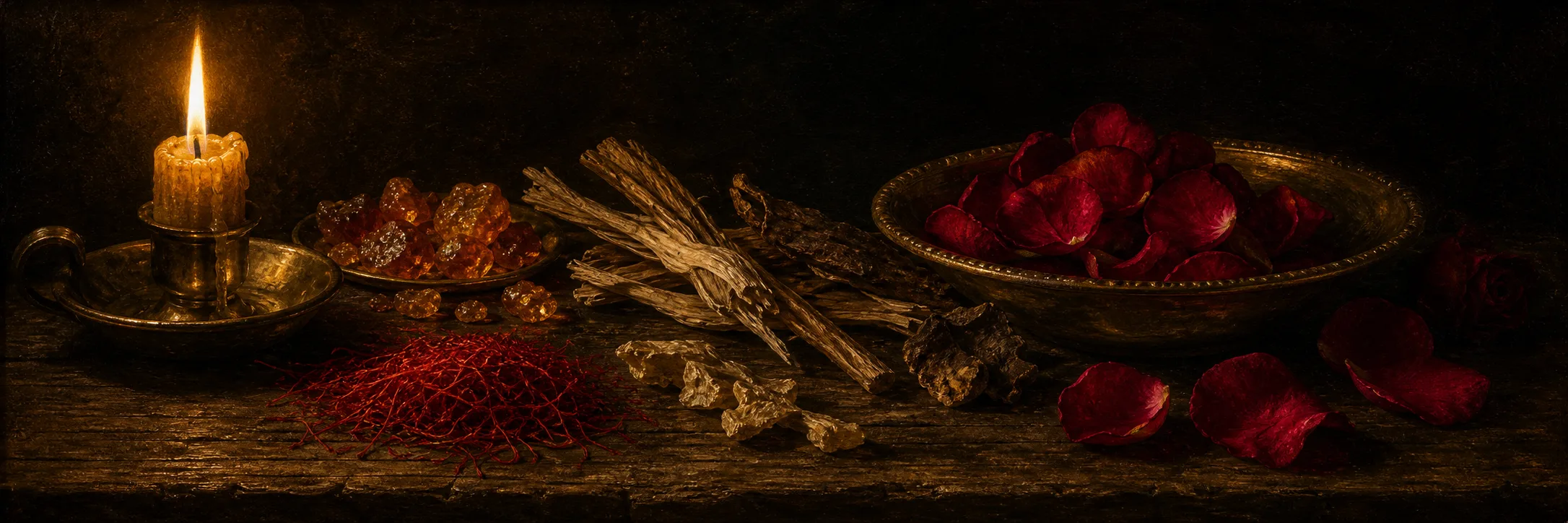
Rose Malaki is Chopard’s 2014 saffron-rose-cedar entry into its Middle East-facing Malaki (“Royal”) collection, composed by Amandine Clerc-Marie. It is the floral counterpart to the earlier Oud Malaki, recasting the same luxury idea around a smoked, leathery damask rose rather than a Western rose soliflore. Understood as a designer-priced take on the Arabian saffron-rose genre, it is interesting precisely because it courts Gulf taste rather than the European or American mainstream.
Scent Profile
The saffron-rose opening is the signature gesture. The saffron leans toward the leathery side of the note rather than the bright, almost medicinal saffron of some Arabian roses, and the damask rose at the center is dry, dusky, and a little dusty — an almost old-world rose rather than a jammy or dewy one. Some wearers detect a faint metallic or dirty facet riding over the rose, a quality that divides opinion. From there the Atlas cedar base does the heavy lifting. Multiple wearers say the cedar reads almost like oud, with a sour woody depth that recalls the lighter end of the Dior ouds. A suede and leather effect builds alongside it. The rose largely recedes within about half an hour, leaving the cedar-suede accord to carry the wear. The drydown is soft, slightly sweet, and vanilla-tinged. The overall impression is of a rich, spicy, vanilla-touched rose that is all about the middle and base rather than top-note sparkle.
Performance
Performance is mixed-to-good and clearly batch-dependent. Projection is frequently strong in the opening hours, while longevity draws more complaints and varies noticeably between bottles, with one weak result attributed to an old batch. The bright rose is the short-lived phase and the woody-suede base is the long-lasting one, so wearers who want a persistent rose may be disappointed while those who like the cedar-suede drydown get good mileage. Treat it as moderate-projection, moderate-longevity by Arabian-genre standards, and apply generously.
Wearing Context
The dominant recommendation is fall and winter, especially evening wear; one wearer described it as best for a winter night by a fireplace. It is widely treated as fully unisex, and several men wear it as a comfortable everyday winter rose, though others find it skews mature. The leathery, dusky character pushes it toward dressed-up or intimate settings rather than office or sport.
Comparisons & DNA
The most persistent comparison is to Aramis Calligraphy Rose: both open on a strong saffron-and-rose combination and dry down to cedarwood, but Calligraphy Rose turns creamy early while Rose Malaki stays drier, woodier, and more masculine until the very end. Within Chopard’s own line it is the floral sibling to Oud Malaki and sits in the broader Malaki and Malika range. Some wearers also reach for Guerlain L’Homme Idéal Eau de Parfum, whose woody-spicy warmth it can evoke, and point to Swiss Arabian’s Middle Eastern roses as the spiritual reference point.
Reception
Reception is positive-leaning but polarized. Wearers who love Arabian roses rate it highly, praising the saffron and a cashmere-wood quality they find better than expected at the price. Detractors split into two camps: those who find the saffron overwhelming, sometimes describing it as a rose disaster on their skin, and those who judge the materials synthetic and designer-grade rather than niche. The balance of opinion is a competent, atmospheric, designer-priced Arabian rose that over-delivers for genre fans and underwhelms those expecting niche-level naturals or a long-lasting rose.
Versions & Reformulation
No formal reformulation is documented. Reports of variable performance are better treated as batch or age differences across production runs. The line was last marketed under Coty’s prestige umbrella; beyond that the evidence is thin, so it is best treated as a single composition with possible batch variation.
Acquisition Notes
Rose Malaki has historically been easiest to find through Gulf-region retail and duty-free rather than Western counters, where it can be hard to source. It is inexpensive relative to its niche aspirations, with the 80 ml Eau de Parfum often available below niche-rose pricing at discounters. Several wearers frame it as a collector’s pick worth grabbing before any discontinuation, so availability may tighten. Where possible, buy from sellers with fresh stock given the batch-variability reports.
Notable Facts & Lore
- “Malaki” means “Royal” in Arabic, and the collection was conceived as Chopard’s answer to the Swiss Arabian Malaki series.
- Rose Malaki is the floral counterpart to the earlier, Dominique Ropion-composed Oud Malaki within the same line.
- The composition deliberately targets Gulf taste rather than the European or American designer mainstream.
- One wearer notes that Atlas cedar, the dominant base material, was used by the ancient Egyptians as an embalming ingredient.
- The ornate Malaki flacons are a recurring talking point and part of the line’s appeal.