Chopard — Happy Spirit Amira d'Amour
Essence
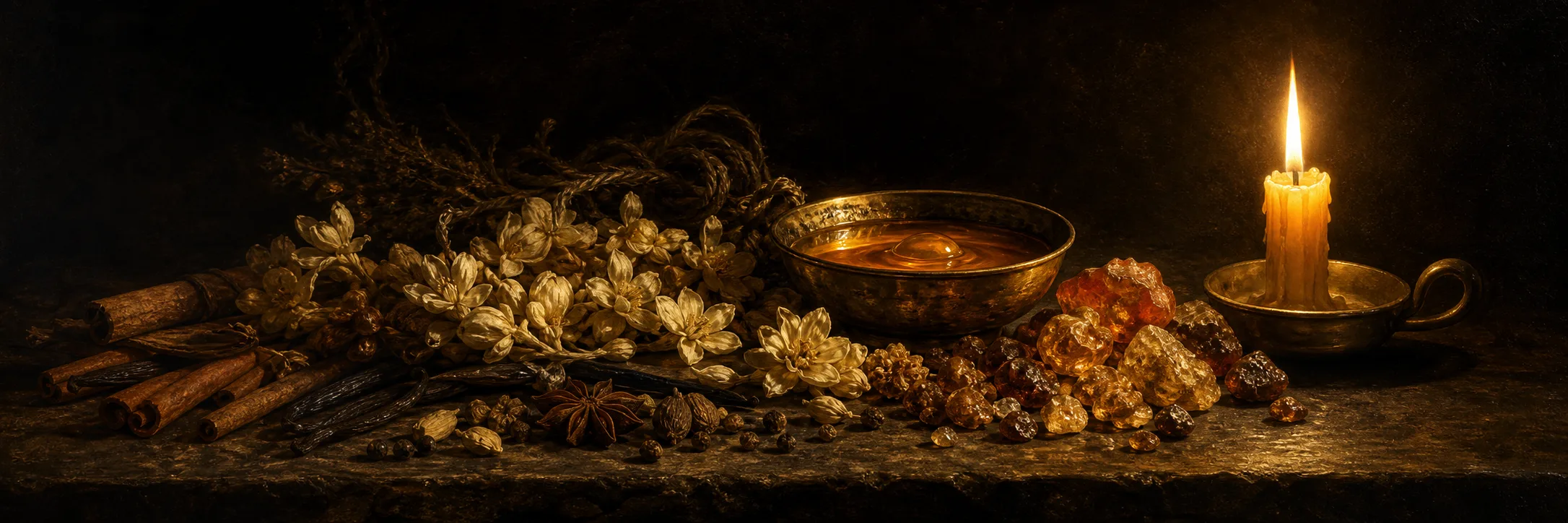
Amira d’Amour (2015) is a Middle East-exclusive offshoot of Chopard’s 2007 Happy Spirit that has almost nothing to do with the bright, breezy original. It is a dense, raw honey-and-tonka oriental by Jean-Christophe Hérault, calibrated for Gulf tastes rather than the Western mass market. Its signature is beeswax: a thick, waxy, animalic honey that wearers compare to a church full of burning beeswax candles. “Amira” is Arabic for princess, but the juice is heavier and more unisex than the romantic framing suggests.
Scent Profile
A brief pink-pepper spark opens, and some wearers catch a fleeting silky-oud or smoky impression in the first moments that quickly burns off. Oud is not actually in the formula, so that effect is an illusion created by the honey and animalic interplay, and the absence of any incense-stick smoke is something wearers specifically praise. What remains is essentially linear: smoked, waxy honey over a creamy, balsamic tonka, with jasmine and orange blossom supporting rather than leading. The florals make the scent soft, creamy, balsamic, deep, and sweet without turning sticky. Some wearers also pick up off-list facets, including a nuttiness like argan oil and a damp earthiness. A minority find it syrupy, reading it as too-sweet honey or detecting a dried-fruit, ripe-pineapple sweetness. The honey’s waxy, animalic quality is the polarizing core of the fragrance, and it stays close to that idea from start to finish.
Performance
Performance is moderate and notably restrained for the genre, which wearers tie to its noble understatement; one argues that more longevity and sillage would have tipped the noble character into headache territory. A retailer-aggregated figure cites six-to-twelve-hour wear, but the more credible read is moderate and intimate rather than a powerhouse. It performs markedly better in cold weather, where several describe it as transformed and heavenly, and warn it would attract bees outdoors in summer heat.
Wearing Context
This is strongly a cold-weather, evening fragrance. Wearers place it firmly in winter, describing it as a warm, dark, cozy wool coat, smouldering and mysterious yet sweet and mature. It is widely treated as unisex despite feminine marketing, and several women note their husbands wear it more than they do. Evening and special-occasion use dominate over daytime or office wear.
Comparisons & DNA
Within the Happy Spirit family it is the dark, oriental sister to the floral-spicy Happy Spirit Forever and a complete departure from the airy 2007 original. One wearer theory holds that its smoked-honey direction anticipated Tom Ford Soleil Brûlant (2020), framed as personal speculation rather than fact. It is also set beside Thierry Mugler Womanity, which shares a sweet-honeyed quality but reads more earthy-floral here, and contrasted favorably with the pricier Guerlain Tonka Impériale, with wearers calling Amira’s tonka more natural and younger. It is consistently described as a reference oriental free of bazaar cliché.
Reception
Coverage is thin but unusually consistent in respect, if not unanimous love. The honey-bomb character is the dividing line: admirers find it opulent, rich, cozy, and noble, while skeptics find it cloying, too sweet, or simply too much beeswax. A representative ambivalent verdict is “I’m not sure I like it, but I respect it.” A recurring theme is that Gulf-exclusive editions punch above the Western designer average in quality and presentation, and Amira is repeatedly cited as the Chopard perfume that best aligns with the house’s jewelry heritage.
Versions & Reformulation
There is no documented reformulation. It launched as a 75 ml Eau de Parfum and is now discontinued, last marketed under Coty’s stewardship of the Chopard fragrance license. Its limited, region-locked distribution is the defining fact about it rather than any change to the formula.
Acquisition Notes
Because it was a Middle East exclusive, Western buyers historically had to source it through travel, contacts in the Gulf, or the secondary market, with one wearer recounting a year-long wait to find a bottle. Now discontinued, it trades on the resale market, with aggregator pricing cited in a modest range, though availability rather than price is the real constraint. As with any discontinued Gulf exclusive, verify seller reputation given the prevalence of fakes in Middle East-market fragrances.
Notable Facts & Lore
- The two-interlocking-hearts purple flacon, designed by Patrick Veillet, was inspired by a Chopard toi et moi ring.
- The faceted stopper stones and golden band tie the bottle directly to Chopard’s jewelry-making craft and an eternal-love theme.
- “Amira” is Arabic for princess, and the launch copy is a pure desert-romance narrative.
- Oud is not in the formula; any smoky-oud impression comes from the honey and animalic interplay.
- It is one of a wave of Gulf-targeted oriental exclusives released by European houses in the mid-2010s.