Coach — Coach Leatherware
Essence
Coach Leatherware (2009) was Coach’s first men’s fragrance, a citrus-chypre EDP created by Firmenich perfumer Honorine Blanc with Coach creative director Reed Krakoff and Estee Lauder’s Karyn Khoury. Its lasting talking point is the irony of the name: despite Leatherware, a nod to Coach’s leather-goods heritage, the composition has essentially no perceptible leather. It is instead a grapefruit-led citrus chypre with tea and an old-school oakmoss-patchouli backbone.
Scent Profile
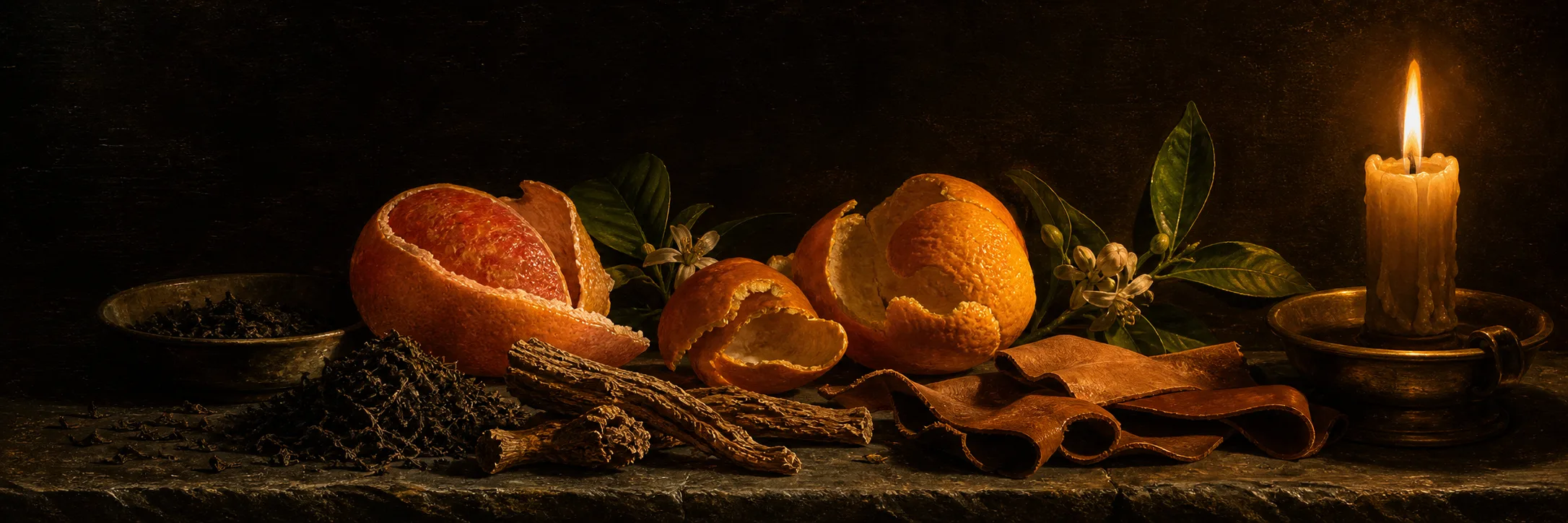
The opening is a bright blast of grapefruit and mandarin, and the citrus is the most consistently praised element, a bitter, hooking freshness. The heart introduces petitgrain, nutmeg, and a Darjeeling-like tea note, giving a green, slightly spicy lift, though several wearers find the tea faint, rounding the blend rather than announcing itself. The base is a traditional chypre: oakmoss, Virginia cedar, and patchouli, with juniper and cedar adding fresh-woody edges. The defining note of the whole experience, however, is a note that isn’t there. Nearly every account remarks on the absent leather, and the fragrance reads as a clean citrus-woody chypre rather than the leather composition its name promises.
Performance
Performance is modest. Reports converge on roughly four hours of longevity with arm’s-length-to-close projection, and the citrus opening can feel fleeting before the fragrance settles into its woody-moss base. For an EDP, several wearers found the longevity disappointing relative to expectations. This is a daytime, close-wearing scent rather than a projection piece.
Wearing Context
Leatherware reads as a clean, refined, daytime citrus-chypre suited to warm weather and office or elegant-casual settings. Wearers describe it as manly, refined, agreeable and high-quality, workable day or night and across seasons but best in warmer weather. It is the kind of well-mannered citrus-woody that signals grooming rather than statement, which is also why critics found it forgettable.
Comparisons & DNA
Critic Varanis Ridari offers the most useful mapping: Leatherware rides a similar vein to Brooks Brothers New York for Gentleman in its grapefruit-led take on a classic chypre, with the tea note as its modern twist, comparable to the smoky tea of Jean-Charles Brosseau The Brun. Its mandarin-over-oakmoss-and-patchouli base also recalls Hermes Eau d’Orange Verte. Positioning-wise it belongs to the retro-chic chypre revival alongside Rive Gauche pour Homme and Tom Ford for Men. Within Coach, it is distinct from the genuinely leathery 2013 Leatherware No. 1, No. 2 and No. 3 trio, which is regarded as far more characterful.
Reception
Reception was lukewarm and divided, and history has judged it harshly. The axis of disagreement is quality versus pointlessness. Defenders found it well-made and natural-smelling, elegant and invigorating, and a strong value for the price. Detractors found it boring and, more damningly, purposeless, with Varanis Ridari calling it a token placeholder for a brand that then had little menswear cachet. The single most consistent thread across all reception is disappointment over the absent leather note.
Versions & Reformulation
There is no true reformulation history, but the lineage is tangled. In some markets the same juice was sold as Coach for Men (2009), paired with the women’s Coach the Fragrance. After Leatherware’s commercial failure, Coach split the name into three genuinely leather-focused fragrances in 2013, Leatherware No. 1, No. 2 and No. 3, then abandoned the concept again for the mass-market Coach for Men (2017). The 2009 Leatherware was discontinued and last marketed by Estee Lauder Companies.
Acquisition Notes
Leatherware is long-discontinued and scarce on the secondary market. When it surfaces, prices can run steep, sometimes well into the hundreds for new-with-box examples, reflecting collector scarcity rather than demand. There is no meaningful decant market for it. It is best approached as a completist or collector purchase rather than a daily wearer, and buyers should be cautious about the condition of a 2009 citrus chypre that may have turned, and about inflated pricing.
Notable Facts & Lore
- It was Coach’s first men’s fragrance, conceived as the signature scent of the modern man.
- Despite the name Leatherware, the composition contains essentially no perceptible leather.
- It paired Reed Krakoff with Estee Lauder’s Karyn Khoury and Firmenich perfumer Honorine Blanc, a notable trio for a debut.
- The launch touted an unusual South American citrus material described as Naartjie Nature Print, said never before used in perfumery.
- Coach tried and failed to build a men’s Leatherware line three times: 2009, the 2013 numbered trio, and a 2017 reset.
- Honorine Blanc went on to far more celebrated work, including Goldfield & Banks Sunset Hour.