Coach — Coach the Fragrance
Essence
Coach the Fragrance is the fruity-rose Eau de Parfum that Coach launched in September 2016 as its new signature scent and the first fragrance of its Inter Parfums partnership, replacing the older Estee Lauder-era “Coach Signature.” Built by IFF perfumers Juliette Karagueuzoglou and Anne Flipo around a raspberry-pear-rose accord over suede and cashmeran, it is a pretty, accessible department-store floral whose quiet standout, for the people who love it, is the suede note in the drydown. The bottle is half the story: a flat glass flacon with a leather hangtag, a turn-lock handbag closure repurposed as the atomizer, and the horse-and-carriage emblem engraved in the glass.
Scent Profile
The opening is juicy and fruity, a transparent pear-and-berry sweetness lifted by pink pepper. Several wearers find it reads at first like a typical fruity-floral, even a synthetic pear-and-rose bomb, before it calms down.
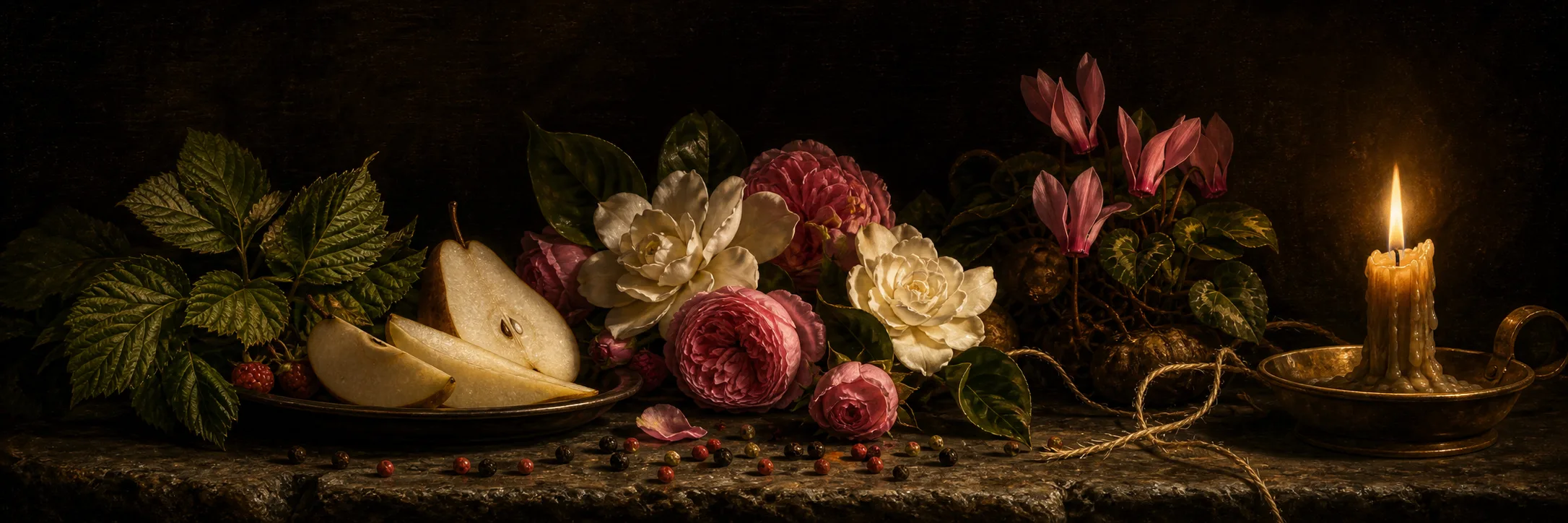
The heart settles into a clean, slightly soapy rose, with Turkish rose well forward; the gardenia and cyclamen are largely submerged and rarely read as distinct white florals.
The defining phase for admirers is the drydown: a soft suede-musk-cashmeran base, rounded by sandalwood into a velvety skin finish. This suede note is what its fans credit for the compliments it draws, and it is the main thing separating Coach the Fragrance from the field of clean rose-fruities. The composition is largely linear once the fruit burns off, holding a raspberry-pear-rose-over-suede signature for the rest of the wear.
Performance
Performance is modest, and it is the most consistent criticism. The EDP is the stronger of the two concentrations but still reads soft, with close-to-skin projection and middling longevity; for some the base fades roughly an hour in, while others get all-day persistence on clothing. The practical approach is to apply generously, reapply for all-day wear, and spray clothing if you want it to last. It is pleasant rather than powerful.
Wearing Context
This is a spring-and-fall, daytime, casual-to-office fragrance. It is squarely feminine but skews slightly older and more sophisticated than juvenile, often noted on women in their thirties and up rather than reading as girly. It works best as an everyday, inoffensive, work-safe signature, a clean and safe office scent, rather than an attention-grabbing evening or cold-weather statement. Think of it as a reliable daily-driver for someone who wants designer-pretty without projection or commitment.
Comparisons & DNA
The most repeated comparison is Mademoiselle Rochas, which one wearer found almost identical. It is also likened to YSL Mon Paris, though some find Coach fresher, rosier and soapier, and to Chloe Eau de Parfum for its rose facet, with the tangy-fruit-and-soapy-rose DKNY Be Delicious line in the same conversation. More broadly it belongs to the clean, pink, fruity-rose school that orbits Coco Mademoiselle, while sitting firmly below the luxury tier. It is an accessible cousin to those references rather than a clone of any one.
Reception
The consensus is pleasant but unremarkable, with a surprisingly good base. Wearers praise the suede-musk drydown, the easy wearability, the bottle (several admit buying partly for the flacon), and the strong value at discount prices. Criticisms are that it is generic, that the fruit can read synthetic, that longevity and projection are weak, and that it overlaps with other clean rose-fruities. It polarizes mildly on a boring-versus-comfortable axis: detractors call it forgettable, while fans treat it as a sleeper signature worth keeping quiet about. As a value proposition it is a low-risk choice for anyone who likes clean pear-rose, provided they accept modest performance.
Versions & Reformulation
The 2016 release exists in two distinct concentrations made by different perfumer teams. The Eau de Parfum (Karagueuzoglou and Flipo) runs raspberry-leaf, pear and pink pepper over Turkish rose, gardenia and cyclamen into suede, musk, cashmeran and sandalwood. The lighter, more citrus-rose Eau de Toilette (Natalie Gracia-Cetto and Sonia Constant) opens with pink grapefruit, pear and mandarin over white and Bulgarian rose and jasmine sambac, in a pink bottle. Both come in 30, 50 and 100 ml plus body products. The fragrance anchors a large later Coach line, including Floral, Dreams, Blue and Love, which are separate fragrances rather than flankers. No reformulation of the original is documented.
Acquisition Notes
This is an affordable designer scent and a perennial discounter staple, with large bottles routinely well below boutique pricing. It is sold in 30, 50 and 100 ml as both EDP and EDT, alongside lotion, cream and shower gel, and decants are easy to find. The two concentrations smell meaningfully different and are easy to confuse, so confirm EDP (beige or clear bottle) versus EDT (pink) before buying. Take care to distinguish it from the unrelated 2007 “Coach the Fragrance,” the 2012 limited “Signature,” and the many later flankers. Counterfeiting is not a notable concern at this price.
Notable Facts & Lore
- It was a deliberate Inter Parfums-era reset of Coach fragrance and the first scent of that partnership.
- The campaign, shot by Steven Meisel, was fronted by actress Chloe Grace Moretz as the “all-American girl.”
- Creative director Stuart Vevers framed it as representing Coach’s free-spirited, individual and cool attitude.
- The bottle translates Coach’s leather-goods iconography directly: a leather hangtag, a turn-lock handbag closure used as the atomizer, and an engraved horse-and-carriage.
- It shares its name with a completely unrelated 2007 Coach scent but is a different composition in a different bottle.
- No significant controversy is attached to its launch.