Dior — Eau Sauvage
Essence
Eau Sauvage is the fragrance that taught modern perfumery how to be luminous. Edmond Roudnitska’s 1966 composition for Dior — the house’s first masculine — sounds simple on paper (citrus, jasmine, oakmoss, vetiver) but is one of the most consequential perfumes of the twentieth century because of a single technical decision: a then-novel dose of Hedione (methyl dihydrojasmonate), which gave the citrus-chypre structure a transparent, airy, almost radiant quality nothing had achieved before. The result is the platonic ideal of clean masculine elegance — still in production, and still imitated.
Scent Profile
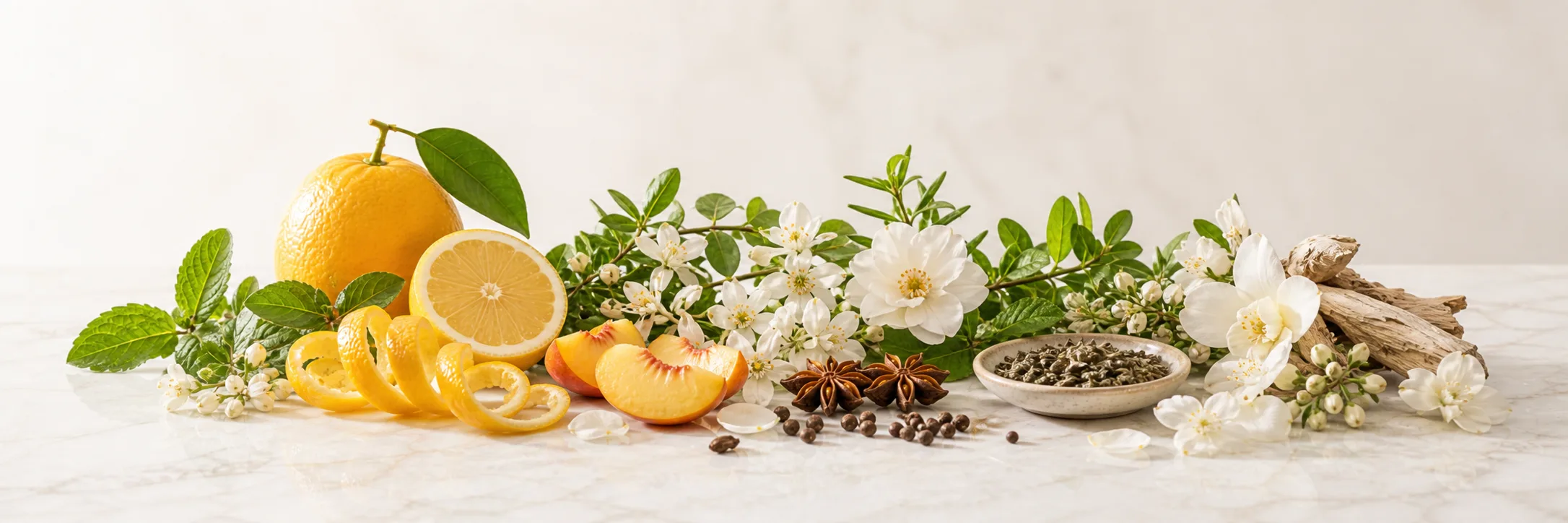
The opening, in a well-preserved bottle, is one of the most precisely engineered citrus accords in perfumery: bright Calabrian bergamot and lemon braced by a bitter-herbal lift of basil and rosemary, with a whisper of caraway adding a seedy, anise-adjacent rasp. This is not a simple cologne hesperidic; it has structure and a distinct vegetal greenness from the start. Beneath the citrus, Roudnitska’s signature move appears at once: a wet, semi-transparent jasmine luminosity that does not behave like jasmine absolute. Hedione here does not so much smell as create space — it expands and clarifies the citrus and lets the jasmine arrive without indolic heaviness.
By the heart, roughly one to three hours in, the citrus fades and a dewy, slightly soapy, faintly animalic floral-aromatic accord rises: jasmine, a herbal coriander-carnation spice, and a low hum of patchouli and orris root. Lily-of-the-valley and rose are present as structure rather than as solo notes, while carnation adds a peppery-clove fizz.
The drydown, past three hours, is where the chypre architecture surfaces, though softer than a classic Mitsouko: oakmoss (much reduced in modern batches), vetiver lending a grassy dryness, an unobtrusive amber-musk warmth, and a trace of tonka. Vintage bottles settle into a soft, slightly bitter herbaceous skin scent with a mineral mossiness; the current version reads more cologne-like and fades faster. The arc is a slow, modulated evolution rather than a hard pyramid, with each phase sharing connective tissue with the next.
Performance
Projection is light-to-moderate by modern standards — an arm’s length for the first hour, then close to the skin — and sillage is intimate rather than a “scent bubble.” Longevity on skin runs about three to five hours for the current EDT and five to seven for pre-2012 production, deliberately short in the eau-de-toilette tradition where reapplication is part of the point. On clothing it extends to eight to twelve hours and is famously good on cotton shirts. It is at its best in heat and humidity; in cold, dry air it sits flat. The classic approach is to splash it generously after shaving and reapply through the day.
Wearing Context
This is a daytime, warm-weather, classic-elegance fragrance. Spring and summer are its native seasons, with shoulder-season range from late March into early October. It is the prototype of the warm-weather office scent — at home in business settings, smart-casual lunches, weddings, and weekend brunches, and especially good outdoors and in ventilated rooms. It falls flat in cold winter contexts, where it can read insubstantial, and in heavy evening occasions, where its discretion reads as under-dressing. Socially it skews well-bred and classical rather than youthful, and it pairs naturally with linen, cotton, and grey flannel.
Comparisons & DNA
The closest sibling in Roudnitska’s own catalog is Diorella (1972), which shares the heart-and-base structure but pushes the fruit riper and the jasmine lusher. Dior Eau Fraîche (1953), also Roudnitska, is the older, simpler cologne sketch that Eau Sauvage perfected. Guerlain Eau de Guerlain is the closest competitor by status and genre — creamier, more bergamot-driven, and less herbal. Chanel Pour Monsieur (1955) is the more austere, lemony cousin, drier and mossier. And Chanel Cristalle is what happens when this formula turns feminine: the same Hedione-jasmine luminosity in a greener, more floral key.
Reception
Eau Sauvage is among the most universally celebrated masculines in critical evaluation. Luca Turin and Tania Sanchez gave it five stars, with Turin summarizing it as “a masterpiece” he keeps forgetting how good it is. Victoria Frolova of Bois de Jasmin invokes it as her reference point whenever she thinks of elegance in perfumery, praising “the perfect balance between simplicity and complexity.” Praise clusters on elegance, wearability, and timelessness. Criticism runs along two lines: that modern batches are thinner and less mossy than vintage, and that wearers coming from contemporary high-projection scents find it weak and short. The disagreement is generational rather than aesthetic — almost no one calls it bad, only that the current version is a shadow of the original.
Versions & Reformulation
The 1966 Roudnitska formula stayed largely intact through the 1970s and 80s. Eau Sauvage Extrême (1984) was a stronger interpretation by Roudnitska himself, later repackaged and reformulated around 2010. The base EDT underwent a major IFRA-driven reformulation around 2012, with oakmoss sharply reduced, bergamot replaced with a bergapten-free version, and some musks swapped; Michel Roudnitska attributes the changes entirely to regulation on naturals. Eau Sauvage Parfum (2012) by François Demachy is a separate bergamot-vetiver-myrrh composition rather than a true flanker, and Eau Sauvage Cologne (2015) is a minimalist citrus-musk offshoot. The original splash-bottle EDT remains the canonical form.
Acquisition Notes
The price bracket is entry designer. The 100 ml EDT spray retails around $90 to $110 at department stores and turns up cheaper at discounters, with 50 ml and a 200 ml splash bottle also available. The splash is the enthusiast preference. Vintage bottles are among the easier classics to find affordably; pre-2010 packaging commands only a modest premium. The most common counterfeit is a genuine bottle refilled with weak juice, so buy from authorized sellers and, for vintage, vetted specialists, checking that box and bottle batch codes match.
Notable Facts & Lore
- Roudnitska described his aim as “the art of fortunate proportions,” treating balance itself as the artistic principle.
- It was briefed as a unisex eau and marketed ambiguously at first; it became a cultural masculine partly through René Gruau’s advertisements of a man bathing.
- It is widely credited as the first commercial fragrance to use Hedione, and as the perfume that launched the upscale masculine market.
- Steve McQueen’s reported use, and later Johnny Depp’s campaign, fed its lore; 2015 research identifying Hedione’s effect on a human pheromone receptor produced headlines it benefited from indirectly.
- In nearly six decades it has spawned remarkably few flankers — a sign of how completely the original solves its problem.