Dior — Sauvage
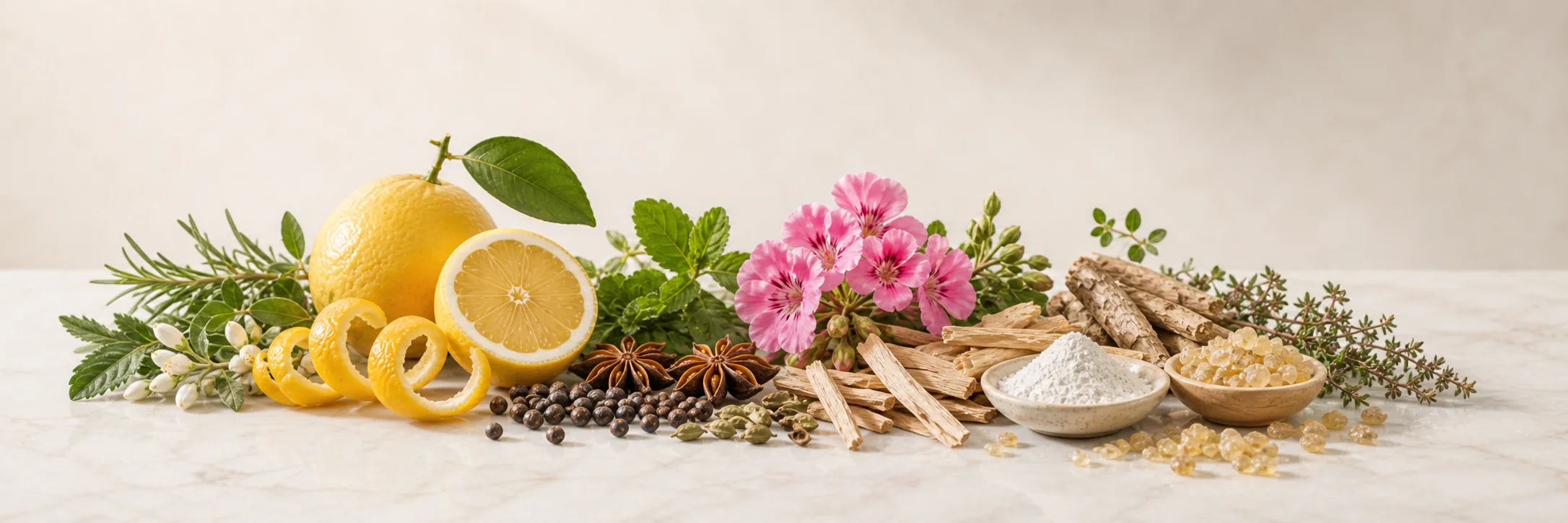
Essence
Sauvage is the single best-selling men’s fragrance in the world and arguably the defining masculine designer release of the 2010s. Francois Demachy built it around a luminous, almost translucent fresh-spicy architecture: Calabrian bergamot crashing into a saline-musky cloud of ambroxan, with peppers lending sparkle and a discreet lavender-vetiver-patchouli underlayer providing just enough texture to feel “perfume” rather than “deodorant.” It is loud, clean, immediately recognizable, and depending on who you ask either the perfect modern masculine or the herald of an entire blue-fragrance era.
Scent Profile
The opening is a coordinated assault: a hyper-bright Calabrian bergamot joined by a buzzing, slightly metallic, almost mineral cloud of ambroxan and dihydromyrcenol, the same clean-laundry, sun-bleached-driftwood pairing Luca Turin identified as the central accord of Green Irish Tweed. The first ten minutes are the sharpest phase: peppery, citrus-acid, bracing, with that signature freshly-cracked-pepper-over-wood-polish quality that became the imitation target for a decade of fragrance.
By twenty to forty minutes the structure relaxes only slightly. The heart is where Sichuan and pink pepper do most of their work, lending a tingling, slightly soapy spice that keeps the fragrance from sliding into pure ambroxan-clean. Lavender is more felt than smelled and functions as a binder; geranium adds a green-metallic edge that hardens the pepper; patchouli and vetiver sit as a thin shadow keeping the bright top from feeling weightless. This is the Sauvage signature, a long, plateaued heart phase from roughly hour one through hour four dominated by the ambroxan-pepper-bergamot triangle.
The drydown, from hour four onward, reveals how little vertical architecture the fragrance has. The bergamot fades, the peppers soften, and what remains is essentially ambroxan plus cedar and a faint labdanum warmth: a clean, salty, faintly woody musk that some wearers love and others find oppressively synthetic. It is famously one main idea executed at high volume rather than a multi-act drama.
Performance
Projection is strong for the first 90 minutes, a roughly 1.5-2 meter scent bubble, then settles to moderate for hours two through five before going close to skin. Sillage is loud in the opening, often louder than the wearer realizes. Longevity on skin averages 6-8 hours, while on clothing such as cotton, hoodies, and wool it easily reaches 24-48 hours, and that cloth-sillage is one of its defining traits. In heat the ambroxan amplifies and the citrus burns off faster; in cold the spice and bergamot register more clearly. Two to three sprays is the maximum almost anyone should use; over-application is the single biggest contributor to its reputation as overpowering.
Wearing Context
All-season versatile with a slight bias toward spring through autumn; it works in winter but loses some of its bright snap, and it is equally suited to day and night. It is best in casual-to-business-casual contexts: office with restraint, dates, dinners, daytime errands, and club nights. It falls flat in formal-classic environments where it can feel too sharp and too youthful. Social perception is bimodal: to the general public it reads as expensive, confident, and freshly showered, while to experienced enthusiasts it reads as the most worn and most cloned designer of the decade.
Comparisons & DNA
Bleu de Chanel (Jacques Polge, 2010/2014) sits in the same blue-fragrance category but is dirtier, drier, and more vetiver-incense-driven, where Sauvage is brighter, peppier, and louder. Creed Aventus is frequently mentioned by aspirational buyers yet shares little compositionally, being a pineapple-smoky-birch scent rather than a fresh-spice-ambroxan one. Versace Dylan Blue is a softer, sweeter take on the same ambroxan-citrus idea at lower designer prices. Prada Luna Rossa Carbon belongs to the same fresh-modern-masculine school but is built on patchouli-lavender rather than ambroxan-pepper. Across the budget tier, Armaf Ventana is the most-cited close approximation of the EDT at a fraction of the price.
Reception
Critical reception was lukewarm-to-negative on launch in 2015. Persolaise wrote that it “isn’t terrible at all,” only “very safe, very predictable and very monochromatic,” likening it to “the morning commute on the train” and predicting Dior would “sell more bottles of it than there are leaves on all the bergamot trees in Calabria,” a commercial forecast that proved exactly right. The Candy Perfume Boy in 2018 called the “ambroxan-laden Sauvage style” both “so popular, and so tired.” Wearer sentiment is polarized: broadly positive on the scent itself, far more negative on its ubiquity, with praise for versatility, projection, and compliments and criticism that it is synthetic, basic, and overhyped. Notably, many veteran enthusiasts who first dismissed it have come to a grudging respect for its technical execution.
Versions & Reformulation
Sauvage EDT has been on shelves continuously since September 2015 with minor production-batch tweaks but no announced formal reformulation; blind comparisons suggest post-2022 batches may have slightly reduced longevity, though this is contested and may reflect storage or IFRA-driven aromachemical limits. The EDT exists alongside three full siblings, each catalogued separately and not simple concentration variants: Sauvage EDP (2018), Sauvage Parfum (2019), and Sauvage Elixir (2021). Bottle sizes run 60 ml, 100 ml, and 200 ml, with a refillable 60 ml and a 10 ml travel format.
Acquisition Notes
Pricing is upper-designer: roughly $105 for 60 ml, $135 for 100 ml, and $180 for 200 ml at full US retail, with frequent seasonal discounts. Counterfeits are the central concern, since Sauvage is the most-counterfeited men’s fragrance in the world; authentic bottles have a strong magnetic cap click, a crisp Dior bee print, and laser-etched batch codes. Buy from authorized retailers and Dior boutiques for guaranteed authentic stock.
Notable Facts & Lore
- Johnny Depp has been the face of Sauvage continuously since 2015, the longest-running celebrity-fragrance pairing of the era, retained by Dior throughout his 2016-2022 legal disputes.
- The 2019 “We Are The Land” teaser campaign, featuring Native imagery, was pulled from social media within hours after immediate backlash over the word sauvage and its colonial usage.
- Sauvage controversially reused the name of Edmond Roudnitska’s 1966 Eau Sauvage, a composition with which it shares nothing beyond the trademark.
- It is the single most-reviewed designer fragrance on YouTube and TikTok, used as a benchmark across the influencer ecosystem.
- Demachy cited “wild, open spaces” and high-grade ambroxan, described in Dior’s brief as “obtained from precious ambergris,” as the structural anchor.