Rasasi — Blue Lady
Essence
Blue Lady is the most famous “Occidental” (Western-style) fragrance from Dubai’s Rasasi, and arguably the budget-fragrance world’s defining loud white floral. Rasasi’s own corporate history calls Blue Lady “the flag bearer of the Rasasi spirit in the Occidental range” and describes it as the house’s “maiden label” — the perfume that proved a Middle Eastern oriental specialist could sell a French-style floral. What it actually is, in 2026 terms, is a screechy, indolic tuberose-jasmine bomb sold for pocket change, beloved and reviled in roughly equal measure. It occupies a specific niche: the cheap, high-impact white floral that lets you wear a 1980s-style powerhouse without spending on Amarige or Poison.
Scent Profile
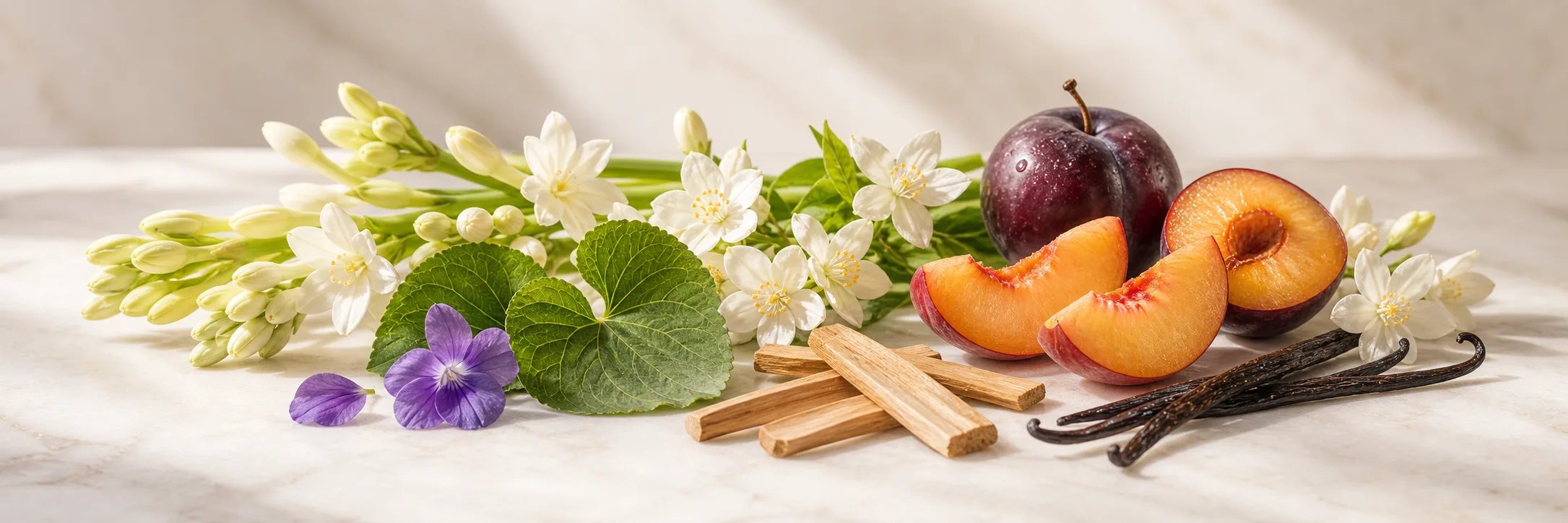
The composition is a classic top-heavy white floral. The opening is the loudest part: tuberose and ylang-ylang fronted by African orange flower and a green violet-leaf bitterness, immediately reading as sharp, indolic, and aggressively feminine. wearers descriptions repeatedly land on “screechy,” “piercing,” and “a punch on the face for the people around you.” One wearer accounts reviewer captured the consensus: “It’s like Poison without the sultry darkness mixed with the piercing shrill of Fracas. It’s a buzzing white floral headache.” The heart, when it emerges, brings jasmine (the note most people pick out most strongly), narcissus, and a fruity sweetness from peach and plum that rounds the sharp edges. The drydown is where Blue Lady earns its keep and softens considerably: a powdery musk-amber base with sandalwood, vanilla, and a touch of cool narcissus, frequently described as “clean,” “powdery,” and reminiscent of the base of Rasasi’s own Romance. Several wearers note the white florals collapse fairly quickly into this musky-powdery skin scent. It is essentially linear-leaning and not complex — multiple reviewers call it “one dimensional” — but the trajectory from shrill floral to soft powder is real and is what redeems it for fans.
Performance
Reports are genuinely split, which usually signals batch variation or skin-chemistry sensitivity. The dominant view is that Blue Lady is a sillage monster in its opening hours — “a beast and leaves a trail wherever you go,” “a silage monster, the longevity is also great.” A meaningful minority report the opposite: “I Love this scent. I wish it would have more sillage,” and complaints that the white florals “evaporate quickly.” Best synthesis: expect strong, room-filling projection for the first one to three hours and total wear in the six-hour-plus range, with the caveat that the brightest floral phase is fleeting and what lasts is the quieter musky base. For the price, performance is considered very good.
Wearing Context
This is a warm-weather, daytime, “I don’t want to waste my expensive perfume” scent for most of its fans — one reviewer explicitly reaches for it “when I don’t wanna waste my pricey perfumes but still wanna smell good.” It skews strongly feminine and youthful; several call it a great signature for “youthful people” and recall it as a teenage or early-2000s signature. Because of its loudness, it is poorly suited to offices, enclosed spaces, or anyone sensitive to indoles (one wearer reported headache and dizziness). It shines outdoors in heat where the sharpness reads as freshness rather than assault. Spring and summer are the consensus seasons.
Comparisons & DNA
Blue Lady’s reference point, cited over and over by the wearers, is Givenchy Amarige — the loud, creamy, sandalwood-sweet white floral of 1991. The honest consensus is that the resemblance is real but only in the opening: as one reviewer put it, “Amarige is thick, creamy white floral with sandalwood sweetness… This one smells similar in a way but the similarity is only in the opening which evaporates quickly.” Others compare the jasmine facet directly to Mugler Alien (“If you like Mugler Alien then you will love this too”) and the overall vibe to Poison and Fracas for sheer indolic volume. Within Rasasi’s own line it has a male counterpart, Blue For Men (a mint-mandarin aromatic, unrelated in scent), and a later reissue, L’Incontournable Blue Lady 2, which shares the same note list. The perfumer and exact release year are undocumented; wearer accounts and wearer accounts both list the year as unknown.
Reception
Blue Lady is a genuine cult cheapie with a polarized but affectionate following. On wearer accounts it is widely regarded as punching far above its price — “smells much more expensive than it is” is a recurring sentiment. The split is sharp: lovers find it a brilliant-value white floral with great trail; detractors find it a “body deodorizer” / “Blue Lady speed stick” that is “unwearable” in heat. Nostalgia drives a lot of the goodwill — multiple Arab reviewers cite it as their mother’s signature scent from 15–18 years ago and repurchase it for the memories. wearer accounts coverage is surprisingly thin (no full reviews on the main entry), but wearer accounts wearers engagement is heavy and wearer accounts classifies it simply as “floral-sweet.”
Versions & Reformulation
The core 40ml EDP (often bundled with a matching deodorant) is the canonical product. A later flanker/reissue, L’Incontournable Blue Lady 2, exists with the same listed notes. No documented reformulation history of the original exists, and given its budget positioning and undocumented launch date, batch-to-batch consistency is the more relevant variable than any formal reformulation.
Acquisition Notes
This is firmly bottom-tier pricing — it is one of the cheapest “real perfume” experiences available, frequently sold as a 40ml EDP with a free deodorant for well under typical designer cost. It is manufactured by Rasasi Perfumes Industry LLC, founded in 1979 by Haji Abdul Razzak Kalsekar in Murshid Bazar, Deira, Dubai, with its first dedicated manufacturing facility built in 1986 in the Jebel Ali Free Zone (note that some retailer listings incorrectly attribute the brand to Lattafa). Given the low price there is little counterfeit incentive, but buying from reputable Middle Eastern fragrance retailers or Rasasi’s own channels is the safest route. Because it is inexpensive and widely available, blind-buying is low-risk — the main thing to confirm is your own tolerance for loud indolic white florals before committing.
Notable Facts & Lore
- Blue Lady is historically significant as the perfume that launched Rasasi’s Western-style range and, per the company, pioneered its retail expansion — Rasasi credits “the insurmountable success of its maiden label ‘Blue Lady’ – the flag bearer of the Rasasi spirit in the Occidental range of perfumes” with establishing the brand’s reputation in occidental perfumery.
- The name reflects a “blue” color-and-mood theme (bold, sensual, fresh) rather than any aquatic note — a point of confusion since some retailer copy bizarrely describes it as “aquatic” with “mint and citrus notes,” which does not match the floral juice at all.
- Its enduring presence as a mother-daughter heirloom scent across the Gulf is a recurring theme in reviews, giving a budget floral genuine multigenerational cultural weight.