Rituals — Voyage en Inde
Essence
A surprisingly rich, plush, “full-bodied” jasmine-amber-patchouli oriental from an unlikely source: the Dutch lifestyle and cosmetics house Rituals, better known for bath products, candles and tea than for serious perfumery. Part of Rituals’ “Oriental Essence” collection, Voyage en Inde punches well above its mass-market price and house reputation, and has quietly become a cult value-buy and a documented dupe for a far more expensive niche fragrance.
Scent Profile
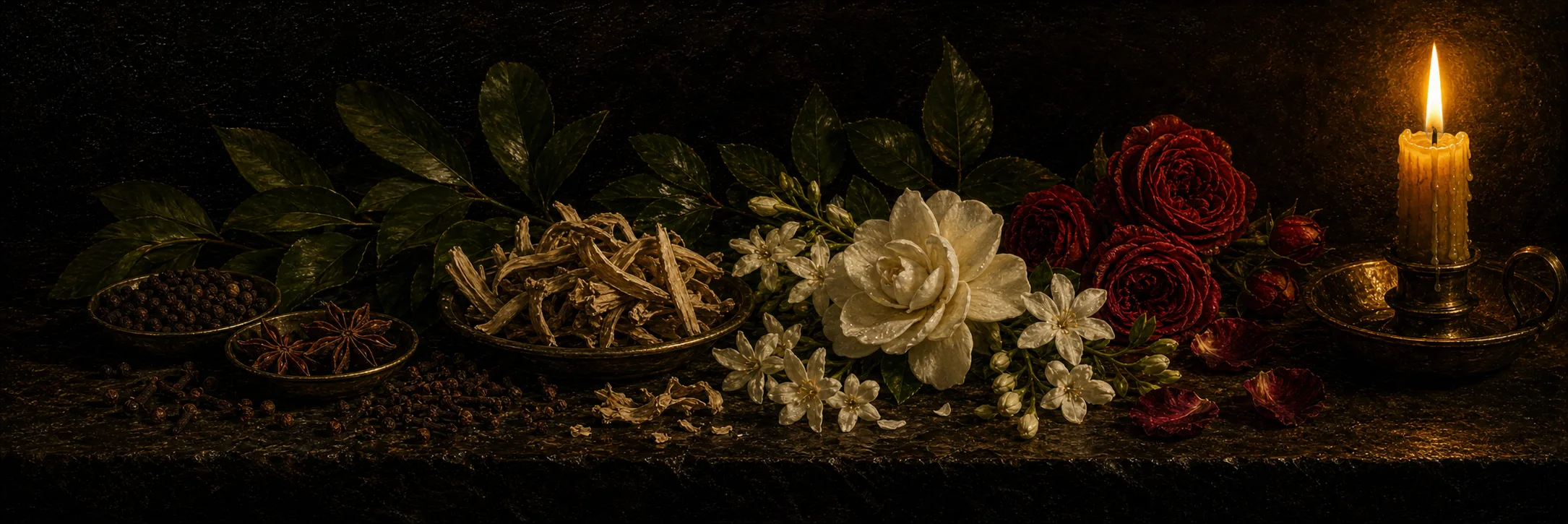
The composition is deliberately simple and built on three pillars - jasmine absolute, amber and patchouli - but rendered with unusual density. The opening (the catalog lists no top notes) immediately conjures a thick atmosphere of spices, amber and a touch of light camphor; critic Chant Wagner of The Scented Salamander described it as “the scent of a trip to India but also very much so, the atmospheric fragrance of an incensey shop of Nepalese and Indian goods, in a good way.” On skin it reads as a creamy, heavy, slightly powdery white-floral-amber: jasmine softened and rounded rather than sharp, patchouli kept clean and in the background, and a warm, sweet, sometimes vanillic amber base. Wearers frequently detect notes beyond the listed three - vanilla, coconut, rose, spice - and describe it as creamy, sweet, suffocatingly rich, and “more expensive and complex than its price.” It behaves, in Wagner’s words, “much like a parfum or pure extrait,” though more linear than the niche comparators.
Performance
Strong - arguably its biggest selling point relative to price. wearers consensus is heavy sillage and long longevity: “you can smell it miles away, it lasts and lasts,” “much better projection and longevity for a fraction of the price.” Some find it borderline suffocating and advise a light hand. This is a high-impact fragrance, not a skin scent.
Wearing Context
A cold-weather, evening, autumn-winter oriental. Reviewers reach for it to “cozy up with” in winter and describe it as sensual, sophisticated and warm. Feminine-leaning but rich enough to read as a unisex heavy oriental. Its density makes it an occasion or evening scent rather than a discreet office wear; the suffocating-for-some projection reinforces that.
Comparisons & DNA
The defining comparison, raised repeatedly by the wearers, is to Memo Paris Lalibela (2007) - a niche chypre-floral of jasmine, rose, ylang, patchouli, vanilla and musk. Multiple wearers call Voyage en Inde the budget alternative they will fall back on when their Lalibela runs out, noting shared coconut and rose facets. It is also compared to Narciso Rodriguez for Her (“NR”) for its musky floral character, though wearers say the Lalibela resemblance is far closer. Critic Chant Wagner grouped it conceptually with two other “full-bodied” 2016-era releases - Van Cleef & Arpels Moonlight Patchouli (Sonia Constant) and My Burberry Black (Francis Kurkdjian) - as examples of richly textured perfumery, while also candidly likening it to Bath & Body Works’ Sensual Jasmine Vanilla body lotion. Within Rituals, it sits in the Oriental Essence line alongside Eau d’Orient and Sultan de Muscat.
Reception
Better received critically than its mass-market origins would predict - but with thin /2 coverage, as expected for a lifestyle brand. The standout critical notice is Chant Wagner’s lengthy, genuinely admiring review at The Scented Salamander, which argued for Voyage en Inde as a welcome example of “the case for delicately trashy perfumes” - full, plush and unapologetically opulent in an era of “see-through” scents, even playing with a deft “cultural debasement” the way classic perfumers used dirty animalics. wearers carry the fragrance in their databases but with little or no review content (wearers: “no reviews”; wearers listings describe it but with the first review yet to be written), confirming that serious-critic circles largely overlooked it. in wearers reviews the wearers is warmly positive, repeatedly flagging it as underrated and an outstanding value. Note that some enthusiast-blog coverage (e.g., Beauty Cooks Kisses) was explicitly compensated/sponsored and should be weighted accordingly.
Versions & Reformulation
Launched 2016, composed by Elise Benat (of Firmenich). There is some database disagreement about its status: wearers listings describe it as a “limited” but “still in production” release, while one major catalog source marks it discontinued. Practically, availability through Rituals has been intermittent - it appears tied to the seasonal/limited “Oriental Essence” and “Travel” rotations rather than the permanent core line, which explains both the “limited” tag and wearers’ anxiety about stockpiling backups. No reformulation is documented. The fragrance family is itself contested in the data: wearers classes it chypre-floral, while other sources call it woody/oriental-amber - a reflection of how the patchouli-amber base can read either way.
Acquisition Notes
A low-risk, high-reward buy when in stock. Original pricing was around $75 (and lower in Europe), a fraction of the Memo Lalibela it resembles. Because it has moved in and out of availability, fans buy backups when they find it. If it is sold out at Rituals, the documented strategy is to either wait for a seasonal re-release or step up to Memo Lalibela for the similar effect at far higher cost. Given the strong projection, a small size is plenty for most wearers. Confirm you are buying the EDP “Voyage en Inde” from the Oriental Essence line rather than an unrelated Rituals “Travel” or scented-product item of similar name.
Notable Facts & Lore
- Rituals was founded in 2000 by Raymond Cloosterman in the Netherlands on a philosophy of turning daily routines into meaningful moments; its fragrance collections draw on Eastern traditions, with Voyage en Inde’s “Oriental Essence” theme evoking the royal palaces of ancient India.
- Perfumer Elise Benat, born and raised in the South of France and trained at Firmenich, has said she experiences fragrance creation “like photography,” seeing scents as images and translating words into aromas
- a framing that fits this scent’s deliberately atmospheric, picture-of-India concept.
- Its strongest cultural footprint in the wearers is as a “Lalibela dupe,” which has driven much of its word-of-mouth discovery.