Roberto Cavalli — Roberto Cavalli Eau de Parfum
Essence
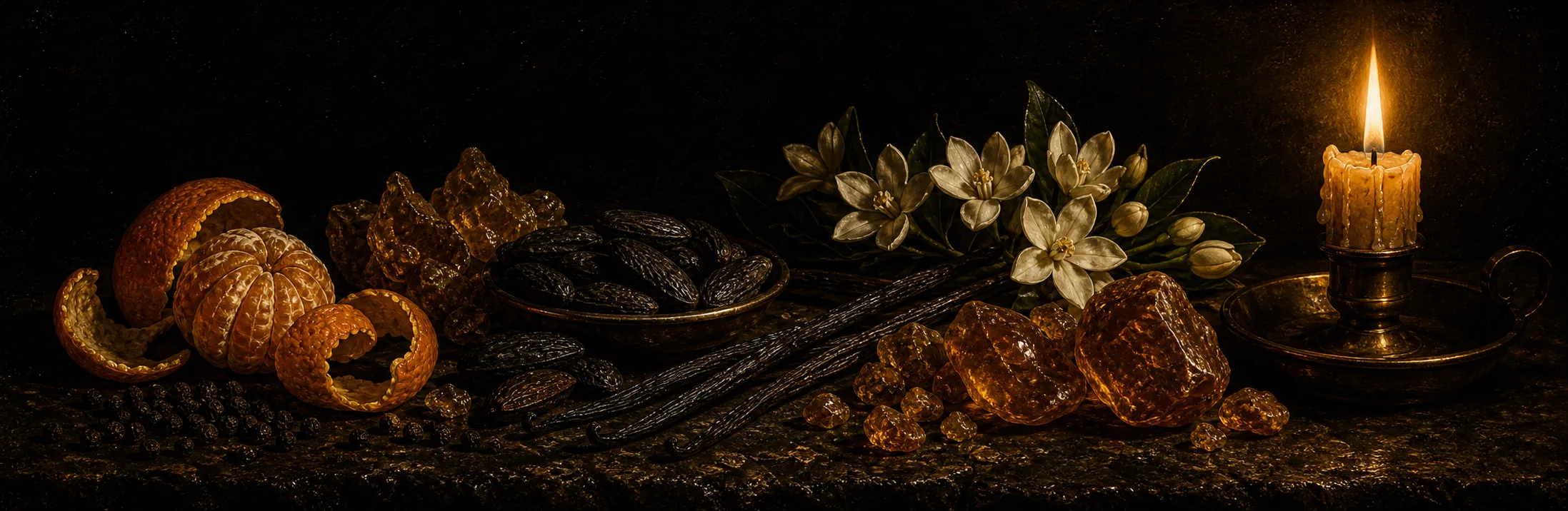
Roberto Cavalli Eau de Parfum is a bold orange-blossom amber-vanilla designer scent that wears “gold” in the way many designer orientals only advertise: not sheer, not sparkling-clean, but syrupy, peppered, plush, and intent on being noticed. wearer descriptions repeatedly frame it as feminine, sensual, mature-coded, and surprisingly rich for a mainstream designer release, with the orange blossom doing the heavy lifting and the benzoin-vanilla-tonka base providing the thick golden glow underneath.
Scent Profile
The official pyramid is spare, but wear reports are richer than that. Now Smell This described a fizzy, pretty opening that felt almost peachy/honeysuckle-like before the fragrance thickened, and ’s early review also picked up a short-lived fruity warmth before the heart turned decisively toward white floral territory. From there the composition lands exactly where its best reviewers say it does: orange blossom in syrupy, tonka-inflected form, then a base of benzoin, vanilla, and tonka that reads as ambered sweetness rather than fluffy gourmand. Several wearers smell phantom tropical fruit or peach/mango/passionfruit facets despite the published note list, which likely comes from the interaction of orange blossom, benzoin, tonka, and pepper rather than from hidden fruit notes. After the opening, it is fairly linear in the sense that it stays centered on creamy-syrupy orange blossom all the way down.
Performance
For a designer release, performance gets unusually strong wearers marks. wearers repeatedly call it long-lasting, sometimes all-night or even next-morning detectable, with moderate-to-strong early projection; documented commentary range from good 7/7 longevity-sillage ratings to qualitative feedback outliers. There are softer reports in the mix, but the dominant pattern is clear: this is not a fresh floral that evaporates after lunch. If anything, the more common warning is overspraying, because the syrupy orange-blossom/vanilla core can become cloying in heat or indoors if applied as though it were a lighter fragrance.
Wearing Context
Everything about the evidence points to cooler-weather, evening-leaning wear. and wearers repeatedly place it in fall and winter, for nights out, dates, dressier settings, or what can only be called “golden glamour.” It can still be worn during the day by someone who likes fuller amber florals, but the social-perception skew is not casual cotton-clean or easy office floral; it is sexy, polished, assertive, and a little mature in the best or worst sense depending on the wearer. High heat is the main danger zone, because several reviewers explicitly say it grows strong or cloying there.
Comparisons & DNA
wearer comparison consistently places Roberto Cavalli near other warm orange-floral ambers rather than near modern fruity florals. Armani Code for Women comes up repeatedly in recommendation threads, which makes sense: Cavalli occupies a similar designer sensual-oriental space, but wearers often treat it as a stronger, sweeter, more orange-blossom-forward alternative. Jean Paul Gaultier Classique Essence de Parfum is another common reference point; even commenters who deny a dead-ringer match still usually concede a family resemblance, with Cavalli described as sweeter, more orange-flower-heavy, and longer-lasting. Elie Saab Girl of Now shows up too, but mainly as a “same golden/sweet aura” comparison - Cavalli is generally read as less nutty and more poised, with less dessert-gourmand pull.
Reception
The praise side of the consensus is strong: sensual, luxurious, compliment-getting, richer than expected, and amazing value if you like this style. The criticism side is equally specific: too syrupy, too mature, too powdery, too much like wax polish or furniture associations for some noses, and potentially overwhelming for anyone who dislikes orange blossom in amber form. One useful nuance from the sources is that the fragrance is often admired even by people who do not usually wear florals, because its real center of gravity is ambered sweetness rather than petally prettiness. Blind buy is therefore conditional rather than reckless: plausible for lovers of Armani Code/Classique-style florientals, much less safe for people who want airy white flowers or who are sensitive to benzoin-vanilla heft.
Versions & Reformulation
Roberto Cavalli Eau de Parfum became the core of a small sub-line rather than remaining an isolated release. documents Roberto Cavalli Essenza in 2015 as a related sweeter-powdery spinoff; documents Roberto Cavalli La Notte in 2018 and Roberto Cavalli Deep Desire in 2019, both still under Louise Turner and both clearly presented as night/darker reinterpretations of the 2012 theme. ’s 2019 launch coverage explicitly refers back to the 2012 original as “Signature,” which is useful naming context when parsing later listings. I did not find solid support for a major reformulation narrative around the core 2012 Eau de Parfum itself.
Acquisition Notes
Launch-size reporting is mildly inconsistent across sources: ’s launch article lists 30 ml, 50 ml, and 75 ml EDP plus body products, while Now Smell This reported 30 ml, 50 ml, and 100 ml. That likely reflects regional or later-market variation, but it means bottle-size data should not be treated as perfectly fixed. directly characterizes the fragrance as medium-high price, though wearers discourse around it often implies strong value because the scent profile feels richer than its market position. I found no strong whitelisted evidence on counterfeit prevalence or batch-code decoding.
Notable Facts & Lore
- The release had very explicit image-building around it.
- Both and Now Smell This note that it was Roberto Cavalli’s first women’s fragrance under the then-new Coty licensing arrangement, fronted by Elisa Sednaoui and packaged in a rounded gold bottle with a tiara-like stopper and animal-print styling.
- Those details matter because they line up exactly with how the fragrance is received: as an unapologetically showy, golden, high-femme designer oriental rather than as a neutral department-store floral.
- Roberto Cavalli Eau de Parfum became the core of a small sub-line rather than remaining an isolated release. documents Roberto Cavalli Essenza in 2015 as a related sweeter-powdery spinoff; documents Roberto Cavalli La Notte in 2018 and Roberto Cavalli Deep Desire in 2019, both still under Louise Turner and both clearly presented as night/darker reinterpretations of the 2012 theme. ’s 2019 launch coverage explicitly refers back to the 2012 original as “Signature,” which is useful naming context when parsing later listings.
- I did not find solid support for a major reformulation narrative around the core 2012 Eau de Parfum itself.