Roberto Cavalli — Tobaccomore
Essence
Tobaccomore is Roberto Cavalli’s 2023 entry into the sweet-tobacco field, a category long dominated by Tom Ford Tobacco Vanille, best understood as a competent, mass-pleasing interpretation rather than a reinvention.
Scent Profile
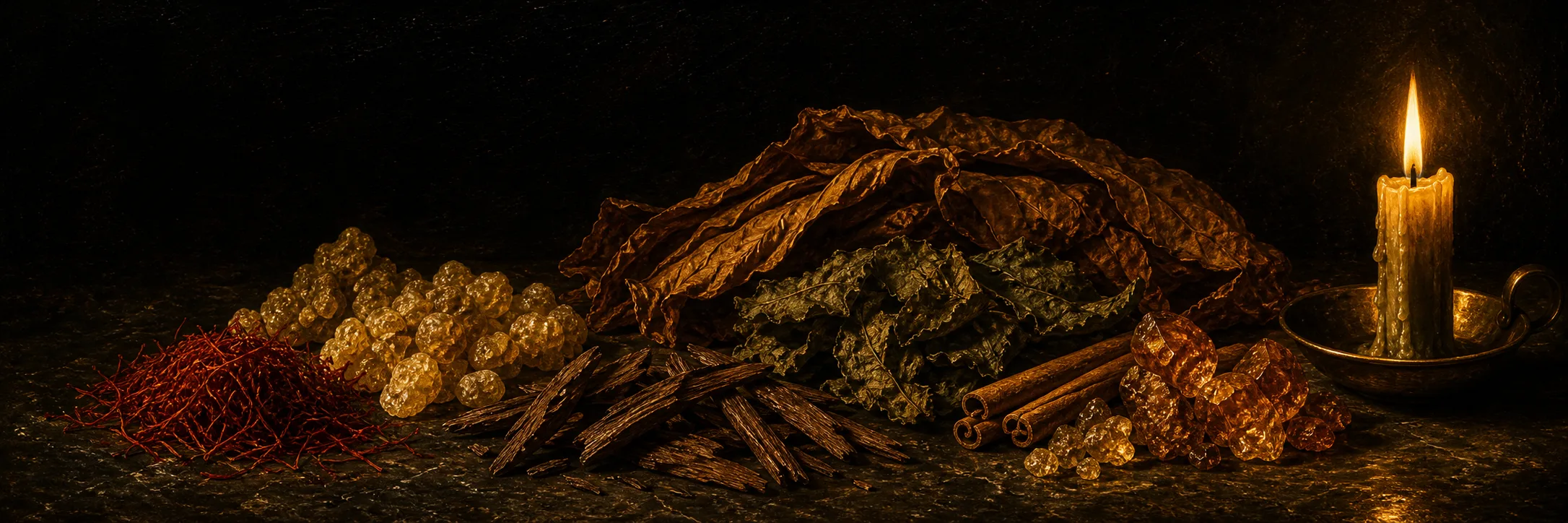
The opening is the saffron-tobacco gambit familiar from countless Arabian-style ambers: a slightly leathery, faintly medicinal saffron over a sweet blond-tobacco accord that reads honeyed, balsamic and pipe-tobacco-sweet rather than ashy. One wearer reports testing at Dubai airport got “strong Patchouli and Tobacco” in the first half hour. Several reach for “Kilian Back to Black-esque” at the top, drying down “to something along the lines of Herod, but sweeter.” As it develops it becomes a fairly linear sweet-tobacco-and-resin affair. The gurjan balsam and labdanum supply sticky ambery warmth; patchouli adds dark earthiness keeping it from pure sugar. The catalog pyramid (saffron / tobacco / labdanum, gurjan balsam, patchouli) matches, but there’s a real discrepancy: the Roberto Cavalli brand site lists a different construction - verbatim, “TOP: Saffron, Dry Fruits / MID: Amyris, Cedarwood, Blond Tobacco / DRY DOWN: Musk, Ambrocenide, Labdanum, Patchouli.” The Ambrocenide squares with reviews citing an ambery radiant push. One recurring critique sharpens identity by triangulation: several wearers independently flagged similarity to Arabian Oud Kalemat Black - “not exactly the same but it shares a similarity to Arabian Oud Kalemat Black.” Others place it near Kilian Back to Black and Parfums de Marly Herod.
Performance
Performance is where reviews diverge most, apparently a genuine skin-chemistry phenomenon. The aggregate verdict is that “projection and longevity are above-average.” Enthusiastic wearers concur - performance “actually better than Herod and pretty close to my vintage bottle of B2B.” Conversely, one detailed tester reported a “brilliant” opening lasting “maybe 30 mins or so” before becoming “a skin scent for sure after the initial Tobacco blast and minimal sillage.” Defensible synthesis: strong projection and a confident first hour, then a long-lasting but quieter sweet-tobacco aura. Reviewers treat it as cold-weather.
Wearing Context
An autumn/winter scent - its honeyed balsamic warmth would turn cloying in heat. Best read as an evening, dinner, and cold-weather daily-driver, the “cozy compliment-getter” wearers reach for when “fall is here.” Despite the unisex label, its sweet dessert-adjacent tobacco lands in the same register as Tobacco Vanille, Back to Black and Herod: date-night and “smell good” contexts rather than office discretion. One reviewer’s framing - that the appeal is precisely that “it is not well known,” a “hidden gem” they hoped wouldn’t “get overhyped” - captures its niche as a less-recognizable alternative.
Comparisons & DNA
Tobaccomore sits firmly in the post-Tobacco Vanille lineage. The most cited comparators are Kilian Back to Black (hay-honey-tobacco opening), Parfums de Marly Herod (sweet blond-tobacco drydown, which several say Tobaccomore beats on performance while running sweeter), Mancera Red Tobacco, and - most pointedly - Arabian Oud Kalemat Black, flagged as a near-DNA match. Against its own author it bears almost no resemblance to Menardo’s idiosyncratic Bvlgari Black or Patchouli 24; where those are tarry and austere, Tobaccomore is plush and crowd-friendly, so her authorship reads as house craftsmanship rather than auteur signature. Within the tobacco field it’s closer to the Gulf “Kalemat” school than the dry leafy style of Dior Tobacolor.
Reception
Reception is modest, polarized, and distribution-constrained. As of mid-2026, no critic coverage exists - unsurprising for a regional designer flanker. Sentiment is broadly positive but quiet; one listing at one point showed it with “no ratings yet.” Dominant tones: pleasant surprise at quality-to-obscurity ratio (“the epitome of a hidden gem”), dismissiveness toward derivativeness (“Generic designer sweet tobacco”), and a recurring “I’ve smelled this before” reaction pinning it to Kalemat Black. YouTube coverage exists but skews promotional. Honest verdict: well-made, well-liked, unoriginal, spared both hype and backlash by under-the-radar status.
Versions & Reformulation
Single composition, no known reformulations. The only wrinkle is the documented inconsistency between the catalog pyramid and the more detailed list on Roberto Cavalli’s own site - most likely marketing-copy elaboration rather than two formulas.
Acquisition Notes
For most of its life Tobaccomore was a Dubai Duty Free / Gulf-market exclusive, genuinely hard to obtain in the West; one UK tester wrote he tried it at DXB but “won’t be buying if/when it hits the English market.” It has since surfaced through online discounters in 100 ml EDP. It appears under the full “Roberto Cavalli Gold Collection Tobaccomore” name, marketed by Coty. Given the strong skin-chemistry variance in reported longevity, a sample before a full bottle is prudent.
Notable Facts & Lore
- The most interesting fact is its authorship: Annick Menardo, one of the most celebrated noses of her generation, lending serious craft to what is otherwise a regional designer flanker.
- Born in Cannes in 1959, she graduated from ISIPCA (the Versailles-based perfumery school) in 1985, was taught there by Isabelle Doyen, apprenticed under her mentor Michel Almairac at Creations Aromatiques (now Symrise), and joined Firmenich in 1991. Her perfumer profile describes her as drawn to “burnt” and dark accords - a reputation Tobaccomore notably does not exploit.
- The second piece of lore is its deliberately restricted Dubai Duty Free launch, which gave it an air of exclusivity and made it a minor grail for tobacco hunters before wider grey-market availability.
- The “-more” suffix plays on “tobacco” plus abundance, fitting the opulent, gold-accented Cavalli aesthetic.
- Single composition, no known reformulations.