The Body Shop — Kistna
Essence
Kistna is a 2002 mass-market men’s citrus-aromatic that has acquired an outsized cult reputation as one of the great “underrated casual scents” of the high-street era - a fresh, zesty, herbal-green cologne that punched above its budget price and then became a nostalgia object after the original was hard to find. Built on a bright citrus opening over a mossy-woody drydown, it was never trying to be sophisticated; its charm is exactly its agreeable, sunny familiarity. The catalog lists it as discontinued, but the situation is more tangled: The Body Shop currently sells a “Kistna” EDT whose marketing notes and formula differ from the 2002 original, making this effectively two fragrances under one name.
Scent Profile
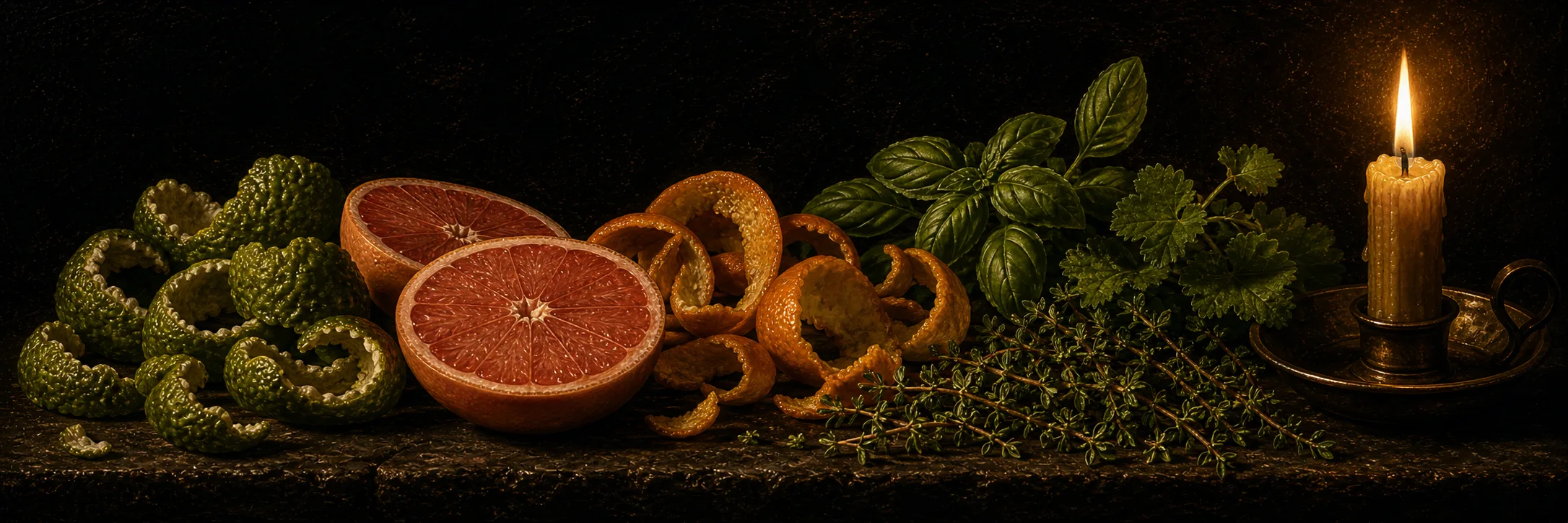
The original 2002 composition is a textbook fresh citrus-aromatic: a bright, “uplifting” blast of bergamot, grapefruit and orange that wearers describe as “zesty, fresh and juicy” with a strong lime-like impression, mellowing into a “smooth, green woody scent.” The basil-geranium-thyme heart supplies the “herbal, MANY herbs” character that long-time wearers single out as its signature (“a very ‘natural’ scent”), and the oakmoss-patchouli-cedar base keeps the drydown “fresh and clean” rather than harsh - “a mossy/woods drydown but not a harsh one.” A minority found it “too sharp” or, in the drydown, “over-ripe, slightly rotten citrus.” The dominant complaint across every source is brevity: the citrus “gives way quickly,” and multiple wearers report it fading to a skin scent within roughly two hours. The current The Body Shop “Kistna” is marketed with different notes - the brand describes “fresh notes of grapefruit, lemon, cedarwood and vanilla” and calls it “a contemporary, fresh and green fragrance inspired by nature” - and a vegan reformulation. Its INCI list shows the scent housed entirely in “Parfum/Fragrance” with the usual allergen markers (limonene, linalool, citral, geraniol, eugenol), so the “cedarwood and vanilla” descriptors are marketing rather than isolated naturals. Anyone chasing the original herbal-thyme character should be aware the relaunched juice is described as greener and simpler.
Performance
Performance is the fragrance’s Achilles’ heel and the single most consistent theme in its reception. Wearers report longevity as low as “30-45 mins” and commonly “2 hours and I can barely smell it.” One devoted wearer who calls it a signature concedes “it does not last very long.” Sillage and projection are correspondingly modest - “stays close to the skin,” “Sillage and longevity are a little low.” published listings wearers reviews echo “weak performance and sillage.” The practical upshot, repeated by fans, is that this is a “spray at will,” reapply-freely scent rather than a one-spray performer - its lightness is partly a feature for those wanting something inoffensive and non-overpowering.
Wearing Context
By consensus this is a daytime, warm-weather, casual scent - explicitly a “sunny day” fragrance, “fresh and invigorating,” ideal for spring and summer and for “light wearing occasions.” A wearers cast it as “that guy everybody likes because he’s always fun to hang out with on a sunny day… never the center of attention, but everyone would be glad that he’s there.” As a practical reading: office-safe, gym-bag friendly (The Body Shop sold a matching hair-and-body wash explicitly pitched as a “gym bag bestie”), and entirely uncontroversial for casual social settings. Its weak performance makes it unsuited to long days or evenings without reapplication.
Comparisons & DNA
Kistna sits squarely in the late-90s/early-2000s fresh-citrus mainstream and wearers name its relatives precisely. The most repeated comparison is CK One (“Kistna smells like CK One”) for its clean unisex citrus. A wearers positioned it as “a greener Acqua Di Gio meets Curve-without-the-musk.” Several wearers call it “a cheaper version of Clinique Happy for Men,” and one points to Zara Lisboa as a current, cheaper smell-alike. Its house-mates frame it too: within The Body Shop’s men’s range it was grouped with Javari (compared to Burberry Touch and JPG Le Male), Arber (likened to John Varvatos/Dunhill), and White Musk For Men. The DNA delta: Kistna is greener and more herbal than the aquatic Acqua di Gio, less musky than Curve, and more natural-herbal than the sweeter Clinique Happy - but markedly weaker-performing than all of them.
Reception
Among the niche fragrance wearers Kistna is a quiet darling: “one of the most underrated casual scents around, easy to compete with designer and even niche scents along these lines.” A former Body Shop employee called it “one of the bestsellers for men.” It is also a documented nostalgia object - on the page for the discontinued TBS “Of a Man,” a commenter laments the house’s habit of discontinuing “good stuff.” The axis of polarization is simple: nearly everyone agrees it smells good and pleasant; the divide is between those who forgive its weak longevity for its low price and charm, and those (and a vocal contingent) who find it generic - “a grassy lemon cleaner,” “0 uniqueness.” Blind-buy verdict: at its budget price, yes, for anyone wanting a cheerful summer citrus and who accepts they’ll reapply - but verify whether you’re buying the original or the reformulated current version.
Versions & Reformulation
This is the crux of Kistna’s story. The original 2002 EDT (aromatic-spicy: bergamot/grapefruit/orange, basil/geranium/thyme, oakmoss/patchouli/cedar) was discontinued and became “hard to find,” with resale listings explicitly tagging it “Discontinued HTF.” The Body Shop subsequently brought a “Kistna” EDT back - current customer reviews capture the gap (“This has been out of stock so long I thought it had been discontinued. Great to have it back”), and the current product is marketed with a different, simpler note set (“grapefruit, lemon, cedarwood and vanilla”) and a vegan formula. No official Body Shop statement documents the discontinuation date or the reformulation, so the timeline rests on review language and resale evidence. Practically: treat the vintage 2002 bottles and the current relaunch as related but not identical.
Acquisition Notes
The current Body Shop Kistna EDT retails at £30 for 100ml (single size), frequently shown as sold out, with a a qualitative verdict rating across 313 reviews - a steep climb from its early-2000s budget positioning, when a wearers cited roughly $28 for 100ml and wearers bought it on buy-one-get-one sales for as little as $14. Vintage/original bottles circulate on the secondary market (eBay) tagged as discontinued and “hard to find.” Decants are not a major market for a fragrance at this price point. Counterfeiting is not documented; the more relevant buyer caution is version confusion between original and relaunch.
Notable Facts & Lore
- Kistna takes its name from the Kistna (Krishna) River in India, consistent with The Body Shop’s nature-and-travel-inspired branding (“inspired by nature”).
- No perfumer is publicly documented for the fragrance - published listings, published listings and published listings all omit a nose, and the original creator appears to be unrecorded.
- The fragrance is now marketed by Auréa Holding Limited per published listings, reflecting The Body Shop’s ownership changes over the decades.
- Its enduring lore is wearers-driven: the published listings anecdote of a stranger asking “Ooh, what was that?” the moment it was sprayed became the title of a long-running appreciation thread.