Amouroud — Agarwood Noir
Essence
Agarwood Noir is not an oud-led bruiser so much as a jasmine-led dark floriental with oud doing structural work underneath. The recurring picture is of indolic jasmine, apricot, saffron, moss, and incense-tinged woods more than of loudly medicinal agarwood. What makes it distinctive is that tension: it wears plush and sensual, but the “agarwood” in the title mostly deepens and roughens the floral body instead of dominating it.
Scent Profile
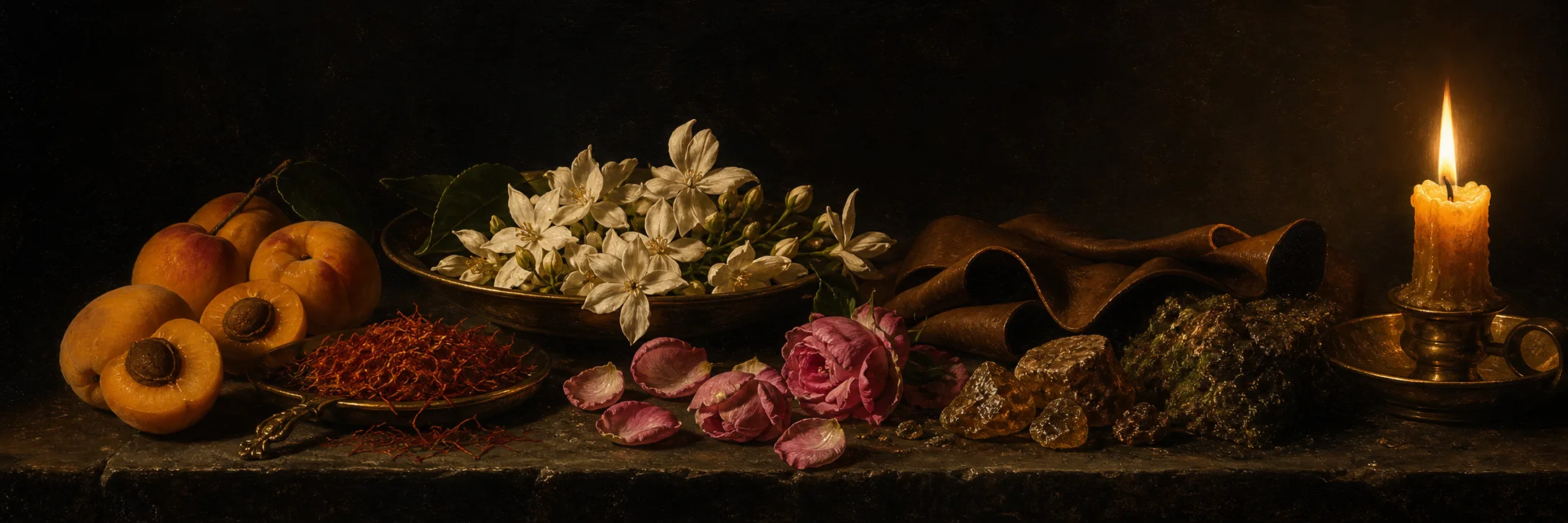
The opening hits with jasmine first, not oud - a floral-animalic blast of jasmine and moss with sweet apricot floating above it, strongly indolic, with saffron and only soft, background leather. In the first ten to twenty minutes the apricot is perceptible but not jammy; it reads more like bruised golden fruit giving glow and softness to a bright, slightly dirty floral core, while saffron contributes warmth and texture and pink pepper shows up more as a faint lift than a sharp spike. In the one-to-three-hour heart, the perfume settles into a woody floriental or incense-carrying floral: rose comes into view, vanilla begins to cushion the edges, and the oud becomes legible as a dry woody shadow or incense effect rather than a raw-material showcase. Oakmoss and olibanum keep the composition earthy and slightly smoky, which helps explain why some place it in masculine-jasmine conversations despite its obvious floral center. By the drydown, what remains is a muted jasmine-and-rose incense effect with soft woods, moss, gentle sweetness, and only traces of the promised leather - one apt image is an unlit jasmine-rose incense stick. It evolves in a controlled way: bright indolic floral opening, incense-woody floral heart, softer musky-resinous floral drydown. The signature accord is indolic jasmine wrapped around a restrained incense-oud-moss base.
Performance
The performance signal is solidly above average. Projection is moderate-to-good rather than explosive room-fill: roughly arm’s length in normal indoor conditions for the first hour or two before it pulls closer, with skin longevity in the eight-to-ten-plus-hour range and fabric wear plausibly extending beyond that. It behaves best in cool-to-mild weather, where the floral-animalic opening and incensey base can breathe; heat tends to enlarge the jasmine more than the woods and can make the floral side feel heavier, while dry air favors the moss, saffron, and incense. Because it already has good persistence and a dense floral center, a moderate two-to-four sprays serves better than heavy saturation.
Wearing Context
Agarwood Noir sits in the fall, winter, and spring corridor, with evening wear coming up more naturally than daytime freshness. It leans slightly feminine but is repeatedly singled out as a rare example of luxurious jasmine carried over oud, leather, and oakmoss in a way that still reads soft but masculine, which makes its wearing context unusually specific: it suits people comfortable with florals, and especially those who want a dark jasmine rather than a macho oud. It shines at dinners, in dim interiors, and in dressed-up cool-weather settings where a plush but not sugary floral makes sense, and is less convincing in blazing heat, casual athletic settings, or anywhere a crisp, soapy, transparent scent fits better. Socially it reads “perfume” more than “cologne.”
Comparisons & DNA
The most useful comparison is not to a barnyard oud but to the dark-jasmine family. It sits near Bvlgari Jasmin Noir, but fruitier and with stronger longevity and sillage, which tracks with its apricot-saffron top and firmer woody base. Against Royal Crown Oud Jasmine, that scent has the more hyper-real jasmine opening while Agarwood Noir wins on the richer fruity-floral, leathery-musky, woody-incense middle. Miguel Matos suggests its jasmine effect may share DNA with The Perfumer’s Workshop Tea Rose Jasmin base, only made richer, deeper, and more wood-framed. Together those references place it in the overlap between dark jasmine, woody floriental, and restrained floral oud: the title promises agarwood, but the actual DNA is closer to a luxurious jasmine noir with oud shading. No obvious documented clone ecosystem exists, and the profile is idiosyncratic enough that it has not generated the copycat conversation that Dark Orchid has.
Reception
Reception is positive but narrow - good approval from a relatively small audience compared with more visible niche releases. Praise centers on consistency: quality jasmine, unusual masculine wearability for a floral scent, strong durability, and a composition that feels opulent without collapsing into syrup. The criticism is just as consistent: it is more jasmine than oud, more floral than some buyers expect from the name, and more “perfume” than “cologne.” It surfaces as a special-case recommendation in masculine-jasmine discussions, while negative reactions come mostly from those who simply do not want a jasmine-heavy wear or who expected a darker, woodier profile. Dedicated major-critic coverage is limited, though Miguel Matos treats it enthusiastically as one of the better floral-oud executions around. It is a plausible blind buy only for someone who already enjoys indolic dark jasmine with incense and woods, not a safe choice for an oud seeker expecting leather, smoke, and obvious agarwood heft.
Versions & Reformulation
Available sources surface only the eau de parfum and do not document flankers or reformulation breakpoints, so there is no established version history to navigate.
Acquisition Notes
Acquisition data specific to Agarwood Noir is thin. It belongs to a niche-positioned Amouroud line associated with Perfumer’s Workshop, and the brand’s boutique-facing rollout was discussed in connection with Osswald NYC around launch. Reliable current official pricing, size menus, and decant-stock specifics for this exact fragrance are not well documented, so the practical shopping intelligence is weaker here than the scent intelligence. The safe recommendation is to sample before committing, since the profile is narrower than its name suggests and depends heavily on your tolerance for indolic jasmine.
Notable Facts & Lore
- The name oversells the agarwood and undersells the jasmine; in wear it is far more a dark jasmine than an oud statement.
- Miguel Matos described it as one of the better examples of a floral oud, centered on a bold jasmine-plus-oud heart.
- Its jasmine effect is suggested to share lineage with The Perfumer’s Workshop Tea Rose Jasmin base, made richer and more wood-framed.
- It has become a recurring answer in “masculine jasmine” discussions, unusual for a scent with this much floral body, and is often experienced as gender-fluid rather than simply feminine.
- Published listings disagree on the launch year, with 2016 and 2017 both appearing, so its release year is recorded inconsistently across databases.