Amouroud — Oud After Dark
Essence
Oud After Dark is Amouroud’s plum-and-tobacco “dark fruit” oriental, a 2016 Claude Dir composition that uses “oud” as a marketing banner rather than a literal centerpiece. What actually defines it is a juicy, almost boozy
Scent Profile
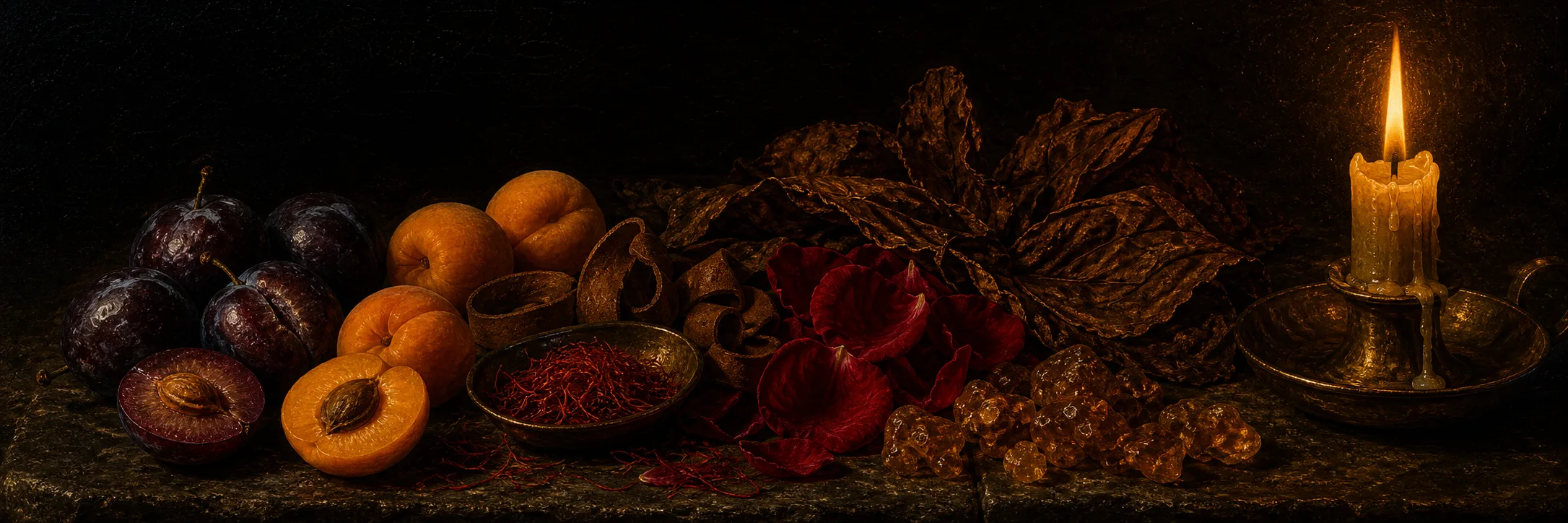
The opening (first 10 - 20 minutes) is the most assertive phase: a fiery saffron-and-pepper jolt softened almost immediately by a juicy apricot-osmanthus fruitiness. Several wearers describe a “fiery, spicy, chlorine-like” saffron threaded with a delicately sweet apricot, and some catch a brief clean, almost menthol-like top facet. This is loud - heavy projection in the first hour to ninety minutes - and the dianthus (carnation) is essentially submerged, contributing a faint peppery-spicy lift rather than a distinct floral. The heart (1 - 3 hours) is where the signature accord settles: a ripe purple-plum note darkened by tobacco, suede, and a smoky olibanum thread. The plum is the true protagonist - repeatedly singled out as the star, “a bold, dark creation with a love for plums at its heart.” Suede gives it a soft leathery texture; the Turkish rose listed in the pyramid is largely imperceptible, with one experienced reviewer noting that if rose is present “it must be just a pin drop.” The olibanum reads as a gentle smoky veil, not a churchy incense bomb. This is the “leathery plum” core that some describe as edging toward an “almost chocolatey” richness. The drydown (3+ hours) softens into amber, vanilla, ebony woods, and musk - a warm, slightly powdery skin-scent that keeps the plum-tobacco impression but loses the opening’s fire. Critics have flagged the base as the fragrance’s weak spot: one wearer argued it resolves into “a feel similar to Maison Francis Kurkdjian Baccarat Rouge 540,” built on saffron, ambroxan, synthetic woods, tonka, and a softening pinch of vanilla and musk, with “no oud” detectable even after sundown. Linearity vs. evolution: there is genuine top-to-heart movement (fiery-spicy to fruity-leathery), but from the heart onward it is fairly linear, riding the plum-suede-tobacco accord into a softer amber close. The signature accord is unmistakably plum + suede + smoky tobacco. Perceptible notes: apricot, saffron, plum, suede, tobacco, vanilla, musk. Submerged or barely-there: dianthus, rose, and - per the consensus of multiple reviewers - the titular oud.
Performance
Projection is strong out of the gate - wearers report “heavy projection for 1 - 1.5 hours” before it settles to moderate, with one wearer recounting being smelled across a department-store fragrance hall. Sillage is above average in the opening and tapers to a moderate, intimate trail. Longevity is a consistent strength: on skin, expect roughly 8 - 13 hours (one wearer reports it “sticks on my skin for a solid 13 hours, by which time there’s still a faint base layer of mild tobacco and woody notes”); on clothing it can persist a day or more, as is typical for this resinous-ambery genre. Heat vs. cold: this is a cool-weather composition. The plum-tobacco-amber density blooms in fall and winter and can turn cloying in heat; multiple wearers note it is “just not hot weather” appropriate, though a few in mild climates wear it year-round anyway. Dry vs. humid behavior is not well documented in reliable sources, but the heavy ambery base suggests it will feel richer (and potentially heavier) in humidity. Application strategy: given the strong opening and long legs, a conservative 2 - 3 sprays is sufficient; over-application risks pushing the sweet-fruity opening into syrupy territory. No house-specified application guidance for this fragrance exists in reliable sources beyond generic pulse-point advice.
Wearing Context
Best in fall and winter, evenings, and cooler date-night settings - the recurring wearers framing is “winter, fall, date nights, rainy days, just not hot weather.” It shines as a rich, attention-grabbing “power scent” for dinners, evenings out, and cold-weather occasions where its plummy-tobacco warmth registers as opulent and confident. It falls flat in heat and in austere professional settings, where its sweetness and projection can be too much. Social-perception skew: the scent leans slightly feminine to many noses despite its unisex labeling - “it leans slightly to feminine scents,” per one wearer who flagged dominant fruity-floral notes. That said, several men report compliments wearing it, and a UK lifestyle blogger noted her boyfriend wears and enjoys it too. The fruit-forward, polished profile makes it broadly approachable rather than challenging, so it skews toward “crowd-pleasing rich oriental” rather than connoisseur statement. Hardcore oud or smoke purists will be disappointed; plum and tobacco lovers are the target audience.
Comparisons & DNA
The most-cited comparison is Tom Ford Plum Japonais (Atelier d’Orient) - wearers note “faint similarities,” with Oud After Dark being cheaper and somewhat fruitier/less refined. The leathery-plum direction also draws comparison to Tom Ford’s plum-leather territory, with Oud After Dark sitting on the fresher, fruitier end. A wearer argued the base most resembles Maison Francis Kurkdjian Baccarat Rouge 540 (saffron + ambroxan + synthetic woods), making it an MFK-adjacent option for thrifty niche seekers, but without BR540’s signature airy sweetness. Within the house, it shares clear DNA with Amouroud Oud Tabac (Oud Tabac swaps plum for a cherry-tobacco accord and adds more overt smoke) and Amouroud Oud du Jour (drier, less sweet, more unisex). One wearer described Oud After Dark as “basic DNA similar to Oud Tabac, but here plum instead of cherry and a noticeable smoke note.” It was also compared to Gucci Intense Oud, though dismissively by one critic who found the quality lacking. Designer/clone alternatives: multiple reviewers flag Armaf Shades Wood as a startlingly close, much cheaper relative - one calling Oud du Jour (its sibling) “95%” similar to Shades Wood, and another noting Oud After Dark resolves into something like “a nice and pleasant Armaf Shades Wood flanker” before it dies. For a budget plum-tobacco approximation, Shades Wood is the obvious entry point; Oud After Dark is the smoother, better-blended, longer-lasting upgrade. Lineage: it is a late entrant in the 2010s “Western oud” / dark-fruit-oriental trend kicked off by Tom Ford’s oud and plum works and amplified by BR540’s saffron-amber template. It did not itself spawn imitators of note, but it sits squarely within Amouroud’s house project of translating Middle Eastern motifs into accessible Western orientals.
Reception
wearer consensus (wearer reports) is broadly positive on smell and performance but polarizing
Versions & Reformulation
Single composition, no known reformulations. (Note: some taxonomies list a 2017 launch year while Amouroud and wearers list 2016; treat 2016 as authoritative. No concentration variants of Oud After Dark are documented in reliable sources.)
Acquisition Notes
Oud After Dark sits in Amouroud’s niche price tier. Catalog pricing lists 230 USD / 100 ml. Oud After Dark is documented as EDP. Sampling is the safest path when the dossier flags polarized wear; treat reseller chatter, batch-code speculation, and unusually cheap listings as non-authoritative.
Notable Facts & Lore
- Amouroud is the niche arm of The Perfumer’s Workshop, the house behind the 1971 cult rose soliflore Tea Rose; the company was formed around 1970 when, per Colognoisseur, “Donald Bauchner formed Perfumer’s Workshop Ltd with his wife Gun.” Colognoisseur identifies “the creative mind behind Perfumer’s Workshop and Amouroud” as Gun Bauchner, “who with her husband Donald created the company.” The house name is a portmanteau of the Italian/French for “love” (amour) and “oud” - which is precisely why the recurring critical joke is that a house named for oud makes “oud” fragrances that contain little recogni.
- Oud After Dark is Amouroud’s plum-and-tobacco “dark fruit” oriental, a 2016 Claude Dir composition that uses “oud” as a marketing banner rather than a literal centerpiece.
- What actually defines it is a juicy, almost boozy.