Amouroud — Bois D'Orient
Essence
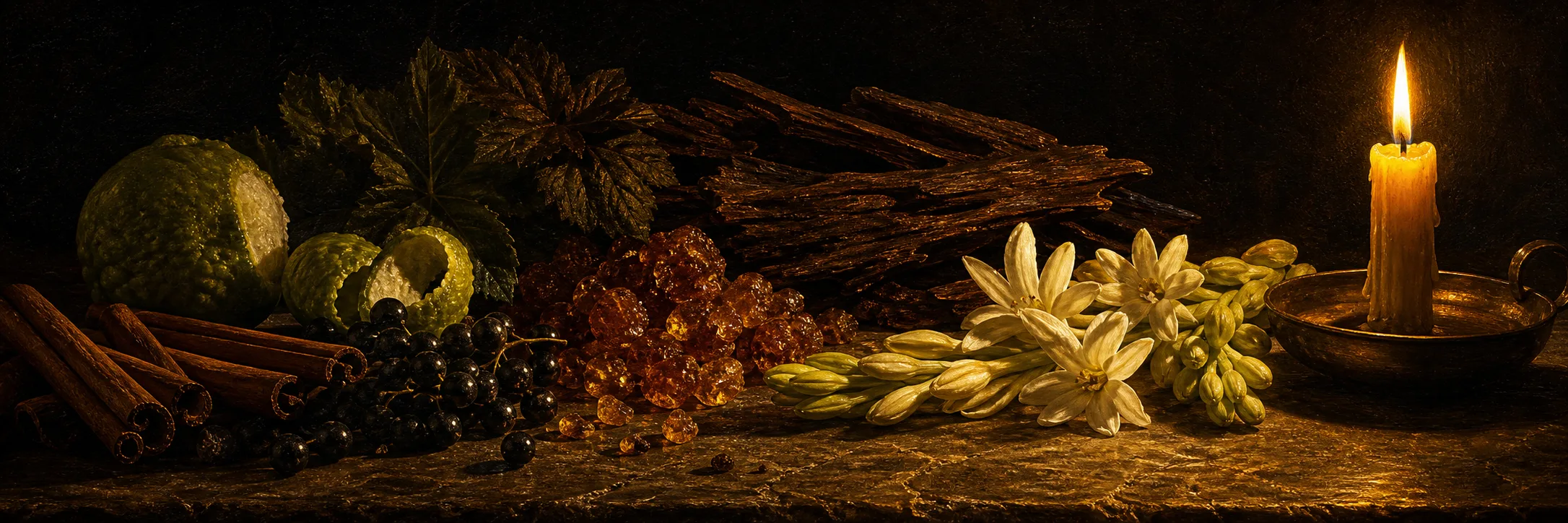
Bois D’Orient wears less like a modern oud launch and more like a resinous, floral-spiced amber with a vintage-leaning oriental backbone. Its real center of gravity is cinnamon, blackcurrant, Peru balsam, amber, patchouli, and lush florals, with the listed oud functioning as background wood shading rather than the star. What makes it distinctive is a split identity: some wearers find it elegant, expensive, and plush, while others hear too many moving parts at once.
Scent Profile
Bois D’Orient opens on a sweet-spiced oriental axis. Cinnamon arrives first, often with a semi-gourmand or pastry-like effect, while blackcurrant adds a dark fruity sheen that keeps the spice from turning dry. Bergamot is present mostly as lift. The early impression is woody, semi-sweet, ambery, and immediately likeable rather than challenging, which already sets it apart from stereotypical niche oud profiles.
As it settles, the floral heart becomes more visible without being sharply separated: ylang-ylang, tuberose, rose, and galbanum act as a lush interior glow rather than as individually spotlit notes. Peru balsam in the base is a crucial note in actual wear, supplying much of the resinous sweetness and late-stage smoothness, and it explains why some wearers associate the scent with older-school orientals or warm pastry rather than with contemporary synthetic oud.
By the drydown, the loudest florals fall back and the perfume becomes balsamic amber, patchouli, woods, and lingering cinnamon, sometimes with a creamy tuberose halo still detectable. The oud is consistently described as quiet; several wearers note it barely registers. The overall signature is cinnamon-blackcurrant draped over Peru balsam amber and dusky florals, evolving from a spice-fruit opening through a lush floral-resinous middle to an amber-balsam-wood finish.
Performance
Performance sits in the better-than-average range, though it reads more as a persistent plume than a brute-force projector. Projection is moderate — roughly within arm’s length, a little more in warm indoor air — while skin longevity runs around 8 to 10 hours and fabric life longer still. Cool weather flatters the resin, amber, and spice, but the tuberose side can also carry it in warmer conditions. Three to five sprays is the sweet spot.
Wearing Context
The default context is autumn and winter evenings, but Bois D’Orient is more flexible than its note list suggests. It suits dinners, bars, dressed-up casual nights, and quiet formal settings, and its sweet-spiced amber body makes it a natural holiday-season choice without falling into tobacco-vanilla cliche. It reads polished, slightly mature, and somewhat vintage in spirit. It is not an oud-flex scent; it is for someone who prefers balsamic texture and warm florals over obvious exoticism.
Comparisons & DNA
Tom Ford Black Orchid is the comparison that keeps coming up: Bois D’Orient is a same-vibe relative that leans on Peru balsam, blackcurrant, cinnamon, and amber rather than Black Orchid’s darker truffle-patchouli oddness, so it reads less dank and more balsamic-spiced. Tom Ford Soleil Blanc shares a tuberose-linked, late-sun warmth, but Bois D’Orient is far woodier, less coconut-solar, and more resinous. Ormonde Jayne Tolu is a useful Peru balsam reference point, though Bois D’Orient is denser, sweeter, and more floral-oriental than Tolu’s smoother elegance. Broadly, its DNA recalls 1980s orientals more than any contemporary oud.
Reception
Reception is favorable but informatively mixed. Praise centers on quality, balance, long wear, and the unusual Peru balsam-driven sweetness; admirers call it elegant and signature-worthy, more graceful than its low market profile would suggest. Criticism clusters around two faults: that it is too discreet for what looks like a rich oriental-oud concept, or that it feels overstuffed and somewhat chaotic. Oud expectations trip people up most often, since many wearers find it smells like a sweet balsamic oriental with floral shading rather than an oud perfume. It is a confident recommendation only for those who already enjoy sweet resinous orientals.
Versions & Reformulation
Only the eau de parfum is documented. No flankers, alternate concentrations, or reformulation breakpoints have been recorded.
Acquisition Notes
Bois D’Orient belongs to Amouroud’s niche-facing line and was previewed during the brand’s early expansion. Current pricing, bottle sizes, and batch-code conventions are not well documented for this specific reference. Because wearers disagree on both projection and complexity, it is worth sampling before committing, especially if the Peru balsam angle appeals but the blackcurrant-floral heart is an unknown.
Notable Facts & Lore
- Miguel Matos previewed it from Cannes TFWA 2016, describing it as a close relative to Amouroud Dark Orchid.
- Despite the name and a listed oud note, its personality is overwhelmingly balsamic amber-spice-floral.
- Source metadata disagrees on its release year, with one record anchoring it to 2016 and another to 2017.
- Peru balsam, not agarwood, is the note most responsible for its character and late-stage smoothness.
- It is frequently likened to Tom Ford Black Orchid, to the point of reading as a same-vibe alternative.