Atelier Versace — Fleur de Maté
Essence
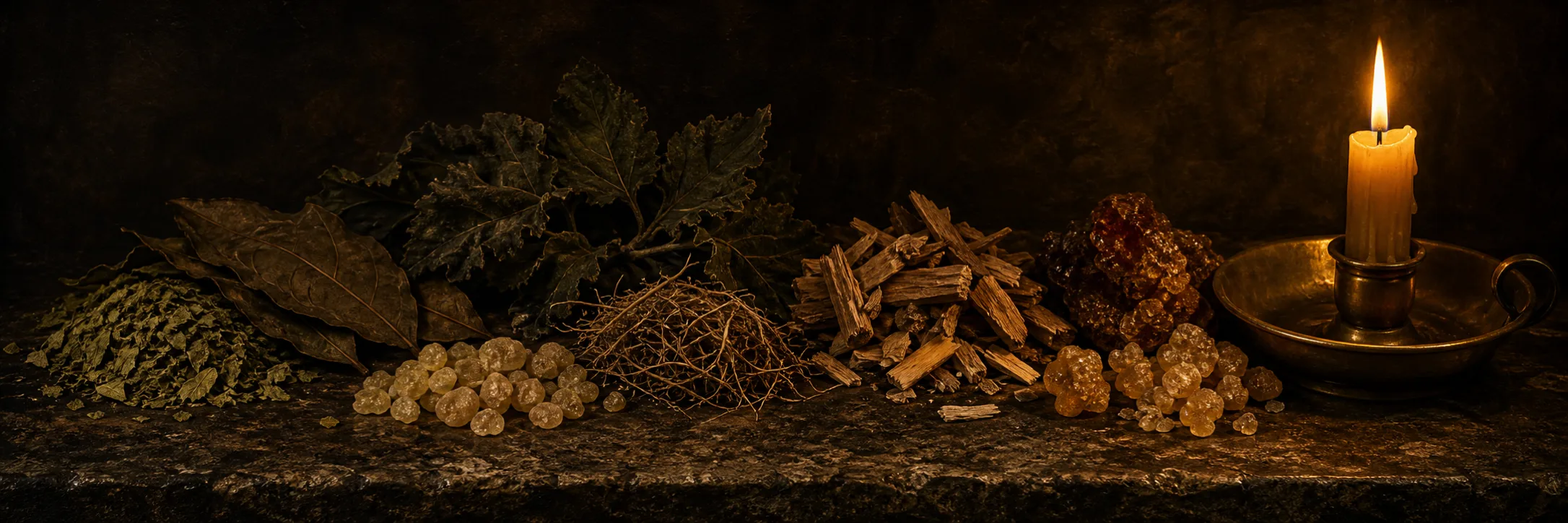
Fleur de Maté is Olivier Cresp’s 2021 contribution to the Atelier Versace collection: a dry, balsamic, slightly smoky woody Eau de Parfum built around a maté absolute that smells less like yerba-mate tea than like sun-baked hay, leather, and ambrox. It is not the bitter green tea fragrance the name advertises; it is a dark, patchouli-and-cistus driven woody amber with a tea-leaf signature embedded in it. Among Atelier Versace’s twelve-bottle lineup it occupies the smoky-leathery slot - Cresp’s most restrained, least show-off composition in a line otherwise tuned for opulence.
Scent Profile
The opening ten to twenty minutes is the most legibly “maté” phase: a dry, herbaceous, faintly bitter green leafiness laid over warm cedar shavings and a curl of resinous smoke. There is no top-note citrus, no aromatic flourish - Cresp drops you directly into a hay-and-tobacco register that reads slightly tea-like, slightly tanned-hide-like. Wearers who know yerba mate consistently say the note is “subdued” or “well blended in” rather than starring; those who do not know it tend to read this phase as fig leaf or unsweetened pipe tobacco. The opening on cloth is more cedar-forward; on warm skin the smoky-hay character dominates. The heart at one to three hours is where the patchouli-cypriol axis takes over and the composition swings darker. Patchouli is dosed heavily - one top-voted wearer captures it verbatim: “Heapfuls of dark, thick patchouli, minimal maté anywhere to be smelled. One might not know that there was any at all, if it weren’t the name that makes one go digging for it.” But it is the modern, cleaned-up, fractioned patchouli of contemporary niche, not the head-shop variety. Cypriol (nagarmotha) adds its characteristic dry, woody-smoky, slightly oudish facet - what gives Fleur de Maté its faint Encre Noire neighborhood. Cistus-labdanum starts to bloom through, contributing a balsamic, leathery, ambery sweetness that softens the rooty bite. Maté is still detectable but now functions more as a textural haze than a discrete note. By the three-hour drydown, the fragrance becomes notably linear and skin-close.
Performance
Projection is moderate at best. The first thirty minutes throw a one-to-two-foot bubble; after the first hour it sits closer to the skin, demanding leaning in. This is intimate-scale projection - “office woody,” not room-filler. Wearer group aggregates rate the scent and longevity favorably and the sillage a notch lower, though the small pool of wearers shows the line is under-tested at the enthusiast level. User reports cluster around six to eight hours on skin; one reviewer reports “10 hours of staying power for this juice.” Realistic skin longevity is six to eight hours from three or four sprays, with the last three hours a near-skin scent.
Wearing Context
This is a cool-weather fragrance: late autumn through early spring, indoors after dark, evening more than morning. It shines at dinner, in low-light rooms, at a winter desk, on a quiet date - contexts where the wearer is within smelling distance of one or two people, not commanding a crowd. It falls flat in heat, in summer offices with air conditioning, and in any social situation where projection is meant to do the talking. Compliment bait it is not; it rewards proximity.
Comparisons & DNA
Jean Paul Gaultier Kokorico (2011, Cresp with Annick Menardo) is the closest sibling. Persolaise flagged the resemblance directly; smelled back to back, Fleur de Maté reads as Kokorico minus the cacao, plus a maté absolute and heavier cistus. Kokorico is discontinued and now commands collector prices, so Fleur de Maté covers roughly seventy percent of that DNA at retail. Both share the fig-leaf, patchouli, cedar, and ambrox architecture from Cresp’s playbook. Lalique Encre Noire (2006, Nathalie Lorson) overlaps in the dark-woody, cypriol-adjacent, vetiver-shaded register.
Reception
Wearer consensus splits along a familiar axis: people who appreciate dry, restrained, adult woody fragrances rate it highly; people who came for a bright maté tea fragrance feel bait-and-switched. The aggregate wearer verdict, from a small pool of wearers, is genuinely favorable on scent - but value for money is consistently its weakest sub-score, which encapsulates the central criticism: it’s nice, but not $300-nice. Reception elsewhere in wearer response is more mixed. One heavily upvoted review pans the broader Atelier Versace lineup as “cookie cutter, well executed but talk about paint by numbers, soulless line up… ya know? an amber one, a fresh one, an oud rose one blaaaahhh!!” - but concedes Fleur de Maté “stands out for use of mate” and is that reviewer’s “favourite of this line.” Common praise: Cresp’s restraint, the unsweetened drydown, the way it stands apart from the dialed-up rest of the collection.
Versions & Reformulation
Single composition, no known reformulations. Fleur de Maté launched in October 2021 as one of six fragrances added to the Atelier Versace collection - alongside Encens Suprême, Gingembre Pétillant, Iris d’Élite, Safran Royal, and Tabac Imperial - supplementing the original six 2019 launches (Cédrat de Diamante, Éclat de Rose, Figue Blanche, Jasmin au Soleil, Santal Boisé, Vanille Rouge). Only one concentration (Eau de Parfum) and one size (100 ml) are produced: no parfum, no extrait, no flanker, no travel size, no rollerball.
Acquisition Notes
The retail tier is luxury-designer-niche, sitting between mainline designer and true niche: the 100 ml lists at roughly 300 to 340 dollars through Versace and luxury department-store retail, and launch coverage cited 345 euros for the collection at debut.
Notable Facts & Lore
- Olivier Cresp’s Atelier Versace involvement is limited to Fleur de Mate; he did not compose the whole line.
- The original 2019 launch leaned heavily on Jordi Fernandez, Marie Salamagne, and Christophe Raynaud, while the 2021 wave added Cresp and additional perfumers.
- House copy frames Fleur de Mate as dark magnetic woods built from mate, Atlas cedarwood, patchouli, and cypriol.
- Its cultural footprint is small: more collector curiosity than mainstream hype piece.