Atelier Versace — Rêve De Myrrhe
Essence
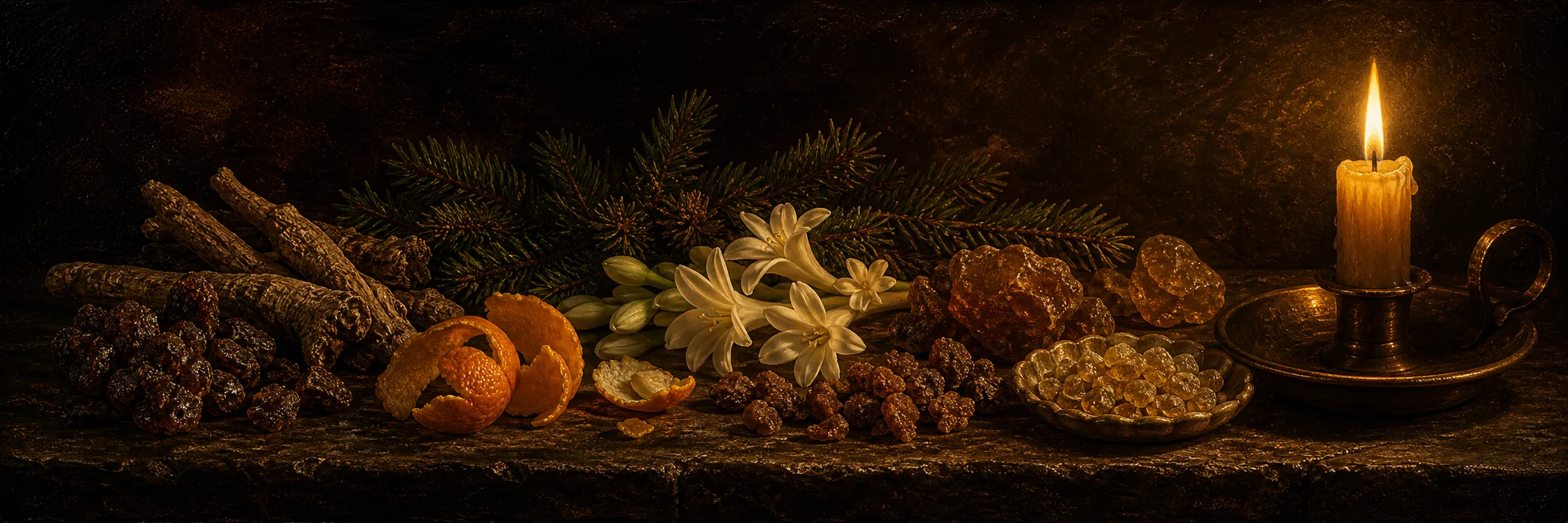
Reve De Myrrhe is a 2024 entry in Versace’s upscale Atelier Versace collection, a floral-resinous fragrance built around myrrh and frankincense by perfumer Gael Montero. Despite a published note list that omits myrrh itself, the resin reads clearly throughout - a smoky-incense church accord wrapped in mandarin, iris, tuberose, and a modern akigalawood woodiness, landing in a soft vanilla-balsam-cistus base. It is an approachable, finessed, unisex incense scent: ceremonial but never harsh, widely judged the standout of the recent Atelier Versace trio - and notably expensive.
Scent Profile
The opening is the high point for most wearers: a fragrant, comforting incense-stick accord - “the deliciously oriental smell of incense sticks sold in stores” - lit by bright mandarin and peppery pink pepper. It is smoky but light, more glowing resin than cold cathedral stone, and several wearers note a genuine, slightly “mushroomy” myrrh facet present from the start despite myrrh’s absence from the official pyramid. The first ten to twenty minutes are pleasant, luminous, and resinous, with frankincense (olibanum) the dominant thread. The heart, from one to three hours, is where opinion forks. Frankincense persists and an iris emerges - dry, slightly cool, powdery - alongside a quiet tuberose that adds a soft floral roundness rather than a big white-floral punch. Akigalawood, a Givaudan captive derived from patchouli with peppery-woody facets, adds “woody modernity”; reviewers are relieved it stays blended and doesn’t “stick out like a sore thumb.” Some find this heart-and-base phase a letdown after the gorgeous opening - “the joy was short-lived,” with the evolution turning toward a sweeter, more generic gourmand-incense reminiscent of Dior Mitzah or Penhaligon’s Clandestine Clara. Others find it elegant and timeless. The drydown, three hours and beyond, goes dry-woody with a milky undertone, then powdery and comforting, settling into vanilla, balsam fir, and cistus labdanum - a soft, resinous, slightly sweet skin scent. The signature accord is glowing frankincense-myrrh incense over powdery iris and vanilla. It is more evolution than linear, with a clear bright-incense opening collapsing into a softer, sweeter resinous base.
Performance
Performance reports are contested. wearer scores put both longevity and sillage in good-but-not-beastly territory, from a small early sample. Several wearers report it “lasts all day without any problems” with “very good” sillage, while others describe a “small/moderate bubble for several hours” - a more intimate, refined diffusion. The consensus middle ground: moderate projection, moderate-to-good sillage, and solid all-day longevity on skin, with the opening the most diffusive phase. Given the resin-and-incense profile it should favor cooler weather and perform more quietly in heat. As a fresh 2024 release the data set is small, so treat performance impressions as preliminary.
Wearing Context
Reve De Myrrhe is best in autumn and winter, and versatile across day-to-evening thanks to its light, comforting incense character - it is an “incense for people who find incense intimidating.” It suits both relaxed and dressier settings, and its refined, unisex, “delicate, elegant, timeless, warm” profile makes it easy to wear to work or social occasions where a full-on smoky oud would be too much. It shines as a cozy, ceremonial-but-friendly scent.
Comparisons & DNA
The most direct comparison among wearer response is Tom Ford Myrrhe Mystere - also composed at Givaudan - which Reve De Myrrhe is repeatedly said to improve upon: “this is what Myrrhe Mystere should’ve been,” lacking the “abrasive synthetic peppery woods” at the Tom Ford’s base (a base also criticized in Ebene Fume and Black Lacquer). Reviewers also liken its sweeter incense turn to Dior Mitzah and Penhaligon’s Clandestine Clara. In the broader incense canon it sits in conversation with classic frankincense scents like Tom Ford Sahara Noir and Comme des Garcons Avignon, but Reve De Myrrhe is far lighter, sweeter, and more floral-powdery than those austere church-incense references.
Reception
For a young release, sentiment skews positive: early wearer scoring are strong, and comments are largely enthusiastic, with multiple wearers calling it “the best myrrh fragrance I’ve ever smelt” and “pure myrrh at its finest.” Several name it their favorite of the Atelier Versace line for its finesse, restraint, and natural feel relative to the line’s more synthetic entries. The dominant criticisms are two. First, price - one wearer: “The negative point is simply the pricing of Versace; in my opinion, the price is just excessive,” and another: “It is ok but for the price you expect more.” Second, a sense that after a stellar opening it becomes flatter or more generic - “quite flat,” with “the evolution after 20 minutes” disappointing some wearers. A recurring point of confusion and charm is that myrrh isn’t on the official note list yet reads clearly - wearers keep asking why.
Versions & Reformulation
Single composition, no known reformulations - it launched in 2024 in a single 100 ml Eau de Parfum. It is part of the limited-edition Atelier Versace line and sits alongside its 2024 siblings Ambre Nectar and Patchouli Precieux.
Acquisition Notes
This is luxury pricing, well above Versace’s mainstream designer offerings: it launched at $339 for the 100 ml and the brand’s US site now lists it at $330. It comes in a single 100 ml Eau de Parfum size, in the sculptural twisted-glass Atelier bottle with gold script, sold through Versace boutiques and high-end department stores.
Notable Facts & Lore
- Gael Montero is credited for the composition, and house copy frames his intent around myrrh with akigalawood for modern woody depth.
- The odd lore point is that myrrh can be omitted from retailer note pyramids even though it is the title material and the dominant impression.
- Its reputation has grown through wearer word-of-mouth as one of the Atelier line’s sleeper standouts.