Clive Christian — C for Men
Essence
C for Men is Clive Christian’s entry into the contemporary luxury-leather genre - a dense, smoky, saffron-and-leather oriental-woody from the house’s “C” pair (a his/hers duo in the Private Collection / “Prive” line), composed by Christian Provenzano. Released 2010 and now discontinued in its original form, it is the fragrance most often discussed as Clive Christian’s answer to Tom Ford Tuscan Leather - and the comparison is the single most important fact in its reception.
Scent Profile
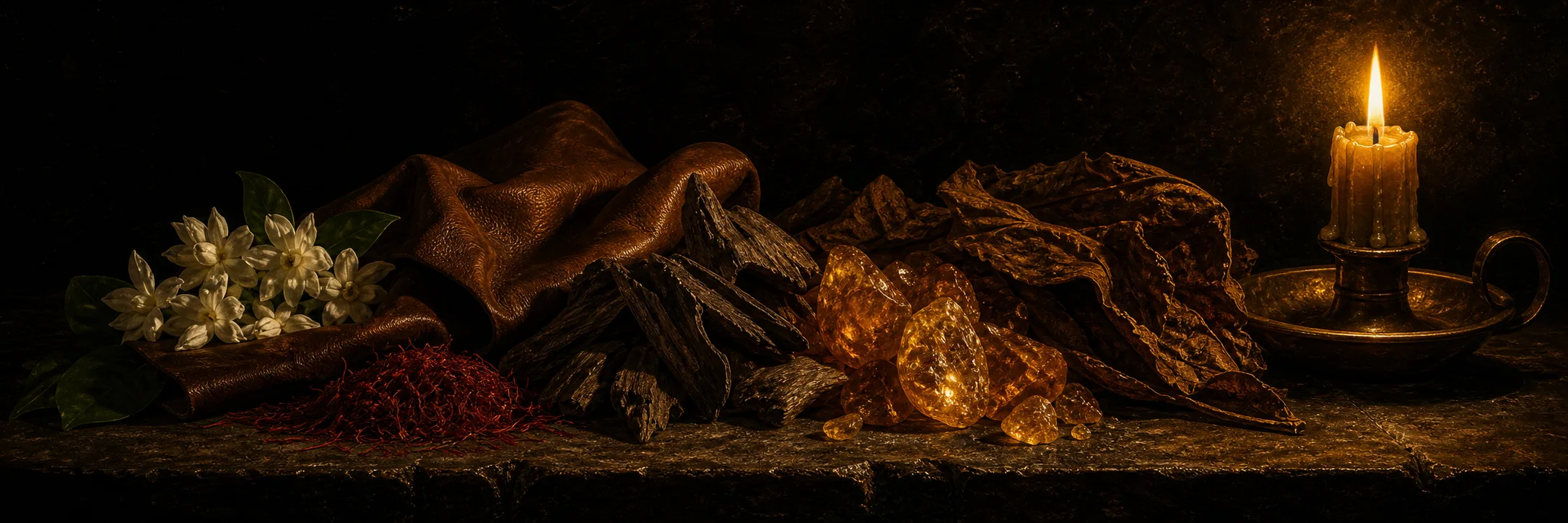
The opening is spicy and resinous: saffron (the signature top note), elemi, thyme and mandarin, with several reviewers also reading “wet tobacco” and citrus peel immediately. Within minutes a rubbery, slightly petrol-like leather-and-oud tandem rises and takes command, with jasmine and a faint rose as background support - one detailed reviewer describes “a transient hint of rose and jasmine before a rubbery petrol-like oud and leather base note. Dominates from the early heart onward. The signature accord is smoky leather wrapped around oud, tobacco and a “dry red fruit”/raspberry facet that is the chief point of overlap with Tuscan Leather. The base is the most-praised stretch: smoky tobacco (described as bitter with a lingering fruity sweetness, not the usual dry/dusty tobacco), guaiac/cedar woods, tonka, amber, vanilla, frankincense, styrax and a patchouli-like mossiness. Most reviewers find it effectively linear despite the long pyramid - “all I get is jasmine, leather and oud” - though a vocal minority experience it as a complex, ever-shifting “chameleon” drydown. The house states the inspiration is Clive Christian’s birthplace, Scotland, evoking a cold late-autumn outdoor scene.
Performance
Performance is a consistent strong point and frequently cited as a buying justification. Projection is reported as average-to-strong and longevity as excellent - summary calls projection and longevity “above-average,” and user reports range from a typical ~7 hours up to claims of “16 hours or more” and even hyperbolic “lasts 3 days. Several reviewers call it among the longest-lasting fragrances in their collections with “beast mode” sillage, attributing the tenacity partly to its parfum/extrait concentration. It is positioned as a cold-weather, fall/winter, evening and special-occasion scent; reviewers consider it too heavy and serious for hot weather or casual daytime use, and note a few sprays are plenty.
Wearing Context
Fall and winter, evening, cooler weather, formal-leaning and special occasions. Repeatedly characterized as a “mature” fragrance aimed at 30s-and-older wearers, the “laid-back, solemnly appointed man,” and not a beginner or blind-buy scent. Several note it leans formal but is “fairly easy to wear” for the genre. Not versatile across seasons - a deliberate cold-weather statement piece.
Comparisons & DNA
The defining comparison is Tom Ford Tuscan Leather. Opinions split three ways: (1) near-identical - one account describes a department-store test where a Tom Ford SA could not tell blind strips of “C” and Tuscan Leather apart; (2) same genre but “C” is deeper, smoother, more refined, warmer and more complex due to the spices and resins (“Tuscan Leather trained in the woods for 9 months and came back”); (3) not that close at all, with a notably different drydown. Other named comparisons: Louis Vuitton Ombre Nomade/Ombre Leather (a “less polished Ombre Leather - I’d pass this for that and save money,” per a dissenter), Acqua di Parma Colonia Leather, Montale Aoud Leather (dismissed by one reviewer as a false equivalence), Rasasi La Yuqawam (cited as a budget stand-in), and classic leathers Knize Ten and Cuir de Russie. DNA: contemporary smoky-fruity-saffron leather in the Tuscan Leather mold, elevated with oud, tobacco and resins.
Reception
On, and it is well-regarded by leather enthusiasts and Clive Christian fans, frequently landing in their top-three-to-five from the house and praised as “smoky leather with raspberry, saffron. Tuscan Leather vibes but deeper, smoother, more refined. The dominant criticisms are: (1) price - described repeatedly as “scandalous,” “exorbitant,” “great but obviously unworthy its price”; (2) for some, a lack of true complexity/identity behind the long note list - “damn near impossible to pick out any individual notes. Boring and missing identity”; (3) the Tuscan Leather similarity raising value questions. A notable dissent exists too - one buyer found it “loud and proud with amber/leather.
Versions & Reformulation
This is the area requiring care. The original 2010 “C for Men” was reformulated and effectively relaunched in 2017 as “C Woody Leather with Oudh Intense” (still by Christian Provenzano), which lists as a separate fragrance with a pared-down published pyramid (oud, mandarin / tobacco, saffron / leather, woody, oriental notes) and which the brand markets as a “wholly reimagined release” of ~208 ingredients. Wearers testimony is blunt: the original “has completely been reformulated. Smells nothing like the original,” prompting the separate page; reviewers note a bottle/cosmetic change around 2017 accompanied the reformulation.
Acquisition Notes
A luxury-priced parfum. Per WWD coverage cited in 2010 launch news, the original C for Men debuted at Fortnum & Mason on 19 July 2010 in 50ml at roughly $375 (a single user later recalled $405); the current C Woody Leather / Oudh Intense has been seen at roughly £600 retail (with discounters and Jomashop/Walmart-type listings far lower, ~$250 for 100ml). Clive Christian positions itself at the apex of British luxury (founder holds an OBE; the house touts the “world’s most expensive perfume” Imperial Majesty Guinness record and 20%+ oil concentrations). Channels: the original is now largely eBay/secondary; Amazon and department stores (Neiman Marcus) historically carried it before moving to the Oudh Intense version.
Notable Facts & Lore
- “C” launched as a male/female pair in the Prive/Private Collection, debuting at Fortnum & Mason in the UK on 19 July 2010 and reaching the US 1 August 2010, in amber-hued bottles, with the pair designed to develop over 24 hours.
- Per the house, the inspiration is Clive Christian’s Scottish birthplace and a cold, pre-snow late-autumn scene.
- The recurring cultural hook in wearer response is the Tuscan Leather “twin” debate, including the half-joking observation that, with Tuscan Leather rumored to smell like cocaine and “C” smelling like Tuscan Leather, naming it “C” was a wink.
- No celebrity endorsement lore is documented for this specific release.