Clive Christian — No. 1 for Men
Essence
Clive Christian No. 1 for Men (2001) is the masculine half of the launch pair that re-introduced the resurrected Crown Perfumery as “Clive Christian Perfume,” and it is inseparable from its marketing identity: the perfume Guinness World Records certified as the world’s most expensive.
Scent Profile
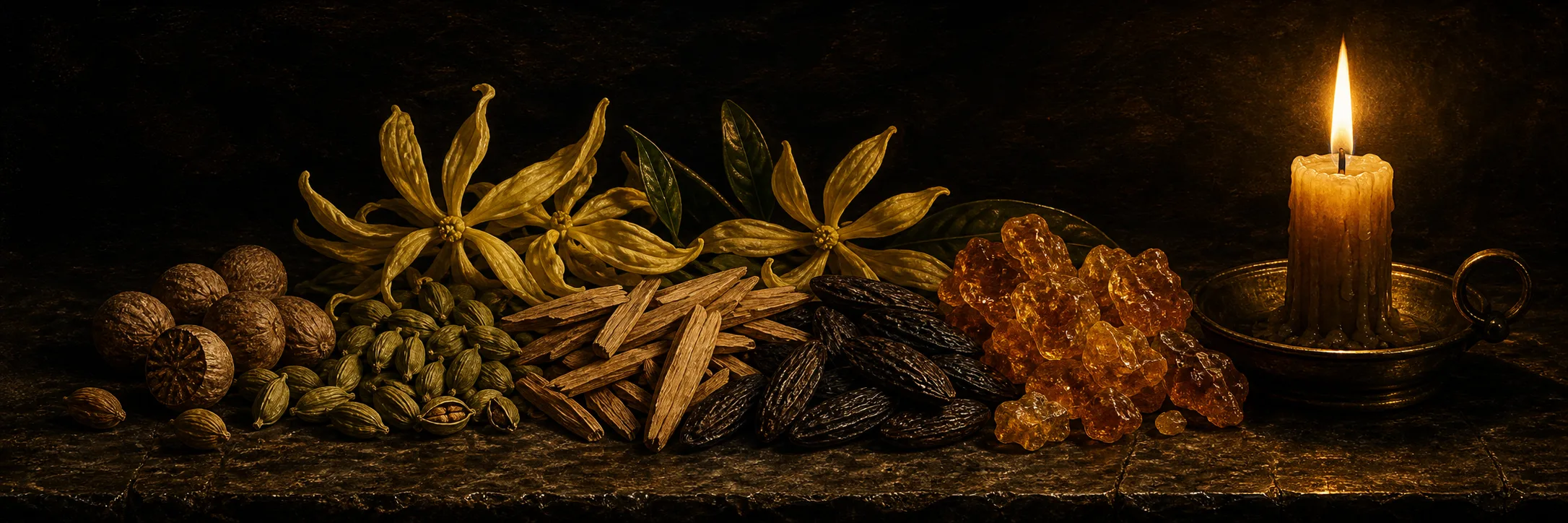
The opening is a fruit-and-spice basket in concentrated form: lime, mandarin, grapefruit and a sweet, sharp citrus burst, mingled with nutmeg, cardamom, caraway, paprika/pimento and artemisia. This sets a sweet-oriental texture rather than a fresh one. The heart is the signature: a baroque golden floral bouquet - ylang-ylang (often read as banana-honeyed and dominant), jasmine and indoles, with rose well in the background, plus heliotrope and iris/orris providing a powdery, almost makeup-like, soapy lift. Many wearers describe the overall heart impression as “an expensive bar of floral-powdery soap. The base is creamy and warm: 50-year-aged Mysore-style sandalwood, amber, tonka, vanilla, musk, Virginia cedar and vetiver, sweet to the edge of cloying but stopping short. The pure parfum is denser and more resinous; the EDP reads more citrus-forward up top and more powdery in the base. The arc: sparkling citrus-spice → soapy golden florals → creamy sweet woods.
Performance
This is where the concentration shows. The pure parfum is essentially all oil - reviewers describe it lasting “until you bleach it off a shirt collar,” with wear times that easily run a full day and a sillage that can be “suffocating. Projection, paradoxically, is restrained for the parfum (density throttles diffusion), so those wanting a bigger cloud are pointed to the EDP. Eddie Bulliqi’s feature (“Clive Christian No.
Wearing Context
Best deployed as an evening or cool-weather statement scent - its sweetness and richness become heavy in heat, and Clive Christian themselves offer fresher options for that. It is formal, “regal,” and self-consciously luxurious; wearers describe reaching for it “when I want to feel powerful and royal. Crucially, it reads feminine-to-unisex to a large share of men: detractors call it “floral baby powder,” a “soap,” or “smells like grandma and grandpa at once,” while admirers find it a refined, mature, old-world perfume. Not a casual daytime or office-blend scent - it announces itself.
Comparisons & DNA
The most repeated and useful DNA pin is Amouage Gold Man (1983) - the same opulent, soapy, golden floral-oriental Middle Eastern register; one reviewer memorably describes No. 1 as “Gold Man with the poop removed and the frankincense toned down to make room for more citrus and florals. Other touchpoints: vintage aldehydic-chypre grandeur in the lineage of Chanel No. 5 parfum, Patou Joy and Jean Desprez Versailles pour Homme; and Patou pour Homme for the floral-masculine ambition. It is repeatedly contrasted with the (drier, mossier) Diaghilev style and positioned closer to “vintage Amouage.
Reception
Reception is genuinely bifurcated and inseparable from price. Critically, the established major critic authorities are silent: Turin and Sanchez never reviewed any Clive Christian fragrance in Perfumes: The Guide (2008), the A-Z Guide (2009), or Perfumes: The Guide 2018 - the brand was explicitly named among houses omitted from the 2018 edition. 5 stars“ figure that circulates online is a amateur rating, not a Turin/Sanchez score - a common confusion.) Among enthusiasts the scent is admired as a well-blended, high-concentration “smells like a rich person” floral-oriental, but the marketing and price draw open contempt: recurring lines include “the world’s most expensive soap,,” “an expensive piece of garbage,” and praise for the smell paired with fury at the $800+ price for the EDP. Own feature captures the ambivalence: technically accomplished, value-questionable, polarizing.
Versions & Reformulation
The line splits primarily into the Eau de Parfum (gold spray bottles) and the Pure Parfum (Baccarat crystal flacon with diamond-set cap), the latter positioned as the ultimate expression. Numerous limited/anniversary editions exist, including coronation/Imperial editions; the formula has also been affected over two decades by IFRA restrictions and the brand’s ownership changes, which Crown/Clive fans cite when complaining about quality drift. Ownership chronology: Clive Christian OBE acquired the Crown Perfumery (founded 1872, granted Queen Victoria’s crown emblem) in 1999, launched the Original Collection (1872, X, No. 1) starting in 1999-2001; a consortium including Stagecoach founders Brian Souter and Ann Gloag and venture capitalist Jon Moulton took a majority stake in 2015; and in July 2019 the business was acquired by Nichebox.
Acquisition Notes
Full retail is steep - the EDP commonly lands in the high-hundreds per bottle, and the pure-parfum/limited editions run dramatically higher. Smart-money strategy in wearer response is to (a) sample first, because a large share of men find it reads feminine and many find the value indefensible, and (b) buy heavily discounted: grey-market and discounter sites (Beautinow, etc.) Routinely cut the price substantially, making it far more palatable than boutique pricing. Decant/sample is strongly advised before any full bottle.
Notable Facts & Lore
- The world’s-most-expensive lore is real and well-documented.
- Per Guinness World Records, “the most expensive perfume commercially available is the Clive Christian No.
- 1 for Men or No.
- 1 for Women - 30 ml (1 fl oz) of which typically costs £1,317 (then $2,355)“ (Wikipedia and Forbes give “$2,150 an ounce” as of 2006).
- In November 2005 the house created No.