D.S. & Durga — Jazmín Yucatan
Essence
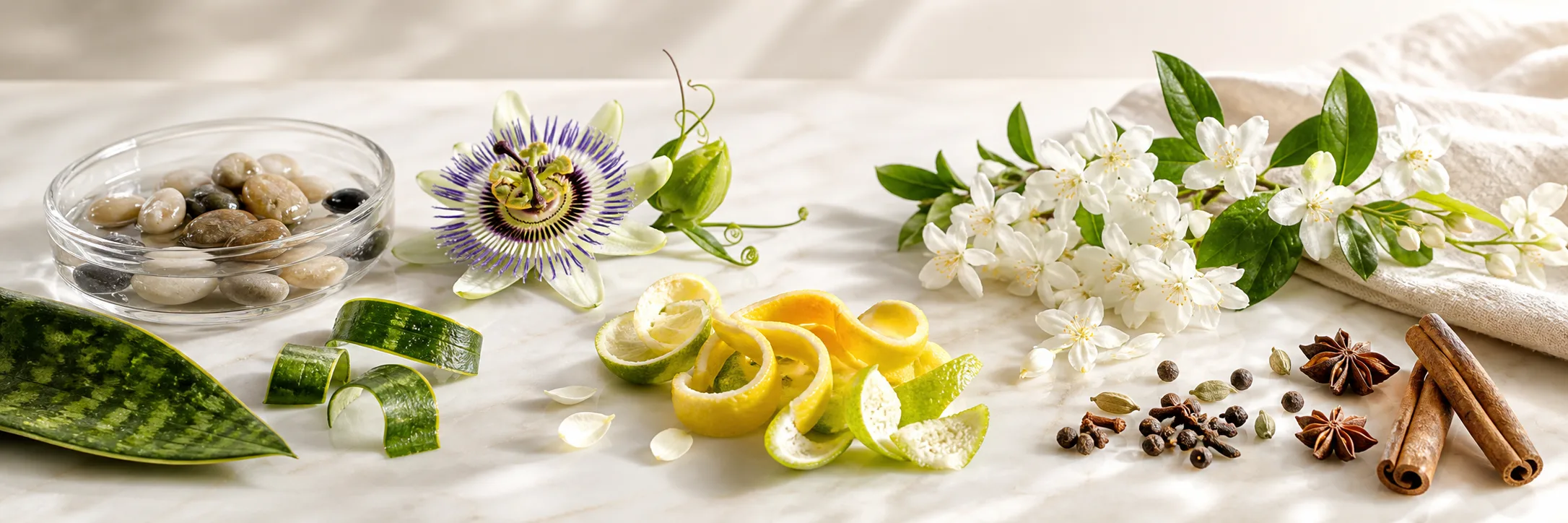
Jazmín Yucatan is one of David Seth Moltz’s place-based “armchair travel” scents, and the place is specific: the jungle interior of Mexico’s Yucatan Peninsula, with its cenotes and limestone Mayan ruins. Created when fashion brand Opening Ceremony commissioned a fragrance for its Year of Mexico project, it sets out to make humidity wearable. The result is a slightly indolic jasmine suspended in wet, green tropical air over earthy vetiver and resinous copal incense. What sets it apart from most jasmines is that it deliberately refuses to be a heady white-floral bomb, reading instead through water, green sap, and a faintly fruity lift.
Scent Profile
The opening is both the signature and the sticking point: a watery, chewy passionflower note that many experience as a loud, grape-like, almost felt-tip-marker or hairspray accord. It can spoil the first few minutes for the grape-averse and delight everyone else. From there it opens into a rounded, aquatic jasmine, big without overwhelming, clean and fresh with a thread of jungle earthiness. This is a realistic, indole-laden jasmine, the smell of the real flower, but tamed and humidified rather than sultry. The water notes do real work, conjuring a wet, cement-after-warm-rain, faintly chlorinated greenness that reads as genuine humidity. The base is where the construction pays off. Snake plant and vetiver give a green, rooty, earthy floor, and copal adds a soft, perfumed-wood incense resin that ties the sweeter notes together without ever turning loud. Clove is listed in the heart but goes unnoticed by many. Readings split sharply: some get a tropical jungle paradise, while others get fresh rubber, an artificial zoo-enclosure quality, or even tuberose.
Performance
Performance reports are unusually contradictory. The critic Mark Behnke cites 12 to 14 hours of longevity with average sillage, while a meaningful set of wearers report the opposite, around two to three hours with very intimate sillage. As an aquatic-floral construction it is strongly chemistry-sensitive: many get radiant projection for hours, others find it goes quiet fast. One useful note is that the juice seems to improve with maceration, becoming muskier and more complex after a bottle has rested open for a couple of months, so a fresh sample that underwhelms may not be the final word.
Wearing Context
This is built for heat, a spring and summer, warm-climate fragrance meant to radiate lightly in the sun. It wears daytime, casual, and evocative rather than formal or seductive, and its green-humid, aquatic character feels outdoorsy and atmospheric. It is fully unisex, though the prettiness of the jasmine can lean feminine. A few wearers enjoy it in deep winter as a transporting escape, which speaks to its mood-fragrance appeal. It is not an office-safe neutral; the grape opening and big jasmine make it a statement.
Comparisons & DNA
Within its own house, Jazmín Yucatan is the gentle opposite of D.S. & Durga’s piercing, animalic Crystal Pistil, and milder and sweeter than the dense tuberose of Durga. Against the wider canon, the key reference is Serge Lutens A La Nuit, the benchmark indolic jasmine soliflore, but the two are inverses in spirit: where A La Nuit is a sultry death-by-jasmine flower study, this is humidified, aquatic, and fruit-lifted. For the aquatic, faintly chlorinated, fantastical greenness, Zoologist Seahorse is the closest adjacent recommendation. The overall verdict is a green-aquatic tropical jasmine rather than a classic indolic soliflore.
Reception
Reception is warm among the niche-literate but qualified. The critic verdicts run affectionate: Colognoisseur tied it to a personal cenote memory and called it a beautifully realized jasmine of the tropical jungle, distinct enough to be worth checking out; Cafleurebon praised the photorealistic jasmine and asked, rhetorically, whether it smells like Mexico; The Scented Hound settled on a measured “Groundbreaking, no. Lovely, yes.” Among enthusiasts it is frequently named a favorite from the house, and even credited as the fragrance that won over jasmine skeptics. Dissent centers on three things: the divisive grape opening, the performance lottery, and a subset who get rubber, plastic, or artificial-zoo facets instead of jungle romance.
Versions & Reformulation
Released in 2020 as a 50 ml EDP tied to the Opening Ceremony Year of Mexico collaboration, it has remained in production with no documented reformulation. The one practical wrinkle is maceration: at least one wearer found the juice noticeably better, muskier and more complex, after the bottle had been open and resting for a couple of months, worth knowing if a fresh sample underwhelms.
Acquisition Notes
Sample first, specifically to test two things: whether your nose loves or hates the grape-passionflower opening, and how the performance behaves on your skin. If both land well, it is a distinctive, high-quality tropical jasmine with little direct competition. Pricing sits in line with the rest of the house, around $175 for 50 ml from the brand and authorized retailers, with some stockists listing it higher. Given the performance variability, a travel or decant size is a smart entry point.
Notable Facts & Lore
- It was commissioned by fashion brand Opening Ceremony for its Year of Mexico project.
- Moltz’s brief invokes “jungle, humidity, snake plants, jazmín yucateco, crocodile by the cenote, shaded temple, limestone ruins.”
- The conceptual hero is jazmín yucateco, the indigenous Yucatan jasmine, paired with snake plant and copal.
- Copal is a resin burned in Indigenous Mesoamerican ceremonies for centuries, giving the scent real ethnobotanical specificity.
- Critics repeatedly cite its wet-limestone, cement-after-rain humidity as proof Moltz captured the actual place.