Frederic Malle — Iris Poudre
Essence
Iris Poudre is Pierre Bourdon’s 2000 contemporary tribute to the great aldehydic florals of the early twentieth century-the Chanel No. 5, Caron Fleurs de Rocaille, Lanvin Arpege lineage-translated into a cleaner, cooler, more synthetic-inflected modern register. One of the inaugural Editions de Parfums Frederic Malle releases, it pairs a shimmering aldehyde top with an ylang-carnation-rosewood floral chorus over a quiet, slightly cosmetic iris/violet heart and a tonka-sandalwood-musk base.
Scent Profile
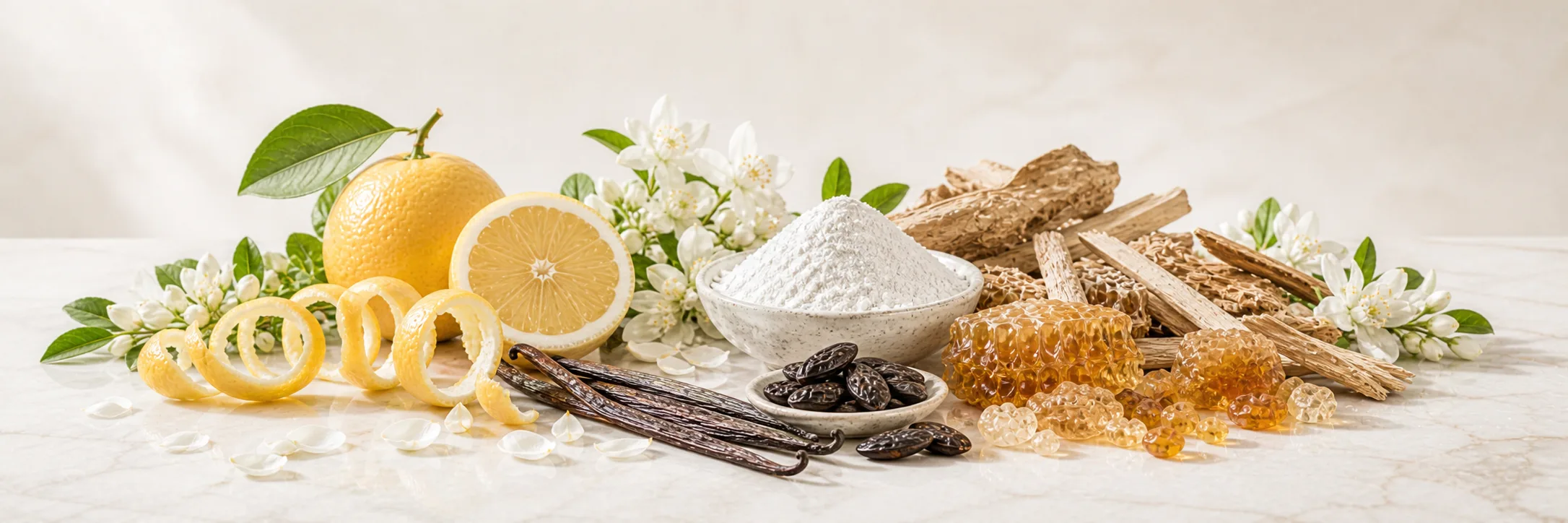
The opening is, in classical fashion, an aldehyde halo: fizzy, soapy, slightly fatty, with the lift-off shimmer that is the genre’s signature. For the first ten to twenty minutes the perfume sparkles outward-bergamot and orange give a brief citrus edge, but the more striking element is a peppery, spicy carnation that snaps through the aldehydic cloud. Ylang-ylang adds a buttery, faintly banana-skin floral warmth. The rosewood is a textural support rather than a perceptible note, lending a pencil-shaving woody dryness to the otherwise creamy florals. This is not the angular, rooty, cold-earth iris school of Iris Silver Mist (Serge Lutens); it is iris as an effect rather than as a centrepiece. From about forty-five minutes to two and a half hours the composition settles into its true register: a powdered-violet, soft-rose, magnolia heart with iris functioning as connective tissue.
Performance
Projection is moderate, with a notable initial lift-off in the first thirty minutes thanks to the aldehydes, then settling to close-skin within the first hour. Sillage is restrained: Iris Poudre is famously polite, an intimate-radius perfume rather than a sillage monster. Longevity on skin is six to nine hours depending on chemistry; on clothing it can last well into the next day, with the powder-musk-tonka tail clinging beautifully to wool and silk. Several wearers note that the perfume reads more strongly on fabric than on skin.
Wearing Context
Spring and autumn are the natural seasons, with comfortable extension into mild winter days when one wants the warm-cool paradox of an aldehydic floral. High summer humidity can flatten the iris; deep winter cold mutes the aldehyde sparkle. Both day and evening work-it is dignified enough for daytime office wear and elegant enough for the opera. Where it shines: weddings, gallery openings, business in a traditional industry, weather-transition days, and as a long-term signature for someone who does not want their fragrance to announce itself.
Comparisons & DNA
The lineage is explicit. Iris Poudre is in direct conversation with the Chanel No. 5 (Chanel) family-close in skeletal structure but cooler, drier, less hot-floral, and with a more prominent powder. Compared with Caron Fleurs de Rocaille (Caron) it is cleaner, more synthetic, less honeyed.
Reception
Consensus is admiring rather than passionate: Iris Poudre is more respected than worshipped. Wearers regularly cite it as one of the line’s standout achievements and treat it as a grown-up recommendation, the kind suggested to people who have aged out of fruity florals. Praise concentrates on the quality of materials, the restraint of the powder, the elegance of the aldehydic opening, and the way the perfume uses the wearer’s chemistry to feel personal. Criticism clusters on three axes: it can read as soapy or like fabric softener to younger noses; some find it too retro or grandma; and the projection-to-longevity ratio frustrates anyone who associates Malle pricing with monster performance, which is the central value tension. Luca Turin gave it a measured three-star verdict, while Persolaise has placed it among the true gems of Bourdon’s catalogue.
Versions & Reformulation
Single composition, with one concentration (Eau de Parfum). The fragrance has been kept in continuous production since 2000 under the same brief; the Estee Lauder acquisition of Editions de Parfums Frederic Malle in 2014 did not trigger documented reformulation of Iris Poudre. Long-term wearers occasionally comment that the carnation reads slightly less spicy in current batches than in early ones, possibly reflecting IFRA restrictions on isoeugenol used in clove/carnation accords, but no formal reformulation has been announced and side-by-side blind testing has not yielded consistent results. Bottles from launch through to the current cylindrical glass flacons share the same juice colour and arc of evolution.
Acquisition Notes
Price bracket: niche-luxury. 2026 retail is approximately $260 for 50 ml, $390 for 100 ml from Frederic Malle boutiques and fredericmalle.com, with 10 ml refill cartridges around $90.
Notable Facts & Lore
- Iris Poudre was part of the original 2000 launch lineup of Editions de Parfums Frederic Malle, the founding shelf that introduced the perfumer-as-author model with names on the labels.
- Pierre Bourdon, the composer, had earlier been the perfumer behind blockbusters like Davidoff Cool Water and Yves Saint Laurent Kouros.
- Its inspiration was concretolide, a legendary French iris base used in many inter-war perfumes that Bourdon set out to revisit with modern materials.
- Malle tied the imagined wearer to Catherine Deneuve and the Belle de Jour archetype of the patrician blonde with secret yearnings.
- Deneuve named Iris Poudre in the foreword to Malle’s book On Perfume Making as the scent that converted her from lifelong Guerlain loyalty.