Frederic Malle — L'Eau d'Hiver
Essence
L’Eau d’Hiver is Jean-Claude Ellena’s 2003 transparent reimagining of Guerlain’s Apres L’Ondee, conceived as the first “eau chaude” - a paradoxical warm-water cologne that crosses the airy structure of an eau de cologne with the soft, almondy melancholy of heliotrope, iris and honey. It is short on notes and rich on atmosphere: a snowy, almost watercolour rendering of a winter morning that smells simultaneously cold and comforting. Inside the Malle catalogue it is the quiet minimalist masterpiece, beloved by the connoisseur fringe and routinely passed over by buyers who want louder Malles.
Scent Profile
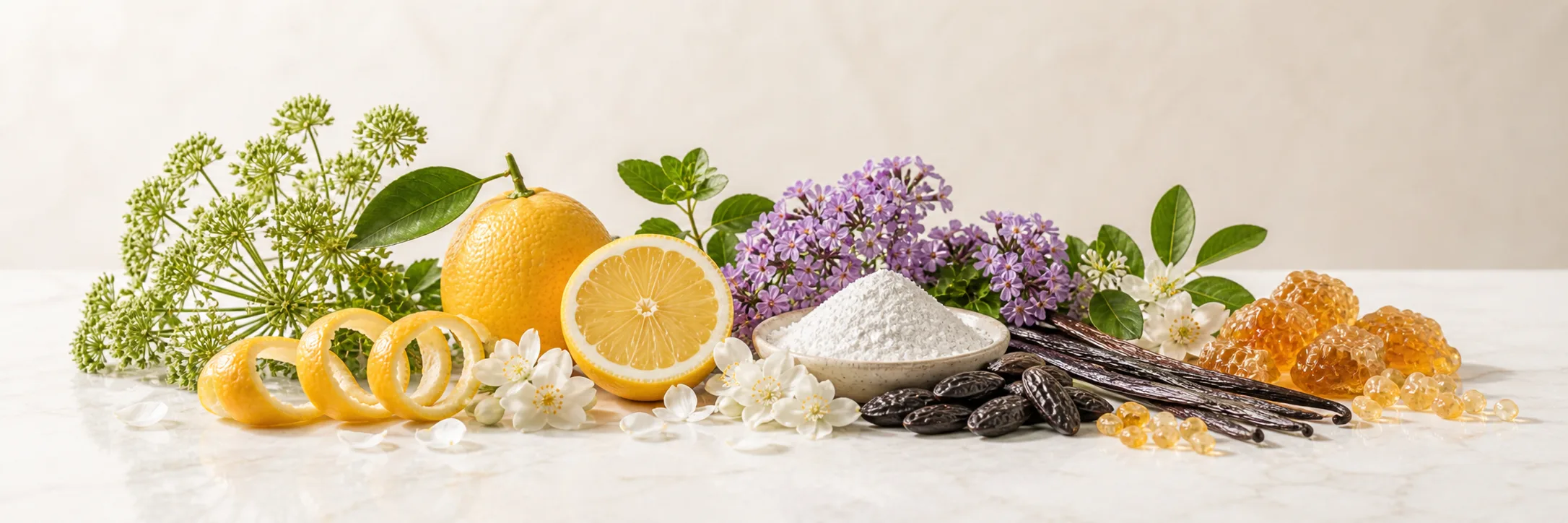
The opening, lasting roughly ten to twenty minutes, is one of perfumery’s most singular: a cool, slightly green bergamot lifted by angelica and hedione, threaded through with the first whispers of heliotrope’s sweet almond facet. There is a soft anisic edge-heliotropine reads as a marzipan-adjacent dust-and a quality Mark Behnke at Colognoisseur described as an “almost too powdery” interplay between iris and heliotrope sitting “balanced on the edge between powdery and metallic,” which he summed up as “a watery spring amidst the snow,” where the warm and cold registers intersect. The honey is detectable but never gourmand; it functions as a fixative shimmer rather than as a sticky sweet centre. From about thirty minutes to two and a half hours the heart settles. Heliotrope and iris occupy the centre, supported by a barely-there hawthorn (almond-floral, slightly aldehydic), and a very fine line of honey behaves like a thin glaze over the whole composition. The signature accord is the heliotrope-iris-white-musk triangle-almond pastry dust suspended in cool air.
Performance
Projection is light. L’Eau d’Hiver is a near-skin fragrance by design, and the only phase with detectable carrying power is the first twenty minutes. Sillage is intimate-you and the person leaning in to greet you. Longevity on skin is the perfume’s most contested attribute: some wearers get four hours, others ten; chemistry matters more here than with most Malles.
Wearing Context
Winter, late autumn and early spring are the prime seasons; cold mornings, snowfall, fog, museum afternoons, libraries, and any context where one wants to smell less like a fragrance and more like an atmosphere. It also works surprisingly well in summer, where its iciness reads as relief rather than as theme. Daytime and quiet evenings are ideal; loud nights are wrong. Where it shines: introspective, intimate, intellectual contexts-close reading, one-on-one conversation, quiet dinners, travel.
Comparisons & DNA
The direct ancestor is Guerlain Apres L’Ondee (Guerlain) - Ellena has been explicit about the homage. L’Eau d’Hiver is cleaner, drier, less honeyed-heavy, and far more transparent than Apres L’Ondee; the older perfume has more violet, more anise, and more carnation, where Ellena strips back to iris, heliotrope and air. Within Ellena’s own catalogue it sits closest to Hermes Hiris (Hermes) - also a quiet iris, but warmer and earthier-and is the direct conceptual seed of the Hermes “Jardin” cycle Ellena composed once he became Hermes in-house perfumer the year after L’Eau d’Hiver launched. The Different Company Bois d’Iris (The Different Company), another Ellena, is a sterner, woodier cousin.
Reception
Consensus is reverent, with a built-in caveat about performance. Among connoisseurs L’Eau d’Hiver is a routine top-five Malle pick; among casual buyers it can disappoint because of how quietly it wears. Long-form reviews repeatedly describe it as a modern masterpiece or the perfume that taught the reviewer to like iris, and it is a textbook recommendation for a sophisticated winter skin scent and a frequent answer to which Malle is most underrated. Wearers consistently praise the realism of the snowy effect, the warm-cold paradox, the elegance, the comfort, and the way it grows on people over months. The recurring criticisms are that it is short on skin and expensive for what reads as low projection, with a small contingent simply disliking its watery powder. Luca Turin gave it four stars, one of his higher Malle ratings, and Mark Behnke at Colognoisseur named it a Modern Masterpiece, while Kafkaesque praised the opening but criticized its short wear.
Versions & Reformulation
Single composition, no widely documented reformulations. L’Eau d’Hiver has been kept stable under the Editions de Parfums Frederic Malle line through the 2014 Estee Lauder Companies acquisition. Long-term wearers occasionally note subtle differences between very early bottles and current production-a slightly fuller honey impression in vintage versus a marginally cleaner musk now-but these have not coalesced into a consensus reformulation complaint. There is one concentration only (Eau de Parfum), no parfum, no flankers; the brand has resisted the urge to spin off a “L’Eau d’Ete” or similar.
Acquisition Notes
Price bracket: niche-luxury. 2026 retail at the Malle boutique runs approximately $260 for 50 ml, $390 for 100 ml, and around $90 for a 10 ml refill cartridge for the brand’s metal travel atomiser.
Notable Facts & Lore
- Malle asked Ellena to attempt the first eau chaude - a cologne that is structurally an eau de Cologne but emotionally warm rather than cold - and called the result one of the line’s purest exercises in transparency.
- Its acknowledged conceptual ancestor is Guerlain’s Apres L’Ondee, whose anisaldehyde-heliotropine-orris triangle Ellena transposed into an airier, hedione-rich modern context.
- The brand frames the perfume as a watercolour rather than an oil painting.
- It launched in 2003, one year before Ellena became in-house perfumer at Hermes, and is read by some as his last major freelance work before that appointment.
- It is anti-viral by structure - more cited than worn - and its standing has grown over twenty years as noisier perfumery around it aged less well.