Louis Vuitton — Ambre Levant
Essence
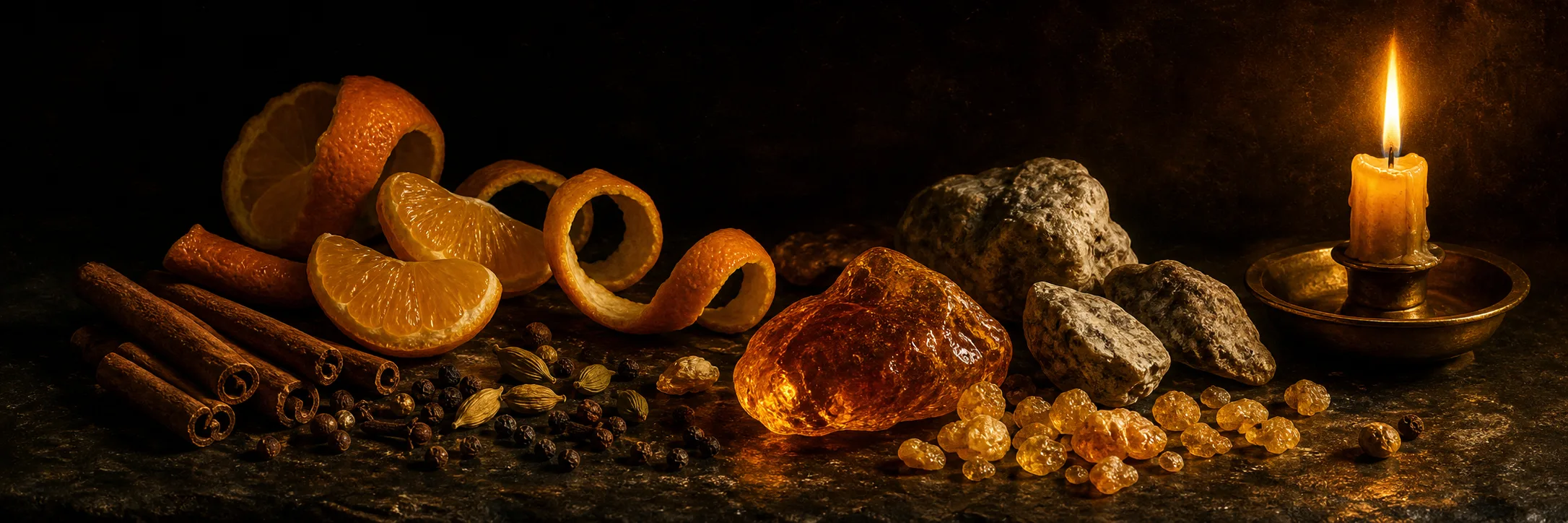
Ambre Levant is not a plush vanilla amber in the Grand Soir mold; it is a dark, spicy, resinous oud-amber with a surprisingly bright mandarin-cinnamon spark on top and an animalic undertow underneath. What makes it distinctive is the contradiction between the name and the wear: the idea suggests a smooth amber glow, but the perfume itself opens more like a smoky, slightly feral oriental that only later rounds into something velvety and golden.
Scent Profile
The opening is the section everyone talks about, because it is where Ambre Levant either wins you or loses you. A published review on the fragrance describes an unashamedly animalic top, explicitly invoking civet-like funk; wearer statements echo that with references to funky oud, cheese, barnyard facets, or a sharp animalic edge. That dark opening is not flat or muddy, though. Mandarin cuts through it with an acidic brightness, and the cinnamon/pepper effect creates a fizzy, almost cola-like spiced-citrus halo around the darker material. This is why some early testers called it “warm and bubbly” despite also finding it misleadingly named: the opening is both dirty and sparkling. After the first half hour, the fragrance settles and starts making more sense as a Louis Vuitton composition. The incense and pepper become clearer, the texture gets drier and more resinous, and the amber begins to feel less like a literal amber accord and more like an ambery veil around oud, ambergris, and labdanum. One detailed review argues that the perfume is ultimately more about oud and incense than amber; that is borne out by multiple wearer reviews, which keep calling the scent smoky, leathery, mineralic, or salty rather than soft and sweet. The listed white pepper is perceptible mainly as lift and tension. Labdanum is more obvious in the mid-to-late stage, where it adds a leathery balsamic density. Ambergris reads not as marine freshness but as mineral saltiness and “human” warmth. In the drydown, Ambre Levant becomes much smoother than the opening suggests.
Performance
Wearers agree on one thing even when they disagree on smell: Ambre Levant lasts. A fair summary is strong projection for the first hours with 10 to 12 hours on skin being common, though not universal; several wearers also report lingering scent on clothing or paper for days. At the same time, a minority finds it far flatter than the hype suggests, especially after the opening shock dissipates. It is most at home in cool weather. Even highly positive wearer reviews note that it is not ideal in spring and summer, and its resinous-animalic opening can feel oppressive in heat.
Wearing Context
Ambre Levant is an evening fragrance first. It makes the most sense in autumn and winter, for dinners, nightlife, dressed-up social settings, travel in cooler climates, or whenever you specifically want the darker Louis Vuitton “Middle Eastern” side of the line rather than the fresh-citrus side. Its best audience is someone who already likes oud, incense, labdanum, or animalic warmth and wants those materials smoothed rather than erased. It feels wrong in casual hot-weather use, gym wear, or safe-office expectations unless applied with a very light hand. Socially, it skews commanding and potentially polarizing. A few reviewers call it luxurious and tranquil rather than aggressive, but just as many describe the opening as fecal, sour, harsh, or challenging.
Comparisons & DNA
The comparison everyone reaches for is Louis Vuitton Ombre Nomade. The wearer consensus is not that Ambre Levant smells identical, but that it occupies the same dark-bottle territory while being somewhat easier, sweeter, and more approachable. Enthusiasts explicitly frame it as the answer for people who find Ombre Nomade “too much,” and wearer reviews repeatedly call it more versatile, more wearable, or lighter on the nose while still preserving that LV dark-oud gravitas. Within Louis Vuitton’s own darker line, it also gets triangulated against Nuit de Feu and Les Sables Roses. Compared with Nuit de Feu, reviewers describe Ambre Levant as a toned-down smoky-wood route with fresher top light. Compared with Les Sables Roses, it drops the rose and feels more ambergris-driven and leathery.
Reception
Reception is strong but clearly polarized. The loudest praise is for the drydown: smoky amber, rich but controlled incense, and a smoother, more adult evolution than the opening suggests. Fans also like that it preserves challenge instead of sanding everything down into bland amber sweetness. The common criticisms are equally specific. First, the name can mislead: many testers expected amber to be the star and instead got oud, incense, mineral ambergris, and animalic funk. Second, the opening can veer into fecal, metallic, cypriol-like, cheesy, or sour territory depending on sensitivity. Third, the price-to-risk ratio is poor for a blind buy, because the fragrance is not universally appealing in the way Louis Vuitton’s fresh scents can be. First-impression discussions and wearer comments are full of some version of the same sentence: “test first.” Blind-buy verdict: no. Even positive reviewers often say the opening is rough, strange, or only worth enduring because the drydown becomes beautiful. At this stage the most accurate read is: admired, talked about, and already divisive.
Versions & Reformulation
Single composition, no known reformulations.
Acquisition Notes
Ambre Levant launched in 2026 and, per launch materials, came in 100 ml and 200 ml formats. Wearer chatter also shows it accumulated unusually fast attention for a new Louis Vuitton release, and enthusiasts noted a U.S. online drop that reportedly sold out in under ten minutes.
Notable Facts & Lore
- The intent is unusually clear: the launch story relays the golden-hour concept: the perfume is meant to capture the moment when daytime intensity deepens into evening celebration, with amber and oud acting as the olfactory translation.
- The launch story also records Jacques Cavallier Belletrud’s specific attachment to amber as an early formative material and identifies the oud as coming from an exclusive Louis Vuitton supplier in Sylhet, Bangladesh.
- For a fragrance sold under an “amber” name, that sourcing detail is the real key to understanding why it wears so oud-forward.
- It also arrived with built-in discourse.