Louis Vuitton — Rhapsody
Essence
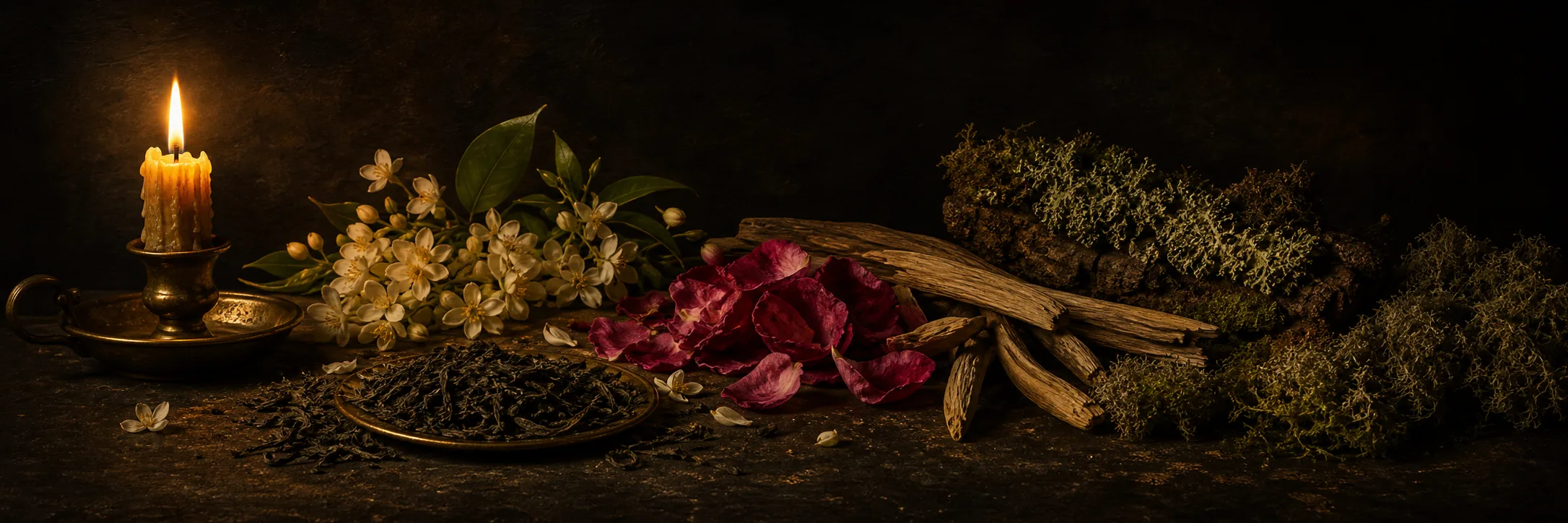
Rhapsody is Louis Vuitton’s deliberate, high-concentration (extrait, ~30%) reinvention of the classic green-floral chypre, released in 2021 as one of five Frank Gehry-bottled Les Extraits. It is the line’s most “perfumey,” structurally ambitious composition: a luminous jasmine-and-ylang heart laid over a mossy, vetiver-patchouli base, lifted by an unusual green maté-tea facet standing in for the citrus-bergamot top a traditional chypre would use. Distinctive because it reads as both retro (oakmoss-driven, mature, almost vintage) and contemporary (bright, transparent, soapy), making it the rare modern designer chypre that genuinely attempts the genre rather than gesturing at it.
Scent Profile
The opening (first 10-20 minutes) is a bright, slightly bitter green rush rather than a citrus sparkle: maté supplies a dry tea-leaf/herbal transparency, immediately entangled with soapy lily-of-the-valley (muguet) and a creamy, faintly banana-tinged ylang-ylang. Several wearers read aldehyde-like lift here, which fuels the recurring Chanel No. 5 comparison. This is not a quiet start - Rhapsody projects assertively and signals “serious fragrance” from the first spray. The heart (1-3 hours) is where the white florals consolidate: jasmine grandiflorum becomes the dominant voice, indolic and full, supported by ylang’s creaminess and a soft rose that stays in the background. The maté threads through as a green, herbal coolness that keeps the florals from turning fully opulent. This is the signature accord - a green-chypre floral built on jasmine + maté + oakmoss rather than the fruit-patchouli most modern “chypres” default to. The much-listed rose and lily-of-the-valley are perceptible but subordinate; rose in particular is more textural than featured. The drydown (3+ hours) is the most polarizing zone. Oakmoss, patchouli and vetiver create a damp, earthy, “forest-floor-after-rain” base that some read as elegant and mossy and others read as animalic to the point of fecal/urinous - the “horse manure,” “cheese,” “damp socks” reactions in wearer reports trace to the interaction of high indole jasmine, ylang’s lactic edge, and oakmoss mimicry (one wearer attributes it to a “creamy-faecal-scalpy” costus/civet-like effect imitating raw oakmoss). As a skin scent it settles into dry patchouli-vetiver woodiness with lingering floral powder. Evolution is real but compressed: a green-floral arc that doesn’t radically transform so much as deepen and dirty-up. Best described as moderately linear with a meaningful base shift.
Performance
Strong performer by extrait standards. Realistic longevity: roughly 8-10+ hours on skin and notably longer on clothing/scarves, where the mossy base clings for a day or more. Given the oakmoss/patchouli/vetiver base and indolic florals, it amplifies in heat - warm, humid conditions push the animalic/dirty facets forward and can tip it into the divisive “fecal” territory, so cool-to-mild weather flatters it more and keeps it crisp and green. Application strategy: this is an extrait - under-spray. One to two sprays delivers the elegant green-floral; over-application is what triggers the heavy, “mothball” and barnyard complaints. Apply to skin (pulse points) rather than dousing clothing if you want the brighter reading.
Wearing Context
Best in spring and autumn, and arguably a true year-round scent in temperate climates; wearer split on summer (the florals “open up” in warmth for some, turn rank for others) and it leans cool-weather-friendly for those who find it heavy. Excellent daytime-into-evening flexibility - its maturity and “smells expensive” quality suit office, dinner, gallery/cultural settings, and dressed-up daytime far better than club or gym. It shines as a statement of taste: the compliment reports (“what is that?”) are frequent and genuine. Where it falls flat: anyone expecting a crowd-pleasing sweet/fruity modern designer scent will find it austere, soapy, even “matronly,” and the animalic-base minority will actively dislike it.
Comparisons & DNA
Rhapsody sits in the modern green-floral-chypre lineage and invites several explicit comparisons. Chanel No. 5 (EDP) is the most- reference - wearer reviewers describe Rhapsody as a No. 5 modernized with more aldehydic lift, more lily-of-the-valley and extra vetiver; No. 5 is more refined and iconic, Rhapsody greener and earthier. Sisley Eau du Soir and Parfums de Nicolaï Odalisque are named by a wearer as fellow green-floral chypres occupying the same “serious, slightly austere” space - both are arguably more polished and far cheaper.
Reception
Among the four dossiers here, Rhapsody has the strongest critical footing - though still thin. Critic Eddie Bulliqi, in the editorial “Louis Vuitton Delivers Some Scintillating Modern-Day Chypres,” singled out Rhapsody (with Symphony) as one of the few LV scents that “deserve the time and effort to think about,” explicitly setting it above the line’s “tired commercial” releases. The pro camp calls it “the most beautiful chypre I’ve smelled,” “stripped down and modern,” a “cool mossy forest floor studded with lily of the valley,” and praises performance and the “smells expensive” quality. The con camp reports a strong fecal/urinous/“horse manure,” “cheese fondue,” or “mothball” reading, especially in the opening and base, plus the persistent objection that the €450-550 price is indefensible (“smells like it barely costs £50”). A second axis is gender (several insist it’s clearly feminine despite the unisex label). Blind-buy verdict: No. The price, the love-it-or-recoil base, and the gender ambiguity make sampling mandatory; it is, however, a strong considered purchase for committed chypre lovers.
Versions & Reformulation
Single composition, no known reformulations. Rhapsody launched October 7, 2021 as part of the five-fragrance Les Extraits Collection (alongside Cosmic Cloud, Dancing Blossom, Stellar Times and Symphony), all at extrait/~30% concentration in Frank Gehry-designed bottles. It remains in production as of 2026 and the Les Extraits line has since expanded (e.g., Myriad, Fantasmagory), but Rhapsody’s own formula has not been publicly reworked. Note only that LV ingredient lists are “updated periodically,” so minor IFRA-driven tweaks to the oakmoss material over time are plausible but undocumented.
Acquisition Notes
Luxury/niche-priced at the very top of LV’s range: roughly US$510-550 / €510 / £455 / C$620 for 100 ml - close to double LV’s standard line. Sold only via LV boutiques and official online store (no wholesale), with the 100 ml refillable at in-store perfume fountains; 7.5 ml travel sprays exist for the standard catalog but Les Extraits availability in travel size is limited, which is why third-party 8 ml decants are popular.
Notable Facts & Lore
- Perfumer intent is unusually clear here.
- Cavallier Belletrud framed Rhapsody as a deliberate modernization of perfumery’s foundational sophisticated form: “It’s the heart of chypre, the first sophisticated olfactive form in modern perfumery.
- I tried to bring it modernity while exalting its DNA,” adding that maté lends “that fresh, transparent tonality of green lily-of-the-valley” (LV press kit wording, widely reproduced).
- The fragrance carries no celebrity face (unlike the 2016/2019 feminine line); its cultural cachet is the art-world Gehry tie and its status, per wearer lore, as “the only LV that actually tries to.