M. Micallef — Black
Essence
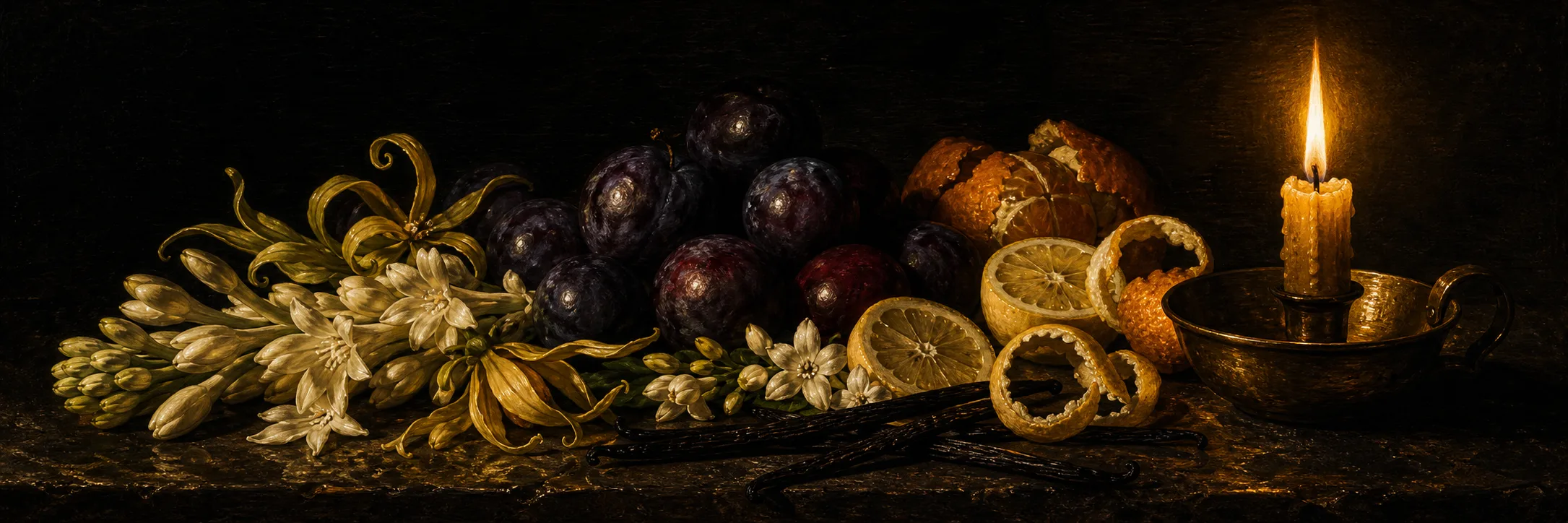
M. Micallef Black is a black-bottled trick: the presentation suggests darkness, but the fragrance is a bright, creamy, feminine tuberose floral. Plum, bitter orange, and lemon lift the opening; tuberose, ylang-ylang, jasmine, and neroli make the heart plush; powder, vanilla, benzoin, and white musk soften the base. Its appeal lies in that mismatch between theatrical bottle and sunny floral comfort.
Scent Profile
The opening is fruit and citrus rather than shadow. Plum gives a rounded, dark-fruit softness, while bitter orange and Amalfi lemon add a tart sparkle. There is a brief fizzy brightness before the white flowers take over. The heart is creamy tuberose, supported by ylang-ylang, jasmine, and neroli. It has the fullness of a heady floral but avoids the most difficult tuberose edges. The scent feels buttery, powdery, and gently sweet, with a dessert-like suggestion of fruit compote or creme brulee without becoming a gourmand. The drydown turns plush and cosmetic. Powdery notes, vanilla, benzoin, and white musk smooth the flowers into a soft sweet cloud. The finish is elegant and expensive-feeling: warm, feminine, and polished, not dark or animalic.
Performance
Performance ranges from moderate to strong depending on skin. The safest expectation is good longevity with moderate projection, while some wearers get a larger room-filling opening and overnight persistence. It is not a shrieking tuberose; it wears as a smooth, quality-feeling floral with a long powdery trail.
Wearing Context
Black is versatile for a niche white floral. It works for day, evening, office, and dressed-up settings, with autumn and winter showing its creamy warmth best. Despite the name, it reads more daytime-luxe than vampish: elegant, soft, feminine, and approachable.
Comparisons & DNA
Givenchy Organza is the key external reference. Black is softer, sweeter, and creamier, while Organza feels more forceful and classical. M. Micallef Watch is the house-relative to know. Both share plum, tuberose, ylang-ylang, and vanilla territory, but Black is fuller, powderier, and more tuberose-driven. M. Micallef Ananda explains the naming confusion. Black is richer and creamier than Ananda’s lighter, clearer floral-fruit style. Chanel Coco and Dior Poison are useful only as broad vintage-opulence markers. Black borrows some heady floral glamour, but it is gentler, more powdery, and less dramatic than either.
Reception
Reception is warm among white-floral lovers, who praise the balance, blending, creamy tuberose, and expensive powdery finish. The main criticism is conceptual: the bottle promises something darker and more mysterious than the juice delivers. For some, that contrast is charming; for others, it makes the fragrance feel pretty but anticlimactic.
Versions & Reformulation
Black, Black Ananda, and Art Collection Black appear to refer to the same composition rather than separate reformulations. It should not be confused with Ananda, which is a clearer and fruitier floral. No documented reformulation of Black itself stands out.
Acquisition Notes
This is a higher-mid niche purchase, commonly seen in 100 ml Eau de Parfum bottles. Sampling is strongly advised because the bottle’s mood and the scent’s actual personality diverge. If creamy tuberose, powder, and vanilla musk are the goal, Black is easy to understand from a decant; if darkness is the goal, look elsewhere.
Notable Facts & Lore
- The most memorable fact is the name-versus-scent twist: Black smells bright, creamy, and floral.
- It is associated with the Ananda family through labels such as Black Ananda, but the juice is distinct from Ananda.
- The bottle follows M. Micallef’s hand-decorated, crystal-studded presentation style.
- Critical reception often centers on whether the packaging misleads or pleasantly subverts expectation.