M. Micallef — Ylang in Gold
Essence
Ylang in Gold is a 2012 feminine eau de parfum from the French niche house M. Micallef, part of its Jewel Collection and credited to in-house perfumer Jean-Claude Astier. It is the house’s most hyped and loved release: a creamy, sweet tropical floral organized around ylang-ylang, coconut and a custard-like vanilla, presented in a Swarovski-crystal-studded bottle whose liquid is suspended with shimmering particles that leave a faint pearly-gold sheen on the skin. Its reputation rests on two things - the genuinely gorgeous, sun-warmed ylang-vanilla accord, and its persistent comparison to a more refined, modern Casmir by Chopard.
Scent Profile
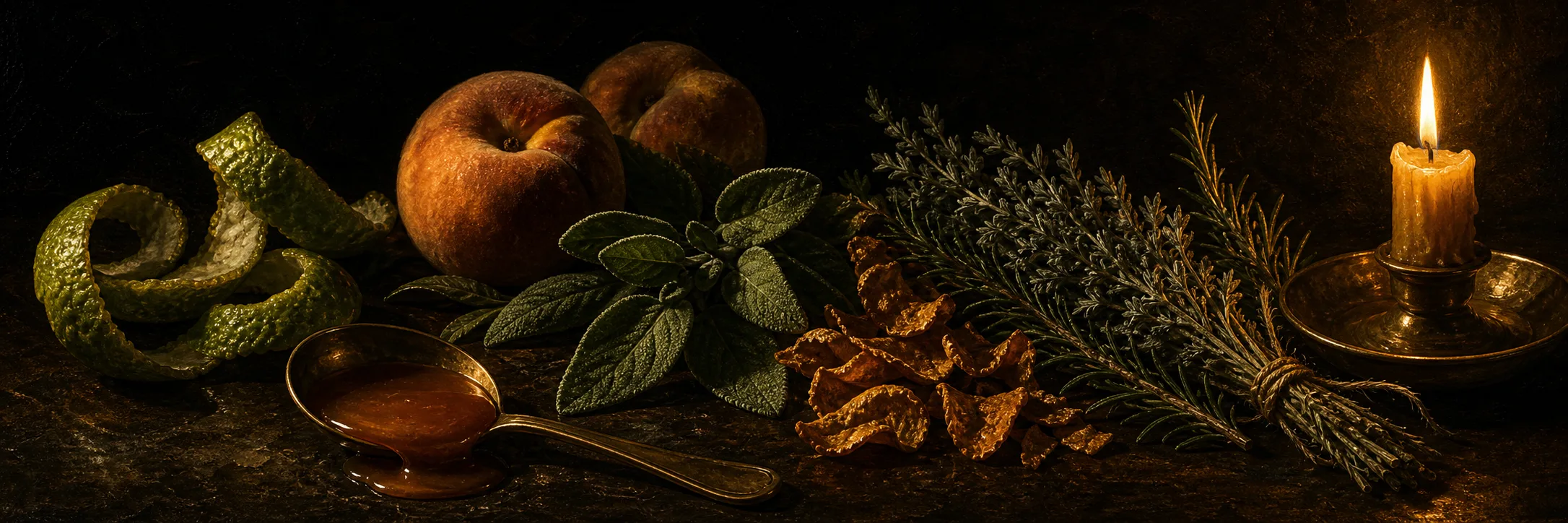
The most-cited critic read comes from Elena Vosnaki, whose review frames it as a salicylate-rich tropical floral that “straddles the precarious balance between sweet, powdery-musky and woodsy and ends up smelling golden, generous and gorgeous.” Note that the published pyramid is contested and varies by source: some listings show caramel/rose/bergamot up top, while Robert Herrmann and the house’s own materials list a herbal triptych of sage, rosemary and artemisia (mugwort) over geranium and tangerine. Crucially, Herrmann reports there is no literal ylang-ylang note - Astier builds the ylang accord from a “clever combination of mint, muguet, and magnolia,” with the pleasure being in watching that accord “unravel into its components.” Whatever the construction, the wear experience converges: a bright, slightly tart citrus opening; a solar, creamy ylang heart that many read as a “floral banana” or banana-custard facet; and a drydown of milky sandalwood, coconut water and a “lemon-tinged vanilla pudding” - Vosnaki compares the ylang/vanilla-salicylate treatment to the lily facet of Hermes Vanille Galante. Detractors get a different scent entirely: a vocal minority reports it collapsing into suffocating talcum powder (“straight out of my grandma’s boudoir”) or a generic banana-coconut candy.
Performance
Performance reports are genuinely contradictory and skin-dependent. Herrmann rated it as having “outstanding longevity and average sillage.” Many wearers, however, describe it as soft, airy and close-wearing - “not a beast mode frag, it’s soft, with weaker projection” - with one noting “the tiniest amount lasts all day” while another finds longevity merely average and disappointing for the price. The consensus middle ground: a restrained, non-projecting floral that stays fairly close but can persist on skin and clothing for those whose chemistry amplifies ylang. The Edition Speciale/special-edition and the later Nectar concentration are widely reported to perform more strongly than the standard EDP.
Wearing Context
This is a warm-weather, daytime-leaning scent in most wearers’ rotations - repeatedly tied to summer, beach, vacation and “tropical island” imagery - though several insist its creamy, cozy warmth also makes it a comfort scent for cold, rainy or winter days (“a hot buttered rum” for dreary weather). It reads as ultra-feminine, glamorous yet playful, and office-friendly precisely because it is soft. The Scentzilla!/“This Blog Really Stinks” reviewer found it “a bit too soft. Too passive. However, it’s definitely office-friendly. It probably works in a lot of situations, actually.” It is most at home as a date or special-occasion fragrance and a year-round creamy floral.
Comparisons & DNA
The dominant and near-unanimous comparison is to Casmir by Chopard (1992, Michel Almairac) - the peach-coconut-vanilla oriental. Many wearers say they are “virtually identical” side by side; the prevailing nuance is that Ylang in Gold is the more refined, elegant, modern and wearable version, while Casmir is thicker, sweeter and distinctly “90s/retro,” sometimes headache-inducing. One reviewer goes further, claiming it is essentially Hanae Mori (Pink Butterfly) and recommending that as a cheaper substitute. Now Smell This places it in the same creamy-feminine vein as Cartier Baiser Vole and Annick Goutal Songes (both vanilla-supported florals), though those are lily- and jasmine/tiare-based respectively. Within the niche tropical-ylang category, wearers triangulate it against Chloe Ylang Cananga and Perris Monte Carlo Nosy Be, generally finding Micallef the most gourmand of the set.
Reception
Sentiment is largely warm but with a real polarization axis. Praise centers on the smooth, classy, “addictive” creamy ylang-vanilla and the sense that the house took the risky coconut-tropical genre and made it refined rather than vulgar - Vosnaki’s whole review is an argument that it transcends the cheap-suntan-lotion trap. The two recurring criticisms are (1) the price - many feel it is “disproportionately” expensive for what is, at heart, a pretty-but-simple ylang-vanilla, especially given how close Casmir is for a fraction of the cost; and (2) inconsistent, sometimes weak longevity. A subset simply can’t wear it: it turns to talc powder, plasticky candy, or becomes nauseating on their chemistry. Now Smell This’s Angela landed the balanced verdict - “pretty and sugary and, well, that’s about all… no surprise, no grit” - beautiful but not profound. Blind-buy verdict: sample first, both because of the chemistry-dependent powder/banana risk and because Casmir offers a cheap reality check before committing.
Versions & Reformulation
There are multiple related versions, which buyers conflate. The original Ylang in Gold (2012) EDP comes in both a plain and a 24K-gold/pearlescent shimmer variety; a later Edition Speciale (2022) exists. Most significantly, Ylang in Gold Nectar (2020), also by Astier, is a more concentrated extrait-style flanker with a fuller fruity-floral top (peach, lychee, exotic fruits, the herbal sage/rosemary/artemisia accord) and an oakmoss-grounded base; wearers describe it as smoother, more sophisticated, more powdery and stronger-performing - “an animalic version” of the original to one nose, “a yellow flower bomb” to another. Note a persistent factual wrinkle: per reviewer Apicius, the “gold” shimmer particles are actually “very finely ground mother of pearl. Not gold,” rather than literal gold.
Acquisition Notes
This is a niche luxury price tier. At launch, per Now Smell This (Angela, Dec 10 2012), “Micallef Ylang in Gold Eau de Parfum comes in a 100 ml gold and Swarovski crystal-bedecked bottle for $245 in a sparkly or non-sparkly liquid.” The house currently lists the standard line and the more concentrated Nectar at different price points (the Nectar around 155 versus the classic around 245 per a customer query on the brand site). Real-world discount and decant channels bring it well down - wearers report 100ml-plus-travel sets around 190 SGD and small 8ml decants for a few euros through European subscription/decant services. Decants are readily available through split sites. The shimmer/special-edition bottles command a premium and are the collectible presentation. No significant counterfeit problem is documented, though buyers should be aware the various editions (standard, shimmer, Edition Speciale, Nectar) differ.
Notable Facts & Lore
- The notes were kept secret until launch as a marketing device.
- The bottle is a signature Martine Micallef design, the gold-fleck juice leaving a pearly sheen on skin - the gimmick that named it.
- Robert Herrmann reported there is no literal ylang-ylang note; the ylang accord is built from mint, muguet and magnolia.
- One reviewer notes the “gold” shimmer particles are actually very finely ground mother of pearl, not gold.
- The fragrance helped cement M. Micallef’s pivot toward an upscale, aficionado-facing market, exemplified by its placement at Osswald in New York.