Salvatore Ferragamo — Incense Suede
Essence
Incense Suede (2014) is Fabrice Pellegrin’s unisex leather-incense for Salvatore Ferragamo’s high-end Tuscan Scent boutique line, later folded into Tuscan Creations. It pairs resinous frankincense and styrax smoke with a saffron-laced suede, yielding a warm, dry, balsamic “church censer” leather. Its hook is being a surprisingly niche-quality leather from a designer house — a cult favorite among leather and incense fans, now discontinued and missed.
Scent Profile
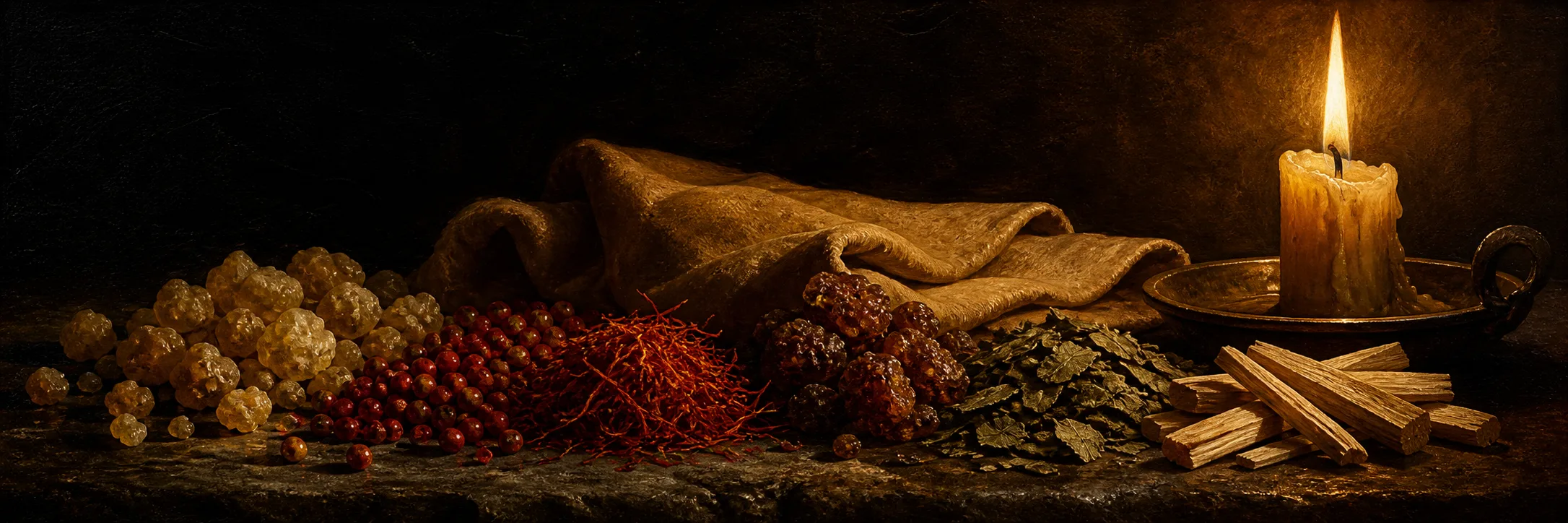
The opening is a thick incense blast: resinous, balsamic frankincense and styrax, lightly peppered by pink pepper, with a smoky, almost rubbery edge some wearers describe as “gasolinic.” The incense and smoky styrax are the loud elements while the pink pepper is a subtle sparkle. Many call this resinous opening the fragrance’s best phase. The styrax reads as a burnt, incense-like resin that blurs the line between top and base. Through the heart a saffron-leather accord moves forward. The saffron gives the leather a “boot polish” facet — the note that most distinguishes Incense Suede from a plain smoky leather and the reason some read it as more refined than Tom Ford Tuscan Leather’s rawhide. The leather is smooth suede rather than rugged hide; the saffron is an accent, not a spike. A dry, herbaceous mate facet keeps the mid-stage taut, and a resinous soapiness stops the woods from going harsh. The drydown is a warm, dry, smoky leather-wood skin scent: frankincense smoke threading through suede over a creamy, lightly smoked sandalwood-styrax base. The fragrance is largely linear, shifting emphasis rather than transforming — incense leads first, then leather, then a long resinous-woody settle. A minority reads the incense as more “Indian grocery” masala or “campfire ash” than liturgical, and a few catch a petrochemical “repolished old shoe” quality.
Performance
Performance reports are sharply bimodal, which is itself the headline. The dominant view is strong, even beastly: wearers report longevity “for ever” — two weeks on a sweater in one case — with some claiming 18+ hours and projection on par with much pricier niche. A vocal minority reports the opposite, occasionally under thirty minutes, likely driven by concentration and version confusion within the Tuscan lines plus skin variance. Most wearers should expect 8–12+ hours, longer on clothing, with moderate-to-strong projection settling to a potent skin scent. Heat amplifies the resin and smoke; cold weather suits its balsamic character. Apply conservatively and judge from the sillage.
Wearing Context
This is a cool-weather, evening-leaning fragrance, though its dry incense works in heat for some. The mood is contemplative and slightly solemn — a scent for sitting by a fire with a cigar and scotch. Best occasions are autumn and winter evenings, cool days, and any setting where a serious smoky statement is wanted. It is genuinely unisex in construction but skews masculine in perception for many, while others read a rosy sweetness softening it toward feminine. It shines as a distinctive, expensive-smelling leather for enthusiasts, and falls flat in scent-sensitive offices and hot crowded rooms where the smoke can be less palatable for bystanders.
Comparisons & DNA
- Tom Ford Tuscan Leather is the reference, made by nearly every wearer: the same saffrony-leather DNA but smoother, more subtle, more incense-forward and less aggressive. Opinions split from “like TL but better” to “nothing like it.”
- Ferragamo Testa di Moro (2018, also Pellegrin) is the in-house near-twin and the de facto in-production replacement — described as “basically Incense Suede, just more wearable.”
- Tom Ford Ombré Leather shares the smoky, faintly rubbery opening.
- Diptyque Tam Dao is the touchstone for the creamy sandalwood base.
- Amouage Jubilation XXV Man is a useful frankincense-led cousin for those chasing the incense facet.
Reception
Reception is strongly positive within its niche, though dedicated critical coverage of this specific scent is thin; the substantive published leather analysis from Persolaise is of the sibling Testa di Moro rather than Incense Suede directly. Among wearers it is repeatedly called the best of the Tuscan Scent set and, by some, the best Ferragamo fragrance period, praised for rich resinous incense, smooth saffron-suede, and an expensive, niche feel. Criticism centers on three axes of disagreement: a liturgical-incense versus ashtray reading, a beastly versus weak performance split, and refined versus one-dimensional. On value, it is not considered a safe blind buy at full boutique price — sample first — but a strong buy if found discounted.
Versions & Reformulation
Incense Suede launched in 2014 in the Tuscan Scent trio (alongside White Mimosa and Golden Acacia), positioned as 75 ml boutique exclusives geared toward the Middle Eastern market. The catalog lists it as an EDT, while the Tuscan Scent line is generally described as a richer EDP-grade boutique tier — concentration confusion that likely fuels the divergent performance reports. Ferragamo later consolidated the Tuscan Soul and Tuscan Scent lines into Tuscan Creations, during which Incense Suede was effectively reissued in spirit as Testa di Moro (2018) — a more wearable, slightly reworked relative rather than an identical reformulation. The original is now discontinued.
Acquisition Notes
Original boutique pricing was niche-luxury — roughly £170 for 75 ml at launch, well above standard Ferragamo designer scents. Now discontinued, Incense Suede trades on the secondary market where prices vary and stock is irregular; the sibling Testa di Moro is the practical alternative when found. The line is known for notably attractive heavy bottles often praised as un-designer-like. Specialist decant sites are the realistic sampling route for a boutique-exclusive leather like this; confirm stock and verify sellers before any secondary-market purchase.
Notable Facts & Lore
- Composed by Fabrice Pellegrin as part of Ferragamo’s Middle East–oriented Tuscan Scent trio, the brand’s “surprisingly good” boutique-exclusive tier.
- Now Smell This covered the trio at launch, confirming Pellegrin as perfumer and the £170 / 75 ml positioning.
- Persolaise framed Pellegrin’s closely related Testa di Moro as a conscious modern reworking of Chanel Antaeus, illuminating the restrained-leather sensibility Incense Suede shares.
- Widely regarded as the best of the Tuscan Scent set and, by some, the best fragrance Ferragamo has ever made.
- Discontinuation turned it into a mourned cult “sleeper” — frequently sought out and hard to find today.