Salvatore Ferragamo — Salvatore Ferragamo Pour Homme
Essence
Salvatore Ferragamo Pour Homme (1999), composed by Jean-Pierre Mary, was the Italian leather house’s masculine fragrance debut and is remembered as a genuine designer hidden gem. It is a fig-leaf scent from a moment when fig was fashionable in men’s perfumery, but rather than leaving the fig as a sunny soliflore it pulls it down into a dry, woody, vetiver-and-oakmoss base. The result is a Mediterranean, green-woody fig masculine of understated Italian elegance - left-of-center for its era and unusually refined for a shoe house’s first cologne.
Scent Profile
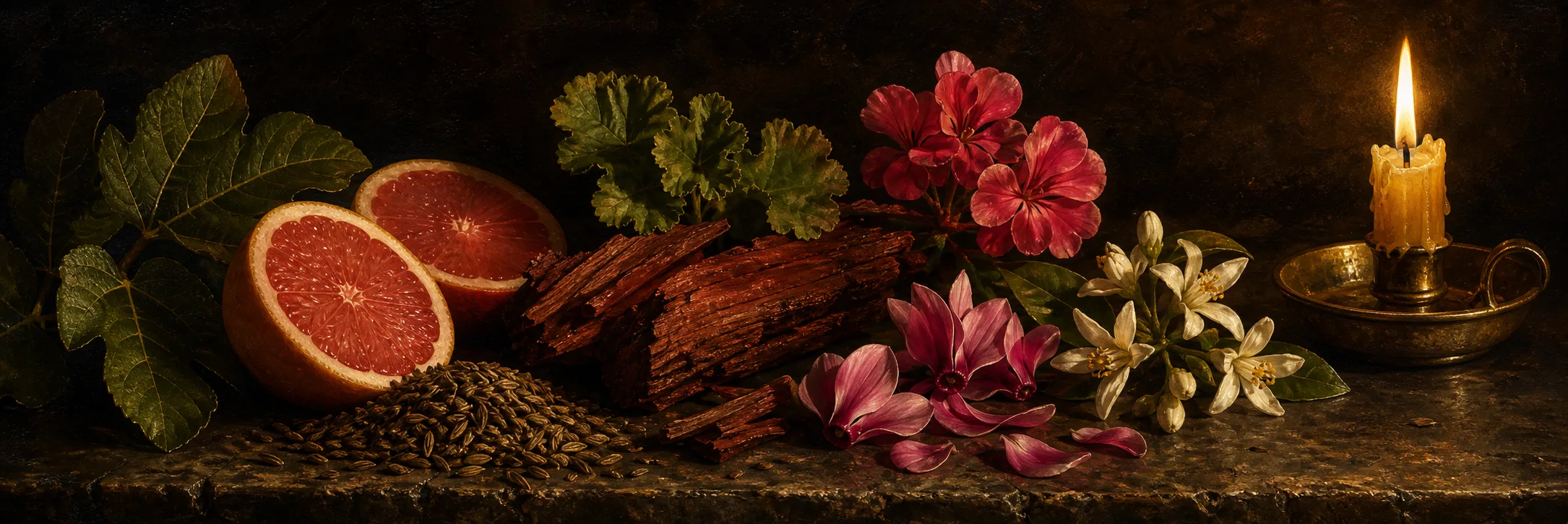
It opens unmistakably on fig, a fresh fig carried by dry grapefruit and neroli, with cyclamen and African geranium adding a green floral briskness and a clove note reinforcing the green theme. The grapefruit is the divisive element, reading sharp and faintly sour to several wearers in the first hour.
A brief floral heart of carnation, jasmine, rose, orris, and cardamom is widely described as transitory and hard to parse note-by-note, functioning more as a bridge than a distinct stage.
The real personality is the base, where cardamom, cedar, and a gentle leather calm the fig onto a cushy pillow of sandalwood, oakmoss, vetiver, and musk. Many wearers ultimately experience it as a dry, inky vetiver-and-fig scent with a crisp, non-sweet, freshly-snapped-plant-stalk greenness - a realistic, milky fig leaf rounding into vetiver, clean soapy musk, and cedar.
Performance
Performance clusters around moderate. Longevity is generally good-to-long, commonly five or more hours on skin and considerably longer on clothing, while sillage and projection stay modest and close to the body. Some recent owners report current stock lasting only four to five hours and infer a performance-reducing reformulation relative to older bottles. The honest read is a quiet, intimate performer that was never a projection beast and may run weaker in recent production.
Wearing Context
This is a versatile, office-friendly, daytime-leaning scent usable across most of the year, favored by some for fall-through-spring office and casual wear and by others as a spring and summer Mediterranean fresh-green. Its restrained sillage makes it safe for close quarters. It is repeatedly described as a mature scent suited to wearers in their thirties and up, and many wearers report compliments despite its understated nature.
Comparisons & DNA
The richest comparison is to Costume National Homme, to which Ferragamo is often called a fresher, more relaxed brother that shares a very similar fig-leaf note while CN Homme runs higher in performance, sweetness, and base weight. It belongs to the fig-leaf lineage alongside Diptyque Philosykos, Dior Dune Pour Homme, and Hermes Un Jardin en Mediterranee, with several wearers arguing Ferragamo handles fig better than the straightforward fig soliflores. Its drydown has been likened to a prototype Chanel Sycomore with a fig twist, and it also draws comparison to Davidoff Good Life balanced out with extra spices.
Reception
Reception is that of a well-regarded cult hidden gem, especially among fig-leaf and vetiver fans, who rate it highly and lament its discontinuation. The split runs along two lines: fig tolerance, since those who dislike fig can find it cloying or spice-rack-like, and an expectations gap created by the rumored Jacques Polge pedigree, which leads a vocal minority to find it subtle to the point of being underwhelming for the talent involved. There is no major mainstream critic verdict on record. The balance is a quietly excellent, distinctive fig-vetiver masculine that rewards genre fans and frustrates anyone wanting power or an obviously “designer” profile.
Versions & Reformulation
The fragrance is discontinued and widely referred to as such. There is also wearer evidence of a performance-reducing reformulation in recent years, with earlier reviews describing decent-to-good performance against current weaker stock, and a long-standing report that older bottles smelled sweeter while a later version struck one returning wearer as harsh by comparison. No authoritative reformulation date is documented, so the reform is best treated as inferred - vintage stronger and sweeter, current weaker - against a confirmed discontinuation.
Acquisition Notes
As a discontinued scent, it surfaces mainly on the secondary market and at off-price clearance retailers, where it has been picked up very cheaply, making it one of the best value finds in the fig-leaf genre. Buyers wanting the reputedly stronger, sweeter experience should seek older stock, since fresher bottles may underperform given the inferred recent reform. Long-time wearers cite the red-box presentation as the recognizable original.
Notable Facts & Lore
- It won the Fragrance Foundation’s “Fragrance of the Year - Men’s Luxury” award in 2000.
- A recurring lore item is the cross-house pedigree story, in which Ferragamo’s corporate ties reportedly allowed Chanel’s Jacques Polge to be involved alongside the credited perfumer Jean-Pierre Mary.
- That story is cited to explain why a shoe house’s debut masculine feels unusually left-of-center.
- It belongs to the late-1990s fig-leaf wave but is praised for grounding the fig in a dry vetiver-oakmoss base rather than a simple soliflore.
- A running joke among owners is the fragility of the spray nozzle, with more than one reporting a failed pump.