Sultan Pasha Attars — Aurum D'Angkhor
Essence
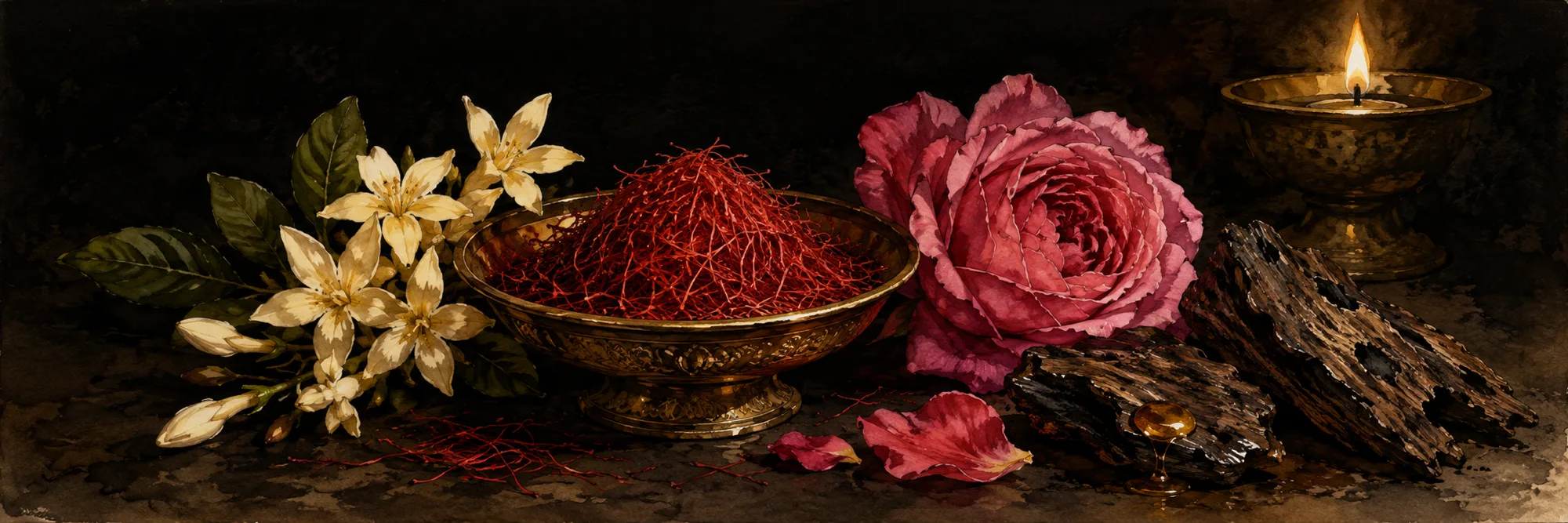
Aurum D’Angkhor is the attar Sultan Pasha himself flags as the apex of his work: a saffron-jasmine-rose oriental built around a small percentage of Ensar Oud’s storied Cambodian distillation Encens D’Angkhor. “Aurum” means gold, and the composition reads gold throughout — saffron threads, honey absolute, beeswax, polished Mysore sandalwood, and a hand-macerated base shamama. What sets it apart from the wider rose-oud field is its use of Jasminum auriculatum, a species rarely seen in Western perfumery, which leads the heart while the oud works in a low, structural register.
Scent Profile
The opening is fiery and dry, driven by high-grade Persian and Spanish saffron with its medicinal-iodine, leathery, red-spice facets, as Jasminum auriculatum and Persian rose otto push in alongside. A transient barnyard or “cow slurry” facet often appears in the first few minutes — the critic Claire Vukčević described it as a startling dark barnyard note that seems to ooze across the room. It is short-lived and typical of fresh Cambodian oud opening up.
Within about twenty minutes the saffron-rose-jasmine triumvirate settles into the heart, where the fragrance becomes recognisably golden. Honey absolute, orange blossom, tobacco, henna and Bulgarian rose absolute interlock into what one critic called a love poem to the golden dust of saffron, smoke, honey and henna over a velvety floral richness. A tobacco-hay-honey phase here draws comparison to Serge Lutens Chergui, though Aurum is softer-edged and less linear.
The drydown belongs to the shamama and ambergris. Hours in, the jasmine-saffron heart slides under a resinous, mineral haze of ambergris, Mysore sandalwood, Siamese benzoin and labdanum, with the oud providing woody depth beneath. The long, slow tail can read as the ambergris nearly overtaking the oud and tobacco.
Performance
Performance is one of Aurum’s most-discussed features. From a single pinprick application it typically wears eight to twelve hours on skin, stretching past twelve and into the next morning on fabric. Projection stays moderate and intimate, close to the wearer rather than loud, yet the trail is unusually wide for an oil thanks to the diffusive saffron-jasmine-honey accord. The material is extremely concentrated — one reviewer called it the strongest perfume material they had ever tried — so Sultan Pasha advises a paperclip or hatpin to dip and dot rather than swipe.
Wearing Context
This is cold-weather, indoor, evening, statement-occasion territory. In heat the saffron-honey-tobacco accord turns denser and more medicinal, while in autumn and winter, especially indoors, it reads regal rather than oppressive. The fit-for-royalty register is invoked repeatedly, underlining how out of step it is with daytime, office or warm-weather wear. It is unisex in temperament but skews toward an older masculine ceremonial-oriental register on most skins, with many women reading it as a deeper, more architectural rose-jasmine than typical feminine florals.
Comparisons & DNA
Within Pasha’s own line the closest reference is Juriah, his stated magnum opus; Aurum offers broader floral-honey complexity and its singular jasmine where Juriah pushes a harder leather-rose-oud thrust. Ensar Oud’s Encens D’Angkhor is a literal DNA cousin, since a small percentage of it sits inside Aurum. Among polished Western niche, Roja Amber Aoud and Maison Francis Kurkdjian Oud Satin Mood are the smoothed, synthetic-led equivalents of the rose-oud-amber idea. The tobacco-honey-hay heart phase echoes Serge Lutens Chergui without sharing its full arc. These are directional rather than dupable references; the macerated saffron, the specific oud, and the rare jasmine place Aurum outside the clone ecosystem.
Reception
Critical reception has been extraordinary. The critic at The Scented Hound called Aurum knowing, mysterious and careworn, and offered it as evidence that perfumery is an art form. Claire Vukčević’s coverage was rapturous, with her line about it blowing her socks off for depth, complexity and beauty among the most-quoted about the attar. Dissent exists: Sergey Borisov found himself unmoved, expecting jasmine to dominate more than it did, and flagged the price as divisive. The recurring axes of disagreement are the brief opening barnyard phase and the cost; for wearers who accept both, enthusiasm is near-uniform.
Versions & Reformulation
Aurum D’Angkhor is sold only in a 3 ml format, typically with a small pre-sample vial attached. It has not been formally reformulated, but because it depends on a finite stock of Encens D’Angkhor, batches differ subtly and the attar has cycled in and out of sold-out status over the past decade. The published notes list has seen minor revisions, with champaca added to the listed heart at some point. As of 2026 there is no alcohol-based extrait version; the attar remains the only format, even after the house launched a separate alcohol-based line in 2025.
Acquisition Notes
The official channel is the house’s own site, where the 3 ml retails around £399 (roughly $490). Stock is irregular, frequently flipping to sold out and returning after batch maceration, sometimes via lottery-style restocks. The brand’s official multi-attar sample set is the standard entry point, with two-drop vials sufficient for several careful wears each. Because batches vary, it is wise to check any same-batch sample included with a bottle before breaking the seal.
Notable Facts & Lore
- Sultan Pasha first smelled the base oud, Ensar Oud’s Encens D’Angkhor, around 2012 and spent two years assembling materials to build the composition around it.
- Pasha’s own copy frames the structure as a king (the oud) and queen (the jasmine) with the remaining materials as “loyal council.”
- It uses Jasminum auriculatum, a jasmine species rare in Western perfumery and material-specific to this attar within his catalog, which mostly uses grandiflorum or sambac elsewhere.
- The “Aurum” name was extended in 2019 to Tabacaurum, a tobacco-forward cousin built with related techniques.
- The oil is among the densest and most viscous Pasha produces and can stain fabric, so it is meant for skin-only application with time to absorb.
- Critical coverage in 2016 and early 2017 effectively launched its Western collector reputation, written from perfumer-gifted sample sets that became standard practice for the house.