Sultan Pasha Attars — Jardin de Borneo Gardenia
Essence
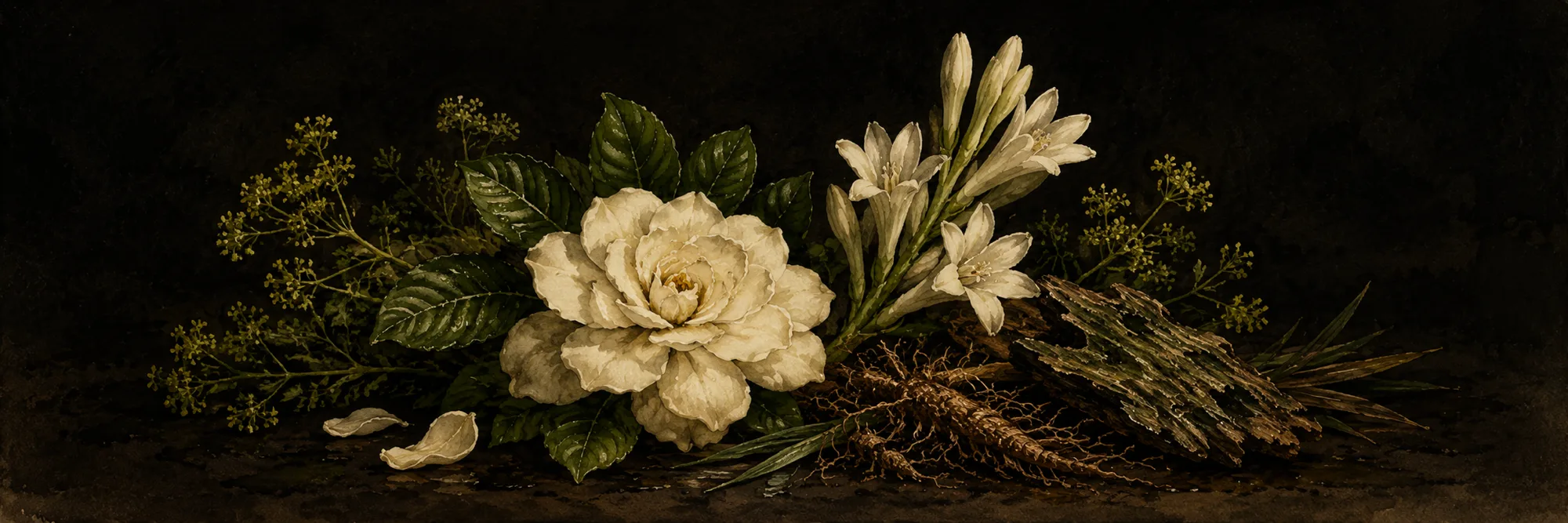
Jardin de Borneo Gardenia (2015) is the gardenia entry in Sultan Pasha’s three-part Jardin de Borneo series, all built on the same fougère-style base of Ensar Oud’s rare, green, almost minty Bois de Borneo oud. What sets it apart is material fidelity: it uses genuine gardenia enfleurage at the top and gardenia absolute in the heart, a flower that cannot be steam-distilled and must be solvent-extracted, making the absolute exceptionally costly. Lauryn Beer treats it as the piece that best shows what attar format can do that commercial perfumery cannot.
Scent Profile
The opening pairs gardenia and jasmine sambac enfleurage, both slow-process materials that read like a living flower rather than an extracted abstraction; wearers repeatedly describe it as smelling like a real gardenia. The gardenia here is the rare un-shampoo kind: rich and creamy with the flower’s true cream-cheese and coconut nuances, but, in Beer’s words, “rich but not sickly, and creamy without any off-putting moldy cheese notes.” A brief greenish-lavender flicker passes through the early heart. The heart locks gardenia absolute, tuberose absolute and Mysore sandalwood together. Beer notes a mysterious diesel facet, hot and almost rubbery, from the tuberose rather than the jasmine; it gives the composition a slightly indolic, animalic edge that lifts it past pretty-floral territory. The tuberose is restrained, never a Fracas-style bombshell, and the gardenia keeps the lead. The drydown is the signature Borneo accord: green, minty oud woven through Haitian vetiver, galbanum, calamus, katrafay, tonka, lightly dosed civet and ambergris, landing in a humid jungle warmth. The civet adds discreet animalic depth, the ambergris a salty mineral lift.
Performance
Performance is moderate-to-strong. Longevity clusters around six to ten hours with extended persistence on clothing, while projection is medium and intimate, as is typical of white-floral oils. Most wearers find it projects well for the first one to two hours then settles closer to skin; the enfleurage gardenia gives it unusual carrying power for an oil. A minority report little sillage, but that is the exception.
Wearing Context
This is white-floral wear that leans slightly feminine but stays unisex on most skins. It is best in moderate-to-warm weather, where the gardenia and tuberose open up rather than congeal; cold weather flatters the green oud-vetiver base but mutes the floral top. It is more approachable than many Pasha attars, closer to crowd-pleasing than connoisseur-only, and is often called one of the most wearable pieces in the line for gardenia lovers.
Comparisons & DNA
- Within the series, Gardenia is the most floral-led; Jardin de Borneo Tuberose is more camphoraceous and bitter, and White Ginger Lily is richer and more translucent.
- Vintage Dioressence is Beer’s explicit historical kin: a sultry green chypre split between an animalic ambergris-civet base and soapy green florals.
- Tom Ford Velvet Gardenia (discontinued) is dirtier and waxier; Strangelove NYC Lost in Flowers is more transparent. Pasha’s gardenia reads closer to the living flower than either.
Reception
Reception is near-uniformly positive among gardenia enthusiasts, with the consensus that it is one of the best gardenia fragrances available in any format; “masterpiece” and “like smelling a real flower” recur. Lauryn Beer treats it as the showcase of Pasha’s white-floral trilogy and the clearest illustration of the cost advantage of attars, and Kafkaesque devoted a dedicated post to the series. The rare dissent is a charge of being a plain green floral with weak sillage, but it is atypical. The most common reservation is the price relative to a more accessible Western gardenia.
Versions & Reformulation
The attar is sold in a standard 3ml format and has not been reformulated; no spray adaptation was part of the 2025 Sultan Pasha Perfumes launch slate. The series as a whole is gated by the supply of Ensar Oud’s Bois de Borneo oud, and goes out of stock when that material is unavailable. Batches vary slightly because the enfleurage gardenia is a natural material, but the structure has stayed consistent.
Acquisition Notes
It is sold through the brand’s own site at a mid-to-upper tier price, historically around £200-280 per 3ml depending on batch and currency, and a Jardin de Borneo entry usually appears in the brand sample set, rotating among the three florals by stock. Supply is irregular and gated by the Borneo oud; restocks are announced via Instagram and mailing list. Because gardenia tolerance varies so widely, sampling before committing to a bottle is essential.
Notable Facts & Lore
- Pasha grew up in Bangladesh among his grandparents’ perfumes and local flora, and the Jardin de Borneo series is explicitly autobiographical childhood-memory work.
- Ensar Oud’s Bois de Borneo oud is the technical key — green and minty, structurally unlike Cambodian or Hindi oud — and gives the whole series its damp-forest base.
- Gardenia cannot be steam-distilled, only solvent-extracted or enfleuraged, which is what makes it a material that genuinely justifies the attar format on cost.
- The canonical series is three entries — Gardenia, Tuberose, White Ginger Lily; a champaca composition exists separately rather than as part of it.
- Katrafay, listed in the base, is an obscure Madagascan wood that behaves like a dry cedar-vetiver hybrid in the blend.
- This is one of the few Pasha attars where lavender plays a meaningful role, inherited from the underlying Jardin de Borneo fougère base.