Tauer Perfumes — Golestan
Essence
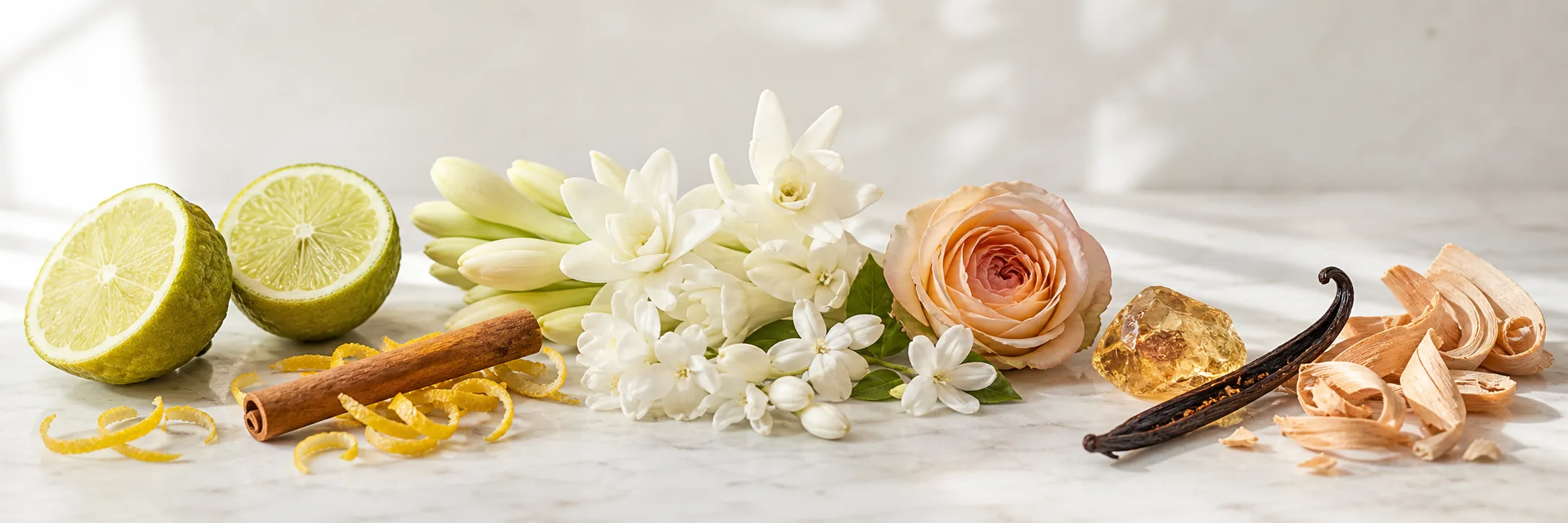
Golestan is a white-floral extrait with tuberose, jasmine, ylang-ylang, and a dry, dusty amber base. It takes the house’s familiar arid warmth somewhere less expected: into an imagined Persian flower garden rather than a desert landscape.
Scent Profile
It starts with a quick flash of citrus and rich ylang-ylang. The heart arrives fast: tuberose, jasmine, orange blossom, and a quieter rose form a dense, indolic bouquet. This is not a watery or delicate white floral. The flowers have real body and a lightly animalic edge. What separates Golestan from a straightforward floral is its mineral texture. A chalky, dusty facet threads through the petals, sometimes reading as dry stone, sometimes as an old, powdery room. Underneath, ambergris, patchouli, vanilla, and sweet woods turn the base warm and faintly balsamic. Some wearers notice a spicy warmth or a fleeting grape-like effect where ylang, tuberose, and amber meet. The result is floral abundance with dry terrain beneath it: glamorous, a little strange, and recognizably Tauer.
Performance
Golestan opens with considerable force and can fill a room in its first hour. Its later wear is far less predictable. Some people find it becomes a close skin scent within a couple of hours, while others get much longer life. Apply lightly until you know how it behaves on your skin.
Wearing Context
The flowers may read feminine to some wearers, but the ambered, dusty base makes the scent comfortably unisex. Spring and cool transitional weather are natural settings. It suits evening plans or a deliberate statement more readily than a quiet office, especially at the start.
Comparisons & DNA
The most useful comparison is Tauer’s own desert-amber family. Golestan shares the warm, dry foundation of Au Coeur du Desert and L’Air du Desert Marocain, but replaces their spice-led profile with a large white-floral bouquet. Sotto la Luna Gardenia helps explain the mineral floral effect. Compared with classic indolic tuberoses such as Fracas, Golestan is drier, dustier, and more ambered.
Reception
The perfume earns admiration for its unusual floral scale and its detailed materials, while its chalky mineral treatment is the main dividing line. Persolaise praised the skill of the floral construction but noted a familiar turn toward tuberose, patchouli, and amber. Other informed critics have found the same dusty effect evocative but overused. Wearers split between devotion to its lush, dry floral character and reservations about its mineral texture, occasional grape-like facet, or uneven longevity.
Versions & Reformulation
Golestan is a 2022 50 ml extrait with no reported reformulation. It belongs to the house’s Collectibles/Perfume Vault grouping and comes in the characteristic pentagonal bottle, decorated here with a colorful Persian floral-tile motif.
Acquisition Notes
The extrait is sold directly by the house and through specialist stockists at a high-niche price. Availability may vary by season and retailer. A sample is useful before a full bottle because both the mineral floral profile and the later performance are highly personal.
Notable Facts & Lore
- Golestan takes its name from Tehran’s Golestan Palace, often translated as Rose Garden Palace.
- The project began after Tauer encountered Persian history at the Louvre in 2020.
- It imagines a Persian flower garden the perfumer had not yet visited.
- The bottle’s ornament references Persian floral tile painting.