Trussardi — Trussardi Uomo
Essence
Trussardi Uomo (1983) is one of the canonical Italian leather powerhouses of the 1980s - a brash-but-refined aromatic-leather chypre that has become a genuine cult object among vintage-fragrance collectors. It is the rare designer release from the decade with essentially no true successors: revered precisely because it balanced 1980s “beastmode” projection with an aristocratic, honeyed leather refinement that most of its contemporaries couldn’t manage. Thecatalogs attributes the composition to Beatrice Piquet. A crucial identity caveat: the 1983 original (greyhound logo, leather-clad bottle designed by Nicola Trussardi) is an entirely different fragrance from the 2011 “Uomo Trussardi” relaunch (coat-of-arms logo, a woody fougere by Aurelien Guichard) - disparaging “smells like hair gel” reviews almost always refer to the latter and should not be applied to the original.
Scent Profile
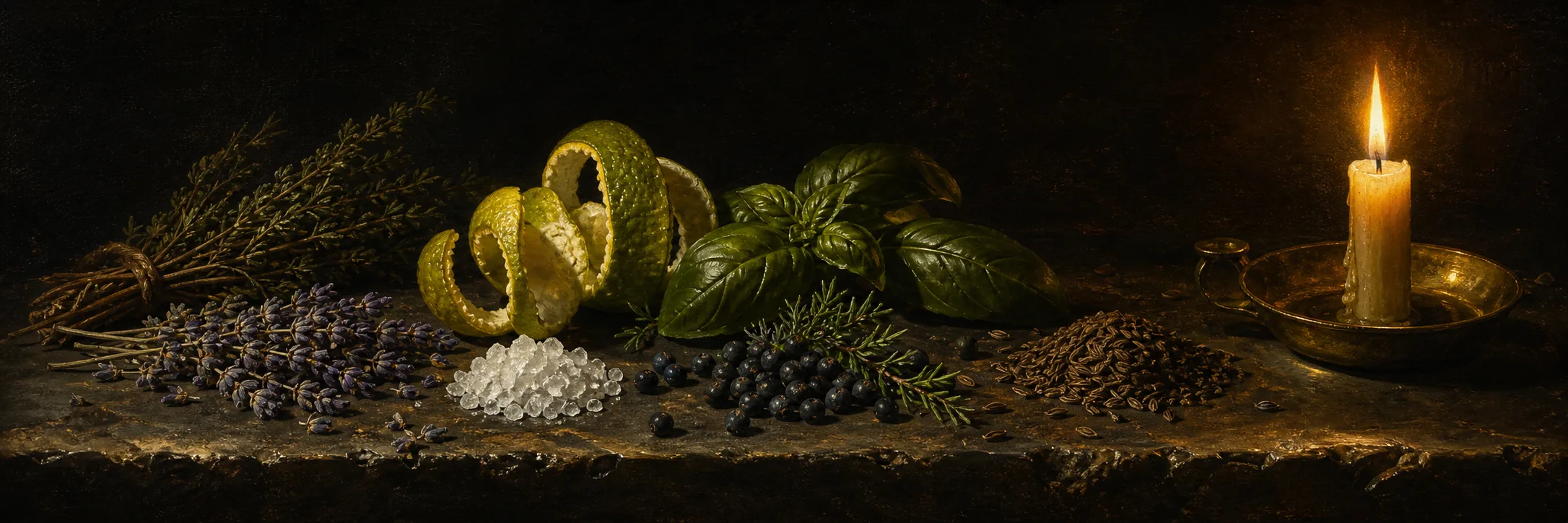
The opening is a sudsy, aldehydic, herb-and-citrus blast - bergamot and lavender over basil, caraway and a green herbal swirl - bright and brash in the manner reviewers compare to entering “Aldehyde City.” Beneath that lies the fragrance’s defining signature: a honeyed leather, warmed by a rosy, carnation-spiced heart with cinnamon and orris, that distinguishes it from drier leather chypres. Connoisseurs repeatedly flag a characteristic bitter-almond facet running through the composition and lending an “aristocratic” cast. The base is the powerhouse engine room - castoreum-inflected leather, oakmoss and labdanum delivering the chypre backbone, with patchouli and cedar for smoothness and a faint tobacco/incense smokiness. The arc, as one detailed blog review put it, becomes “a boxing match” between dandyish florals and macho tobacco-leather elements.
Performance
Monstrous, by consensus. This is one of the most frequently cited longevity-and-projection beasts of its era - wearers report 8 to 12+ hours and sillage detectable across a room, to the point that overspraying induces nose-blindness. The vintage is so concentrated that a single spray to the neck is widely described as sufficient for a full day. Performance is so dominant that some reviewers note it became a magnet for people who wanted only projection and never engaged with the fragrance’s actual subtlety.
Wearing Context
A cold-weather, evening, mature-skewing scent. Reviewers across and converge on it being unsuited to summer or to younger noses without a “nostalgic spirit,” recommending it for 30-and-up wearers and formal or evening settings. It is repeatedly framed as autumn/winter, dark, “deep and dark and sexy” - a deliberate, old-school statement rather than a casual daily driver.
Comparisons & DNA
The most-cited neighbors are Van Cleef & Arpels pour Homme (1978) and Leonard pour Homme, though several careful reviewers argue the resemblances are overstated and that Trussardi Uomo stands genuinely alone. Other repeated reference points: the original Burberrys for Men (a “forgotten classic leather”), Jean-Marc Sinan’s Version Originale (1980), Boss Number One (1985) for its honeyed benzoin-geranium-rose phase, Salvador Dali pour Homme (1987) for the dandy floral, Giorgio Beverly Hills for Men (1984) for resinous patchouli, plus Quorum, Aramis Havana and green Polo by Ralph Lauren in the brash opening. Fendi Uomo (released about two years later) is widely dismissed as a sweatier, inferior clone. one reviewer reached for Creed Bois du Portugal as a “more accurate, complex and prestigious” cousin.
Reception
Among wearers sources, the original enjoys near-reverential status - “could very well be the greatest men’s leather fragrance ever created,” “a black magic masterpiece from the 80s,” repeatedly called a hidden gem and an embodiment of itswearer’s identity. Note an important sourcing limit: despite expectations, the fragrance does not appear to have been reviewed in Luca Turin and Tania Sanchez’s Perfumes: The Guide / The A-Z Guide - a search of the books’ compiled star-rating index and quoting sources turned up no Trussardi Uomo entry, so claims of a Turin star rating should be treated as unverified. The strongest critic-adjacent writing is on enthusiast blogs (e.g., the detailed Scented Devil deep-dive), which treat it as a powerhouse landmark.
Versions & Reformulation
The lineage is the single biggest buyer hazard. The 1983 original was produced first by Scannon, then by Selective Beauty SA (widely regarded as having preserved the formula well), with later marketing under AB Parfums / Angelini Beauty; it was reformulated and lightened prior to discontinuation. The 2011 “Uomo Trussardi” (Aurelien Guichard, coat-of-arms logo) is a separate, weaker woody fougere often confused with it by vendors. Collectors prize the earliest “ICR SpA Milano” / greyhound-logo bottles; even within the original line, some report the very latest pre-discontinuation batches were thinner than earlier ones.
Acquisition Notes
This is a vintage hunt. The original is discontinued and trades on the secondary market, where prices are inflated by Trussardi’s “house of unicorns” reputation (echoing Jean Patou and Balenciaga). Buyers should verify the greyhound logo and leather-clad bottle, look for older production stickers, and treat any coat-of-arms 2011 bottle as the wrong fragrance. EDT and the aftershave are both sought; some collectors specifically rate the aftershave highly. Caveat emptor on provenance and fill level given the price climate.
Notable Facts & Lore
- The bottle - a black, crocodile-textured leather-look flacon - was designed by Nicola Trussardi himself and is integral to the fragrance’s identity as a luxury-leather-house statement; the contrasting black (men’s) and white (women’s) bottles earned it the unofficial nickname “Black.” The house’s leather heritage runs deep: Trussardi was founded in 1911 by Dante Trussardi as an artisanal leather-glove workshop in Bergamo (per the house’s official heritage page: “It all began in Bergamo in 1911, with an artisanal leather glove workshop founded by Dante Trussardi”), with the now-iconic greyhound logo unveiled in 1975 - making this one of the more literal designer-house-to-fragrance translations of its era.