Yardley London — English Lavender
Essence
English Lavender is the archetypal British lavender water: a clean, herbal, soap-and-countryside lavender that has been a fixture since the Victorian era and is one of the oldest continuously produced fragrances on the market. It is not an artistic, perfumer’s lavender but a straightforward aromatic fougère built to smell like freshly laundered linen, lavender water and hand-milled herbal soap. Its appeal is heritage plus price: it does one thing, a crisp and dignified lavender wreathed in rosemary, geranium and mossy warmth, and historically did it with surprisingly good materials for a budget scent. Yardley and most critics date it to 1873.
Scent Profile
The opening is the most assertive phase, a fairly fierce burst of lavender, rosemary and geranium that reads sharp and herbal-camphoraceous, with the eucalyptus and rosemary giving a cooling, green edge. Within a few minutes it softens into a smoother, slightly spicy lavender.
The heart is carried by geranium and clary sage, which add a gently spicy green-floral lift; the cedar is barely perceptible and mostly contributes dryness. This is a largely linear composition, so the changes are subtle rather than dramatic.
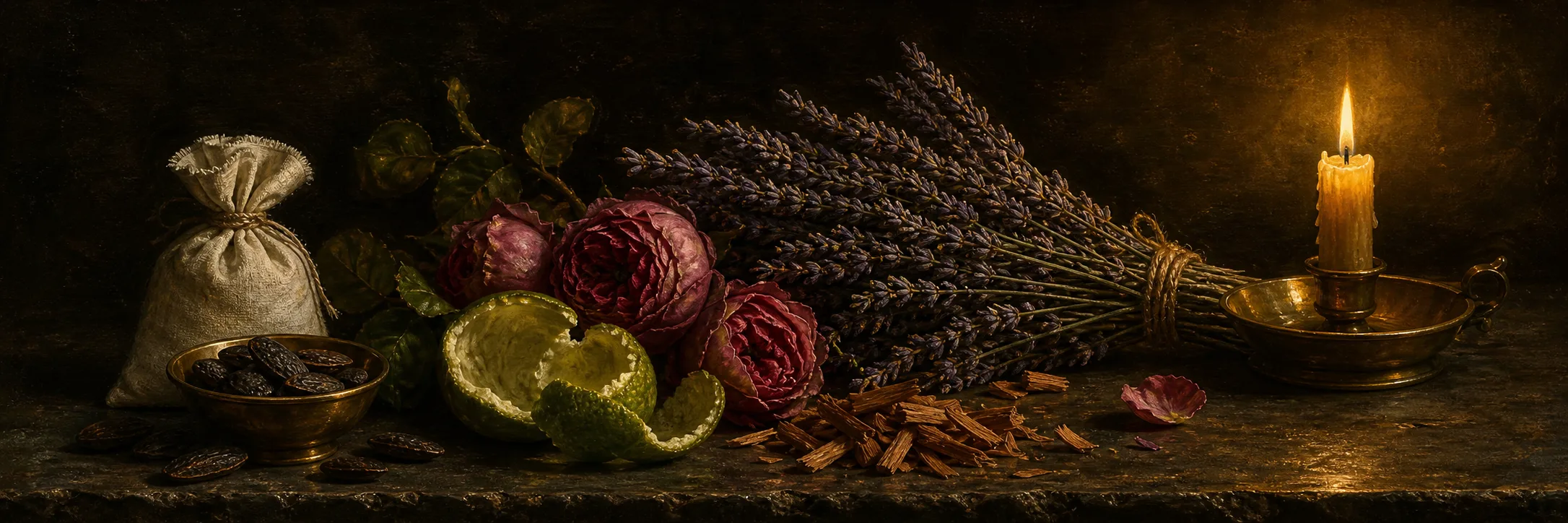
The drydown is the prized part, especially on the original and vintage versions: a soft, soapy, almost ancestral musk-tonka-oakmoss base that wearers describe as talcy, dreamy and musky, with a powdery, mossy, tonka-laden chypre quality. Throughout, the most perceptible threads are lavender, herbal rosemary and sage, and a soapy musk, while the bergamot, cedar and oakmoss sit more as a textural haze. The signature, repeated again and again, is clean lavender soap, evocative of old-fashioned English soap and bath powder.
Performance
Performance is the defining weakness, and there is strong agreement on it. Reviewers consistently describe poor longevity and modest sillage, with wear often lasting only a couple of hours close to the skin before fading to a soft skin scent; this is lavender-water behavior by design. The original and vintage versions last somewhat longer than the contemporary reissue. The sensible approach is to spray liberally and reapply, to layer with the matching soap, talc and body products, or to use it as a post-shower refresher or even a pillow and linen spray. It is best as a light, warm-weather freshener rather than something built to carry through a long day.
Wearing Context
This is a spring and summer daytime fragrance, fresh, clean and cooling, and especially pleasant in real heat where its herbal crispness shines. It is office-safe and casual rather than seductive or evening-appropriate, though some find a quiet, soap-fresh sensuality in it. Its social read leans toward mature or grandmotherly associations, which some younger wearers cite as a deterrent, but many push back and call it dignified and genuinely unisex. Despite the feminine marketing, its lavender-fougère DNA is classically masculine-adjacent and it wears easily on men. Above all it is a personal-comfort and grooming scent, often worn for oneself rather than to project.
Comparisons & DNA
English Lavender sits at the historical root of the aromatic-fougère and lavender-water family, and it is most useful as the affordable baseline against which more artistic lavenders are measured. Serge Lutens Gris Clair is the cool, refined, modern counterpoint, far more complex and longer-lived. Caron Pour Un Homme is the plush, vanilla-softened lavender classic, while Penhaligon’s Sartorial dresses the fougère idea in a barbershop-and-beeswax style. Houbigant Fougère Royale is its ancestral cousin, the foundational fougère of the genre. Against all of these, English Lavender is simpler, soapier, more linear, far cheaper and far weaker in longevity.
Reception
Affection for English Lavender is warm but qualified. It is beloved as a heritage classic and an honest, natural-smelling lavender at a giveaway price, with its clean, soapy comfort and nostalgia drawing consistent praise and its value considered unbeatable. The persistent criticisms are weak longevity and projection and an old-fashioned image. Above all, opinion splits along the line between the original and the newer Contemporary Edition: the writer Neil Chapman, on his Black Narcissus blog, published an elegy titled “The Cruel Desecration of Yardley English Lavender,” praising the original as refined, unsweetened and utterly dignified while condemning the reformulation as a travesty, and his post became a rallying point for fans who felt they had been sold a harsh, chemical version. For the original or vintage, it is an easy recommendation given the trivial cost; the only real caution is making sure which version you are buying.
Versions & Reformulation
The version is the whole story here. Three things are effectively sold under the name: the original and vintage English Lavender, rosemary-forward over a tonka, musk and sandalwood base; the current “original” reissue in the purple box, which stays closest to the classic herbal-soapy profile; and the English Lavender Contemporary Edition from 2015, a reworked composition that adds jasmine, chamomile and violet up top and shifts to a drier vanilla, synthetic-wood and patchouli base that fans widely consider thinner and less weighty. A separate “Original English Lavender” line is sold in the UK specifically to distinguish the classic. Beyond the eau de toilette, the scent appears across soap, talc, lotion, body spray, cologne stick and more.
Acquisition Notes
This is a genuine budget cheapie at rock-bottom pricing. In the UK the 125 ml eau de toilette is around £18 from Boots and Yardley’s own site, with a 50 ml also available and soap and talc costing only a few pounds. In the US it typically runs in the low double digits. The original and vintage are harder to find outside the UK. There is no meaningful counterfeit problem at this price, so the real authenticity question is simply which edition you are buying; for the heritage profile, choose the UK “Original” purple-box eau de toilette or the matching soap and avoid the Contemporary Edition.
Notable Facts & Lore
- Yardley as a house dates to 1770, with the fragrance dated to 1873, making it one of the oldest continuously produced scents on the market.
- The house holds two Royal Warrants as manufacturers of toiletry products, having received its first in 1921.
- Frank Sinatra was famously loyal to Yardley English Lavender soap and aftershave and reportedly traveled with it, with both of his daughters mentioning it in their memoirs.
- After it became hard for him to obtain, Sinatra reportedly switched to Puig’s Agua Lavanda.
- A Marilyn Monroe association is widely repeated, popularized by a line in the 2011 film My Week with Marilyn, and is best treated as lore rather than documented fact.
- The defining modern chapter is the reformulation backlash, framed by devotees as the desecration of a 150-year-old classic.