Yardley London — Khadine
Essence
Khadine (released circa 1967-1968) is a discontinued vintage feminine from Yardley of London, a rare and now hard-to-find floral-oriental built on an unusual-for-its-day incense-iris-violet opening. It was an ambitious, heavily marketed “exotic” launch - named after a fictional harem favorite (“She was The Favoured One…”) and supported by lavish in-store displays and millefleur packaging - that has since slipped into obscurity, surviving mostly in vintage-collector circles. Its distinction, for the few who have smelled it, is how modern and spicy-incensey it reads relative to Yardley’s better-known single-note florals (English Lavender, April Violets).
Scent Profile
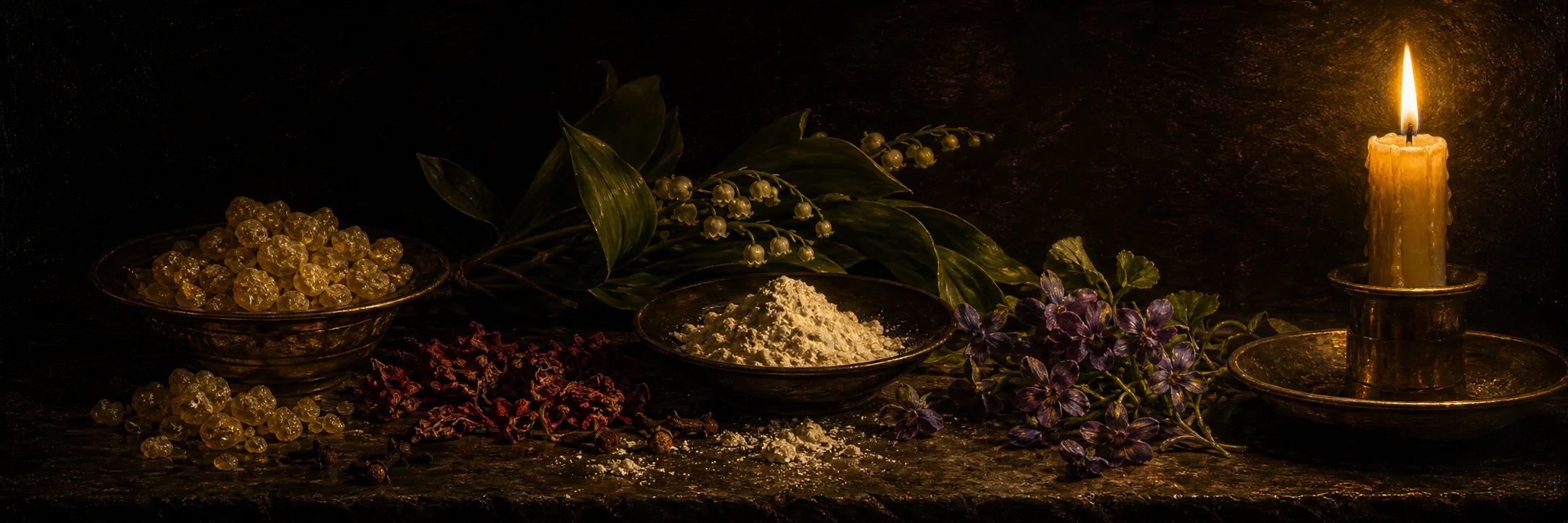
Coverage is thin and comes mainly from a handful of vintage-collector accounts (wearer feedback’s John Biebel article and comments, the Perfume Charm blog), so stage timing should be read cautiously and with the caveat that surviving bottles vary with age. The picture that emerges: a brightly floral, mildly amber opening led by a “high-pitched” violet blossom with iris, threaded throughout by a sweet, persistent incense. The heart adds spicy carnation, a green sappy galbanum, and lily-of-the-valley; one detailed wearer reports “gummy-green galbanum layered over a sonorous violet-iris incense” with “spicy rose, peppery carnation” as it advances. The drydown grows smokier and muskier over sandalwood and musk. Several note the absence of heavy oakmoss/patchouli, which is precisely why John Biebel and others find it “shockingly modern” - minimalist and focused, “as though some notes were removed so that only the essential elements remained.” Signature impression: spicy violet-iris over a steady incense thread. A dissenting view (Perfume Charm) finds the materials “muted,” with bitter galbanum unbalanced by sweetness - “a pleasant floriental, but it isn’t transporting me to ancient Arabia.” Note: a couple of vintage listings circulate an alternate note set (aldehydes/rose/ylang/patchouli), likely reflecting different concentrations or seller guesswork; the incense-iris-violet/carnation-galbanum-LOTV/sandalwood-musk structure is the one tied to the catalog and the most-cited reviews.
Performance
Evidence is thin and based on aged bottles, so treat with caution. The strongest single account (wearer feedback) reports it as surprisingly potent and tenacious: “pretty strong off the bat” with long longevity and “far reaching sillage,” to the point of advising against over-application, and notes the scent clinging to a sweater “over a week” after wear, with musk emerging within an hour and lasting a “good 6-8 hours” on skin (longer on fabric). wearer feedback’s directory characterizes projection as above-average. Given conflicting “muted” impressions elsewhere, the safest synthesis is that well-preserved Khadine projects assertively for a 1960s floral, but bottle condition heavily determines the experience. No reliable modern weather/application consensus exists.
Wearing Context
Practical reading (not consensus, given sparse coverage): a cool-weather, evening or “dressed-up” scent. Its incense-spice-carnation backbone and serious, somewhat formal character suit autumn/winter and occasions where a vintage, sophisticated floral-oriental feels appropriate rather than a casual daytime fresh floral. One wearers calls it “one s-p-i-c-y lady… for the seriously spicy aficionado.” Social-perception skew, inferred from the documented profile: distinctive, mature, and faintly “exotic/bohemian” in line with its hippie-era Persian-fantasy marketing.
Comparisons & DNA
Hard comparisons are limited by scarcity, but several recur. Modern wearers repeatedly invoke Prada Infusion d’Iris (“renovated her yoga room into a boxing gym and started vaping,” per one memorable wearer feedback line) as a reference point for the iris facet - i.e., Khadine as a spicier, incensey cousin. John Biebel’s research traces it into the same mid-1960s “exotic”-marketing lineage as Emilio Pucci Vivara (1965) and Molyneux Vivre, and one wearer felt the drydown turned “very much like Pucci Vivara.” Within its own decade it belongs to the late-60s incense/iris/violet/carnation floral-oriental family alongside the era’s Diorling, Calèche, and Chamade-adjacent feminines (a reasonable DNA placement rather than a sourced equivalence). No modern dupe exists; a “type” recreation is sold by an indie recreation service, but that is not a comparison to an actual mainstream fragrance.
Reception
Genuine wearer consensus is impossible to establish - there are very few responses (Available wearer feedback suggests essentially none; Available wearer feedback suggests only a small cluster of comments). The available sentiment is affectionate and curiosity-driven rather than a broad verdict. Praise: nostalgia, the “modern”-feeling minimalist incense-violet structure, surprising strength, and gorgeous period packaging. The most substantive coverage is John Biebel’s wearer feedback retrospective (“Khadine: Unexpected Treasure from the Past”), which treats it as an archaeological “relic” worth dusting off and notes how thoroughly it has vanished - “I’ve never seen Khadine in the wild.” The main critical note is the “muted/underwhelming” verdict from the Perfume Charm blog, which speculates Khadine was discontinued because “the fragrance just wasn’t good enough.” Blind-buy verdict: not applicable in the normal sense - acquisition is a vintage hunt, and the advice from those who’ve worn it is that it’s better on skin than in the (sometimes aldehyde-cheap-smelling) bottle.
Versions & Reformulation
No reformulation in the modern sense, but the line went through a documented packaging redesign and multiple concentrations/formats. Per Perfume Charm: original ~1967 presentation used pressed-glass splash bottles with a green-and-gold cap and millefleur-flowered paper (the most commonly sold was the cologne concentré); circa 1972 a complete redesign introduced purple-and-white packaging with a classical purple onion-dome lid and gold-embossed “Khadine.” It was sold as perfume, cologne mist/concentré, perfumed powder, and bath oil. Discontinued around the early 1980s; the trademark was abandoned in 1992.
Acquisition Notes
A vintage-collector item with no current retail. It is genuinely scarce - collectors note it rarely surfaces even at antique stores (unlike ubiquitous vintage No. 5 or Arpège). When found, formats include the cologne concentré splash, small mini sprays (e.g., a boxed 27g mini spray), perfumed powder, and bath products. Channels are eBay/Etsy/estate sales and collector swaps; condition and concentration vary enormously, and surviving juice may be aged. Buyers should expect top-note degradation and verify format. No batch-code system or counterfeit problem is documented - the risk is condition and authenticity of vintage stock, not active faking.
Notable Facts & Lore
- Khadine’s marketing is its richest lore.
- Yardley built an orientalist fantasy around a fictional harem favorite, with box copy reading: “Who was Khadine?
- She was The Favoured One, chosen by the greatest ruler in all the East to be the favourite of his harem… surrounded always by a subtle, luxurious fragrance.“ A large plaster/plastic in-store display statue (marked “1967 Yardley of London, Inc.”) was used in Yardley’s New York store, signaling a high-budget launch.
- John Biebel situates the campaign in its historical moment: only about a decade before the 1979 Iranian Revolution, its idealized “Persian romance” exoticism would soon read as naïve.
- A charming human footnote from the Perfume Charm comments: a reader was named “Khadina” after the perfume around 1973, when it was apparently re-promoted.
- The perfumer of record is Raymond Chaillan (corroborated by both wearer feedback and the Now Smell This perfumer index); no documented statement from him about Khadine specifically appears in the available sources.