Acqua dell'Elba — Bimbi
Essence
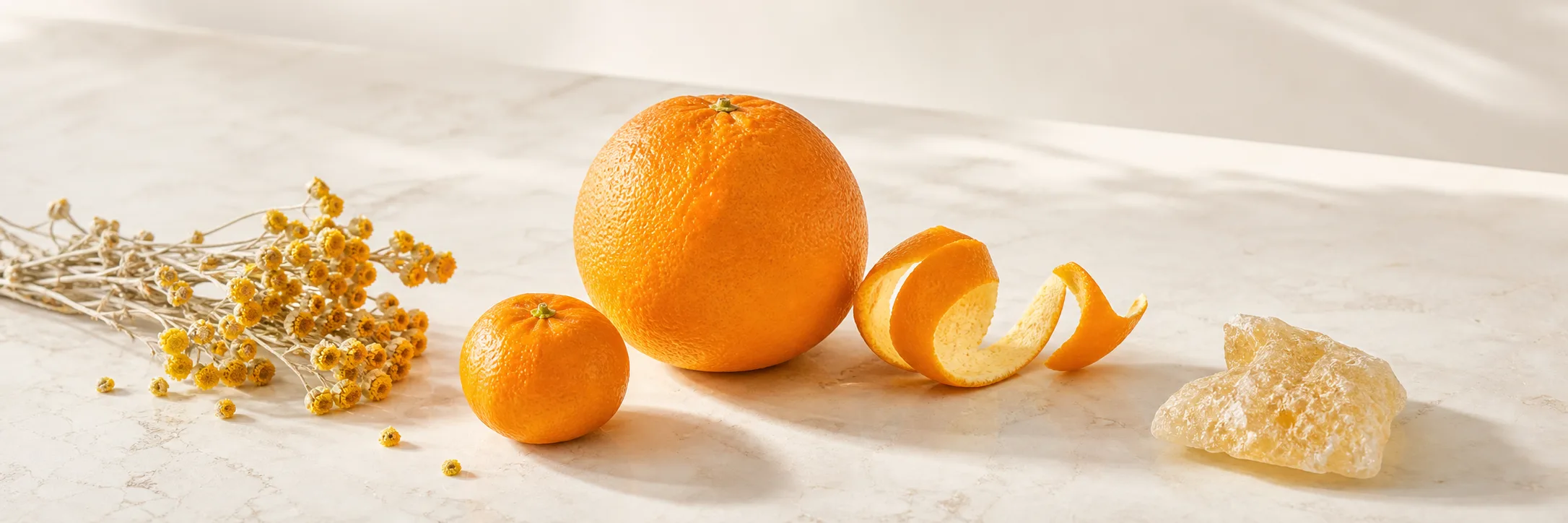
Bimbi — Italian for “children/kids” — is Acqua dell’Elba’s light citrus eau de cologne conceived as a gentle fragrance for children, though it has been quietly adopted by adults and is now catalogued unisex. It is the simplest, airiest composition in the house: a clean, juicy orange-and-mandarin citrus that dries down greener and more herbal than its sweet top suggests, with a soft immortelle/labdanum warmth keeping it from being merely a cologne splash. Think of it as a wearable, low-stakes Mediterranean citrus designed for heat and for skin that wants something inoffensive and fresh.
Scent Profile
With no heart or base notes published in the catalog, Bimbi must be read through its accords (citrus, herbal, amber, warm-spicy) and the limited documented wearer description — which is genuinely sparse, so this is a cautious sketch rather than a confident pyramid. The opening is a bright, juicy citrus dominated by orange and mandarin: “so juicy fresh and delicate,” in one parent’s words, and broadly in line with the house’s natural-smelling, non-screechy citrus signature (the same quality praised in its siblings, where the orange is “not screechy, synthetic citrus”). It is sweet-but-clean rather than sharp.
The development is where the most useful documented detail lives. wearer notes’s most substantive review describes a fragrance that “while there is obviously citrus in there… dries down to a very green, herbal scent,” and likens it to “a powerful childhood memory of the smell of giant orange wild nasturtiums warming in the sun after summer rain.” So the arc runs juicy citrus → green-herbal, with the immortelle (helichrysum) supplying a dry, slightly honeyed-herbal warmth and the labdanum a soft amber underpinning that, per the warm-spicy/amber accords, rounds the base without making it heavy. The same reviewer stresses that “whilst there is obviously citrus in there… there’s certainly nothing childish about it” — i.e., on adult skin it reads as a competent green-citrus cologne, not a juvenile candy scent. Perceptible: orange/mandarin up top, a green-herbal middle, a faint warm-amber close. Submerged/ambiguous: the labdanum and immortelle work more as background tone than identifiable notes. Linearity is fairly high — this is a citrus cologne with a green-herbal turn, not a multi-act evolution.
Performance
Bimbi is, by design and by data, a light and fleeting fragrance — appropriate for an EDC marketed at children. wearer notes’s wearer voting puts longevity at roughly qualitative and sillage at qualitative, both below average, and the most concrete review reports “good projection and an acceptable longevity (3 hours) for a citrusy perfume” on a child’s skin. That ~3-hour, soft-projection profile is the honest expectation: a refreshing burst that needs reapplication, with the green-herbal drydown lingering closest to skin. As a low-concentration citrus EDC it will fade fastest in heat even as heat is its ideal context (it “paired perfectly with the boiling heat in Genoa”). No documented humidity- or cold-specific data exists, and the wearer review base is too small to generalize confidently — flagged as a genuine data gap. Best strategy is liberal, frequent application and acceptance of cologne-like transience rather than any expectation of projection or all-day wear.
Wearing Context
Bimbi is a hot-weather, daytime, casual scent — its natural home is high summer, the beach, and warm-climate errands where a light citrus is exactly right. Its original brief (a children’s cologne) makes it inherently gentle, clean and crowd-safe, and adults who have adopted it use it as an easy, unobtrusive everyday freshener — “a wonderfully clean, light fragrance” that evokes summer and Italian seaside memory. It shines as a refresher and a “no-thought” warm-weather splash, and as a genuinely unisex option given its uncomplicated citrus-green profile. It falls flat anywhere that calls for presence, longevity or sophistication — evenings, cold weather, formal occasions, or any context where you need the scent to last or project. Social-perception skew is neutral-to-positive: clean and inoffensive, with no gendered or age-coded loudness.
Comparisons & DNA
Bimbi belongs to the classic light-citrus-cologne lineage, so its comparisons are eaux de cologne and Mediterranean citrus splashes rather than complex perfumes. Within the house, it is the lightest sibling to Acqua dell’Elba Classica Uomo/Donna (more aquatic-floral) and the Blu line (more citrus-woody-marine); it shares the brand’s “natural, non-screechy citrus” DNA but at the lowest concentration and complexity. The most apt external comparisons are traditional citrus colognes: 4711 Echt Kölnisch Wasser (the archetypal sharp-clean citrus cologne — Bimbi is sweeter, juicier and greener in drydown); Acqua di Parma Colonia / Arancia di Capri (Italian citrus benchmarks — Colonia drier and more refined, Arancia sweeter-orange and similarly simple); and Goutal Eau d’Hadrien (brighter lemon-cypress, classier, also short-lived). Its green-herbal turn and immortelle warmth give it slightly more character than a pure cologne, nudging it toward sunlit-herbal territory. No Armaf/Lattafa/Maison Alhambra clone exists — a niche children’s citrus EDC is not a clone target. As lineage, Bimbi descends straight from the eau-de-cologne tradition and starts no trend; it is a gentle, regional entry in a very old genre.
Reception
This is the thinnest-documented fragrance in the batch, and that must be stated plainly: there is no documented critical review of Bimbi anywhere in the documented source list (Çafleurebon covered other Acqua dell’Elba scents but not this one), and wearer notes had zero member reviews at last check (“Write the first Review”). Reception rests on a very small number of documented wearer notes entries, so no real “consensus” can be claimed — silence here is absence of coverage, not absence of merit. The available signal is positive but tiny: one detailed reviewer who discovered it in a Genoa grooming shop calls it “a wonderfully clean, light fragrance… nothing childish about it,” prizing its green-herbal drydown and summer-memory association; a parent reports their nearly-eight-year-old son “loves wearing it.” A separate wearer notes commenter who sampled across the line grouped Bimbi with Blu and Arcipelago as “high quality… crowd pleasing.” The only consistent criticism is implicit and structural — light performance befitting an EDC. Blind-buy verdict: low-risk precisely because expectations should be low. If you want a gentle, genuinely unisex summer citrus and accept cologne-grade longevity, it is a safe, pleasant buy; anyone wanting projection, complexity or value-for-concentration should look elsewhere. Sample if possible, but the downside of a miss is small.
Versions & Reformulation
Bimbi is an eau de cologne (the house’s lightest concentration). It appears in databases under both “Bimbi” and “Bimbo,” and wearer notes notes it was “originally intended as a fragrance for boys” before being recategorized unisex — a positioning shift rather than a reformulation. No dated reformulation is documented in documented sources. Treat as a single composition; the only real variation to watch is the name (Bimbi/Bimbo) and the EDC concentration.
Acquisition Notes
Bimbi sits at the more accessible end of the house’s niche pricing, consistent with its EDC concentration and children’s-cologne brief, and is typically sold in a 50 ml format. The decant ecosystem is essentially nonexistent — it is not carried by major US splitters, and the only practical sampling route is the brand’s discovery sets or buying a small bottle outright; in-person discovery (Italian grooming shops, on-island, the e-boutique) is how most wearers encounter it. Counterfeiting is not a documented concern for so low-profile a product. No batch-code decoding guidance exists in documented sources. Buy from the official Acqua dell’Elba e-boutique, the authorized US distributor, or Italian retailers; confirm you are getting the Bimbi EDC and not a higher-concentration sibling.
Notable Facts & Lore
- Bimbi means children, and the fragrance began as a gentle cologne for kids.
- Adults have quietly adopted it because the green-citrus drydown does not read childish.
- Perfumer and launch year are undocumented in the available record.
- Its charm is small-scale and practical: a family-friendly summer citrus from an island house.