Acqua dell'Elba — Classica Men
Essence
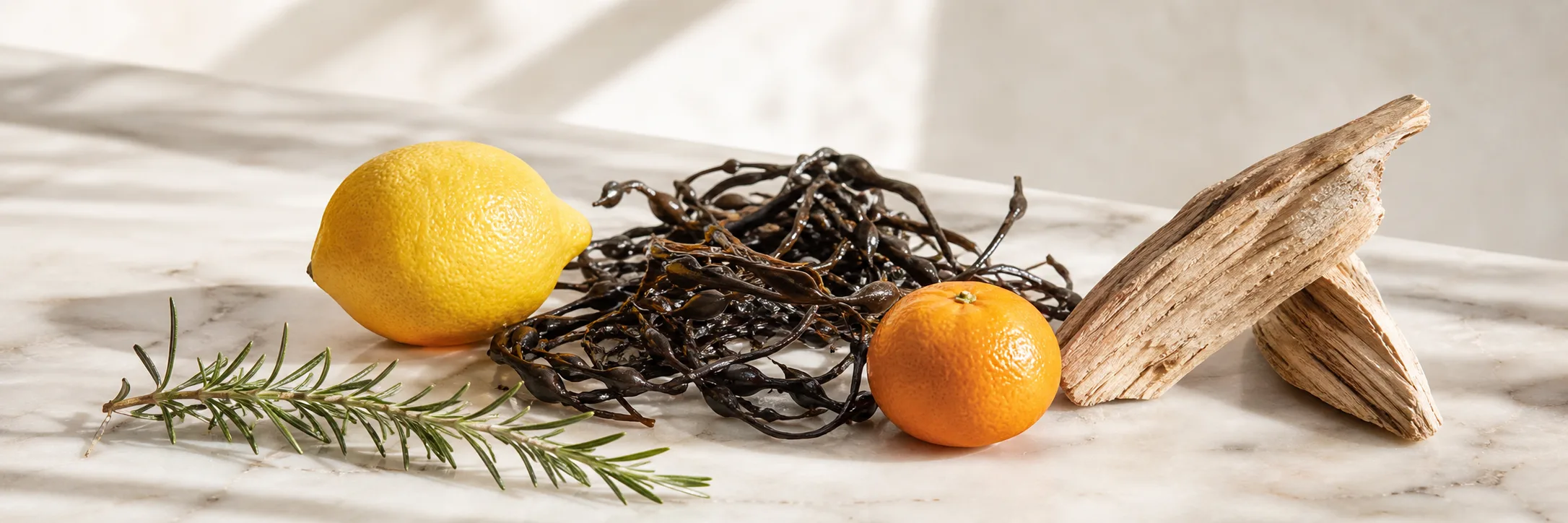
Classica Men is the masculine half of Acqua dell’Elba’s 2001 debut and the fragrance that launched the Elban house. It is a fresh-aquatic citrus built around a lemon–mandarin–rosemary opening and a distinctive, almost edible seaweed note that the wearer repeatedly singles out as its signature. The clearest reference point is Acqua di Gio, but Classica reads as a more natural, better-blended, lower-projection take on that Mediterranean blue template — “the Med in a bottle” rather than a department-store sport scent. Sold as both EDT and EDP.
Scent Profile
Catalog facts list only top notes (seaweed, lemon, mandarin orange, rosemary, woody, musk) with no documented heart or base pyramid, so what follows is read from accords and consistent wearer wear reports rather than an official structure. The opening is citrus-forward and, per multiple wearer notes wearers, reads almost like “lemon spongecake” — ripe rather than sharp, with mandarin rounding the lemon into something sweeter and more natural than a typical synthetic citrus blast. Within the first ten to twenty minutes rosemary arrives as a restrained aromatic lift; one detailed wearer notes review describes “ripe citrus fruits with a hint of rosemary,” explicitly more summery and natural than the mandarin in Bvlgari Aqva Amara or Acqua di Parma’s Arancia di Capri. By the one-hour mark the citrus cedes to the fragrance’s defining accord: a salty seaweed/marine note that wearers describe as surprisingly beautiful rather than off-putting (“the seaweed note is truly beautiful”). This marine-citrus pairing is the signature accord and the through-line of the whole wear. The drydown, again per wearer reports and the house’s own “lemon, rosemary and moss” description, settles into a soft, sun-warmed mossy-woody base — one wearer notes reviewer evokes “warmed moss … dry, earthy, grassy,” Mediterranean rather than damp-forest. Musk and generic woody notes provide a clean, skin-close finish. The progression is best characterized as gentle evolution rather than strict linearity: a citrus-to-marine-to-moss arc, but a quiet one, with everything kept transparent and “airy.” Perceptible throughout: lemon/mandarin early, seaweed in the heart, dry moss late. Submerged or faint: the rosemary (a hint, not a herbal blast) and the woody-musk base, which several wearers can barely detect. The defining caveat is variability — some skins get a full, long arc; others report the citrus and middle notes nearly vanish, leaving only a faint woody trace.
Performance
Performance is the single most polarizing axis and clearly skin-dependent. Projection is generally light to moderate — wearers repeatedly call it “airy,” “understated,” and “very low sillage,” explicitly NOT a “blow-out-your-nostrils projection monster like AdG.” Longevity reports diverge sharply: at the strong end, one committed wearer notes wearer reports “nine, ten hours” depending on application, and a wearer notes user got “more than 6hrs”; in the middle, many describe a strong first hour that “quickly retreated to an almost intimate skin scent”; at the weak end, multiple users report near-total collapse (“basically gone in 14 mins,” “can’t smell it after 5 minutes,” sample wearers smelling “only a very subtle woody scent”). On clothing it is far more tenacious — one wearer notes a few sprays on fabric lasting essentially until washed. Best read: skin longevity is a coin-flip 3–6 hours for most, with outliers in both directions; fabric longevity is excellent. Suited to heat and humidity, where the marine-citrus reads as refreshing; in cold it falls flat. Best application strategy per wearer: spray generously and onto clothing, since skin alone underperforms for many.
Wearing Context
This is a daytime, warm-weather scent: late spring, summer, and early fall, beach and seaside contexts, casual and office-safe wear. Wearers describe it as “the most accurate depiction of summer at the beach” and a reliable “mood lifter” for hot days. It is broadly inoffensive and reads clean and “fresh,” generating positive close-range compliments (one wearer notes it “elicits positive comments when close to a female”) precisely because it is intimate rather than loud. Where it shines: hot, humid Mediterranean-style days, holiday and vacation settings, anyone wanting an ADG alternative that smells more natural. Where it falls flat: cold weather, formal evening occasions, and any situation demanding projection or longevity, where its quiet performance disappoints. Socially it skews masculine but is widely worn as unisex (“both masculine and unisex to me”). It is a connoisseur’s quiet-freshie, not an attention-grabber.
Comparisons & DNA
The dominant comparison, made on nearly every forum, is Giorgio Armani Acqua di Gio — Classica shares the citrus-salty-marine vibe but is “definitely more understated, smooth and beautifully blended,” more natural and less “chemical/sporty.” wearer notes regulars judge it closer to Acqua di Gio EDP / ADG Essenza than to the EDT, and several say that given ADG EDP’s pricing they “would choose Classica any day” — though detractors find it weaker. Within the house, Classica is the citrus-marine baseline that sits between the sea-themed Blu Uomo and the spicier island scent Arcipelago Uomo; wearer members explicitly map Acqua dell’Elba’s line onto designer DNA (Classica→Acqua di Gio, Blu→Allure Homme Sport/Dior Homme Cologne, Sport→Allure Homme Edition Blanche), calling the house “a clone company” in a half-admiring way for its natural-materials execution. Other marine adjacents cited: Creed Erolfa (saltier, pricier), Bvlgari Aqua/Atlantique (more generic, brinier), and Profumum Roma Acqua di Sale in the saltier register. Designer/clone alternatives running the opposite direction: for those who want the ADG profile with more punch, forum users point to Acqua di Gio Profondo and budget option Perry Ellis 360 Red; a contrarian wearer notes review suggests Franck Olivier Blue Touch as a cheaper, better-blended aquatic. There is no Lattafa/Armaf/Maison Alhambra direct clone of Classica itself — the cloning runs the other way, with Acqua dell’Elba positioned as the natural-materials “niche” interpretation of the mass aquatic trend.
Reception
Wearer consensus (wearer notes, wearer notes, wearer notes, online forums) is genuinely split but skews positive among those who own it. Praise: natural, high-quality blending; the standout seaweed note; “superb” quality and a convincing summer-at-the-beach effect; better materials than ADG. Criticism clusters on two points: performance (the weak-longevity camp is loud, with multiple “gone in minutes” reports) and value, with one blunt wearer notes review calling it “overpriced … bathroom soapy and the rosemary is way too pronounced.” A recurring meta-theme is bafflement that the house “isn’t more talked about.” On the “blind buy?” question, the wearer notes forum verdict is a qualified yes — “if you like AdG, Classica men is a perfectly safe blind buy” — but several caution that performance is skin-dependent enough to warrant a sample first. No documented critic (Turin/Sanchez, Burr, Beaulieu, NST, Bois de Jasmin, Persolaise) reviewed Classica Men specifically; Cafleurebon has covered the house warmly but reviewed the women’s Classica Donna, not the men’s. documented critical coverage of this exact reference is therefore thin, and reception rests on documented wearer sentiment.
Versions & Reformulation
Classica exists in both Eau de Toilette and Eau de Parfum concentrations (the house currently markets the EDP as “Classica Uomo”; the catalog reference here is the EDT). Per the brand’s own guidance (acquadellelba.us), “EdP contains a higher concentration of perfume oils … (10-20%, usually around 15%) than an EdT (5-10%),” and “an EdT wearer may expect two or three hours of fragrance, the wearer of an EdP may expect the fragrance to last four or five hours.” At least one wearer notes wearer who tried both reports the EDP is “stronger than the edt” but otherwise the same scent. No formal reformulation has been documented in documented sources, though the line has run continuously since 2001 and batch-to-batch variability is plausible given the small-batch artisanal production. Treat as: single composition across two concentrations, no documented reformulation.
Acquisition Notes
Pricing is entry-niche/affordable-niche: roughly €57 starting on the Italian site, about $80 for 100ml on the US boutique, with 50ml and 15ml travel sizes plus discovery vial sets (~$15). Bottle sizes: 15ml, 50ml, 100ml. Distribution is the key friction — the brand sells primarily through its own single-brand boutiques (33 single-brand shops per Il Sole 24 ORE, 9 Sept 2025, plus “a distribution network of over 1,000 selected perfumeries in Europe and beyond”), concentrated in Italy and touristy European locations (Lucca, Florence, Venice, Portoferraio), with one US branch and one in China; it is rarely in mainstream third-party brick-and-mortar outside Italy, so many buyers blind-buy or sample. The traditional US decant ecosystem (Surrender to Chance, Scent Split, MicroPerfumes) coverage is not confirmed in documented sources; the most reliable sampling route is the house’s own “Originals for Him” / discovery sample sets. Counterfeiting is not a documented problem for this low-profile house. Buy authentic from acquadellelba.com (EU) or acquadellelba.us (US), or in-person at a boutique.
Notable Facts & Lore
- Classica Uomo is historically important as the fragrance that launched the brand in 2001.
- The founding workshop opened in Marciana Marina, close to the sea, at the end of 2000.
- Its stated aim is to bottle Elba’s core materials: flowers, citrus, herbs, and the sea.
- Its under-the-radar reputation is part of the lore: many wearers discover it by accident in Italy.