Burberry — Brit for Her Eau de Toilette
Essence
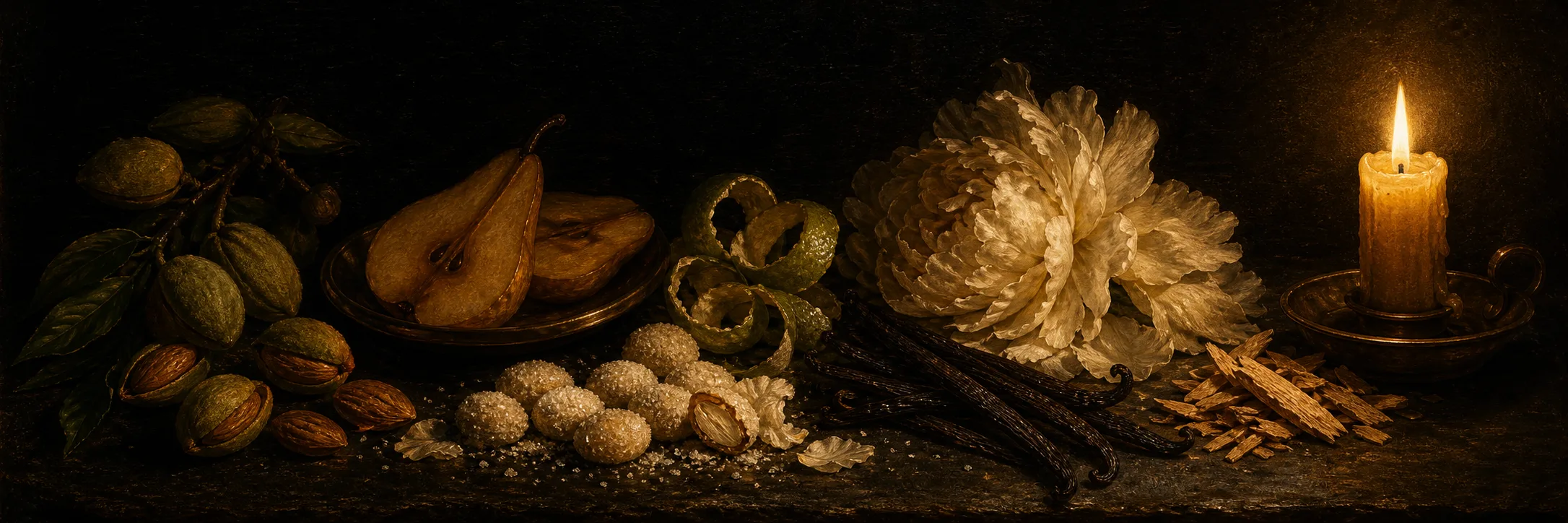
Brit for Her EDT is the lighter, more citrus-forward sibling of Burberry Brit (the 2003 Nathalie Gracia-Cetto original); the EDT version arrived in 2004. It’s a sweet almond-vanilla gourmand-floral hybrid: crisp lime and frosted pear up top, sugared/candied almond and peony in the middle, vanilla-amber-mahogany underneath. The EDT distinguishes itself from the EDP by adding a lemongrass note and pushing the bright citrus forward, making it the fresher, more wearable “diet” cousin of the denser EDP - a cozy, comforting, inoffensive everyday sweet.
Scent Profile
The notes manifest very literally - this is a “what you see is what you get” composition with no niche sleight of hand. The opening (first 10-20 minutes) is the freshest and most citrusy phase, and the clearest point of difference from the EDP: Italian lime and icy/frosted pear sparkle brightly, lifted by a lemongrass facet (present in the EDT, absent from the EDP’s note list). Green almond sits underneath, slightly nutty and crisp rather than sweet yet. This is the “ice-cold pear drizzled with lime, underneath sparkling almond fizz” stage. The citrus is bright, sparkly and crystalline rather than sour.
The heart (1-3 hours) is where the candied/sugared almond and sugar take over and the fragrance reveals its true gourmand-leaning self: sweet almond-and-sugar with a soft peony floral providing a powdery-pink lift. The fruit’s “plastic doll” pink sweetness fades somewhat from the opening, and the almond becomes the spine of the scent. Peony is perceptible but functions as a soft floral cushion, not a star. This is sweet-on-sweet - described by one critical review as “pure almond-vanilla icing.”
The drydown (3+ hours) is warm and vanillic: vanilla dominates, with amber adding warmth and a faint mahogany providing a smooth, “buttery sandalwood-like” texture (despite no sandalwood being listed - wearers consistently detect a creamy, milky, “warm skin” quality). The mahogany is subtle; this is not a woody fragrance. Many note a soft musky “your skin but better” effect. Skin-scent stage is creamy almond-vanilla with a citrus memory. Evolution is modest - fresh-citrus-almond into sweet-almond-vanilla - so it’s better described as fairly linear with a citrus-to-vanilla arc. The signature accord is candied almond over vanilla, with the lime keeping it from cloying.
Performance
Performance is the recurring weak point and the main complaint. On skin, longevity is moderate at best - commonly 4-6 hours, with many wearers noting it fades fast and stays close. Projection is light-to-moderate; sillage is gentle. The standout, repeatedly emphasized, is clothing performance: it lasts dramatically longer on fabric - “the toilette lasts forever,” “ten hours on my clothes” - so spraying clothing/scarves is the recommended strategy for longevity. The EDT is also reported to handle heat and humidity better than the heavier EDP, which can turn amber-dominant and cloying in the sun; the EDT’s lime keeps it wearable in warm weather, though it’s most beloved as a cool-weather cozy scent. Best application: spray clothing plus pulse points; expect a soft personal aura rather than a room-filler.
Wearing Context
A versatile everyday/casual scent that leans cozy: autumn and winter are the sentimental favorites (the “comfy knit sweater, crisp autumn morning” associations recur constantly), but the EDT’s freshness makes it genuinely year-round, and some specifically prefer it on hot days where the lime-pear reads as refreshing. Office- and daytime-friendly, “no one will be scent-offended.” Strongly coded feminine and youthful in social perception - frequently described as a high-school/college first-love fragrance, a “soft girl energy,” or a Y2K-era classic, though many wear it well into adulthood and read it as elevated-cozy rather than juvenile. Where it falls flat: anyone wanting projection, complexity, or an evening statement - it’s a comfort scent, not a performer.
Comparisons & DNA
The clearest internal comparison is to its own Burberry Brit EDP - wearers shorthand is exact: “EDP is scrumptious and fat. EDT is a citrusy diet version.” The EDP is sweeter, denser, more vanilla-and-almond-forward and longer-lasting; the EDT is brighter, limier and easier in heat. Externally, Brit is repeatedly likened to Juicy Couture Viva la Juicy Gold Couture (a “grown-up version”) for the warm caramel-almond sweetness, and Brit’s almond places it near the sugared-almond/cherry-almond family. For the almond-vanilla-gourmand lane, comparisons reach to Lancome La Vie Est Belle (more praline/iris and far louder) and various cheaper almond gourmands. Brit’s nearest housemate confusions are with Burberry London (a heavier white-floral, different character) and the Brit Sheer/Brit Red flankers (Sheer is the citrus-lychee freshie; Red the spicier, harder-to-find cult favorite). Direct designer clones aren’t really necessary given Brit itself is affordable; budget almond gourmands approximate the candied-almond effect but rarely the lime-pear top. Lineage: a 2003-2004 landmark in mainstream sweet “candied/gourmand floral,” cited as one of the sweetest mass-market scents of its era and a gateway fragrance for a generation of wearers.
Reception
Consensus across wearers is warmly affectionate, with heavy nostalgia weighting - for many it was a first signature and a sentimental favorite, praised as comforting, cozy, classy-but-approachable, and a reliable compliment-getter. The dominant criticism is uniformly performance/longevity on skin. A secondary polarization is the sweetness itself: some find the candied-almond-vanilla blissful, others find it nauseatingly saccharine. A notable critical take from one critic, reviewing the EDP but speaking to the same DNA, memorably frames Brit as “Barbie: the perfume” - “sugar on sugar on pure almond sugar,” “an iconic landmark in the land of perfume sweetness,” cutesy yet somehow adult - praising it as “sincere” and distinctive while admitting it’s among the sweetest things they’ve tried. Brit won the 2004 FiFi “Fragrance of the Year - Women’s Luxe” (department/specialty stores, 250+ doors) at the 32nd annual FiFi Awards on June 9, 2004, a marker of its immediate impact. Blind-buy verdict: very safe blind buy for anyone who likes sweet almond-vanilla and isn’t chasing performance - it’s cheap, near-universally pleasant, and low-risk; skip only if you dislike sweet gourmands or need projection/longevity. No major critic review surfaced specifically for the EDT.
Versions & Reformulation
Two main concentrations: the 2003 EDP (almond, lime, pear / candied almond, sugar, peony, dragee / vanilla, tonka, amber, mahogany) and the 2004 EDT reviewed here, whose note list per wearers is “Green Almond, Lime, Pear and Lemongrass; middle notes are Almond, Sugar and Peony; base notes are Vanilla, Mahogany and Amber” - lighter, fresher and more citrus-driven via the added lemongrass. Wearers consensus: EDP is sweeter/denser/longer; EDT is brighter and better in heat - and a sizable minority finds them very similar on skin. Some wearers report slight reformulation over the years (newer batches a touch lighter or more synthetic), but the core candied-almond-vanilla identity is intact and performance broadly holds. Flankers in the wider Brit family (Brit Sheer, Brit Red, Brit Rhythm) are distinct compositions, not concentration variants. Packaging note: the EDT historically came in a bottle without the iconic classic-Burberry design, which some longtime fans found disappointing.
Acquisition Notes
Designer / affordable pricing - among the better values in mainstream designer; large bottles routinely available well under $100 and often $30-$50 on grey-market/discounter sites. Sizes commonly 30/50/100 ml EDT.
Notable Facts & Lore
- Brit launched in 2003 during Burberry’s Christopher-Bailey-era brand renaissance (trench-coat heritage modernized into a fashion powerhouse), and the fragrance’s plaid-and-trench British-cozy positioning is deliberate. Perfumer Nathalie Gracia-Cetto (Givaudan) created it and won the 2004 FiFi for it, following up with Brit Red the next year. There’s no single dominant celebrity-signature lore, but the cultural read is remarkably consistent in the wearers - Brit is repeatedly cast as the scent of a specific feminine archetype (the cozy, put-together young woman; “Margot Robbie’s signature scent” in The Scentaur’s Barbie framing). It endures as a nostalgic Y2K-era gateway fragrance rather than a viral or controversial one.