Lattafa — Ameer Al Oud Intense
Essence
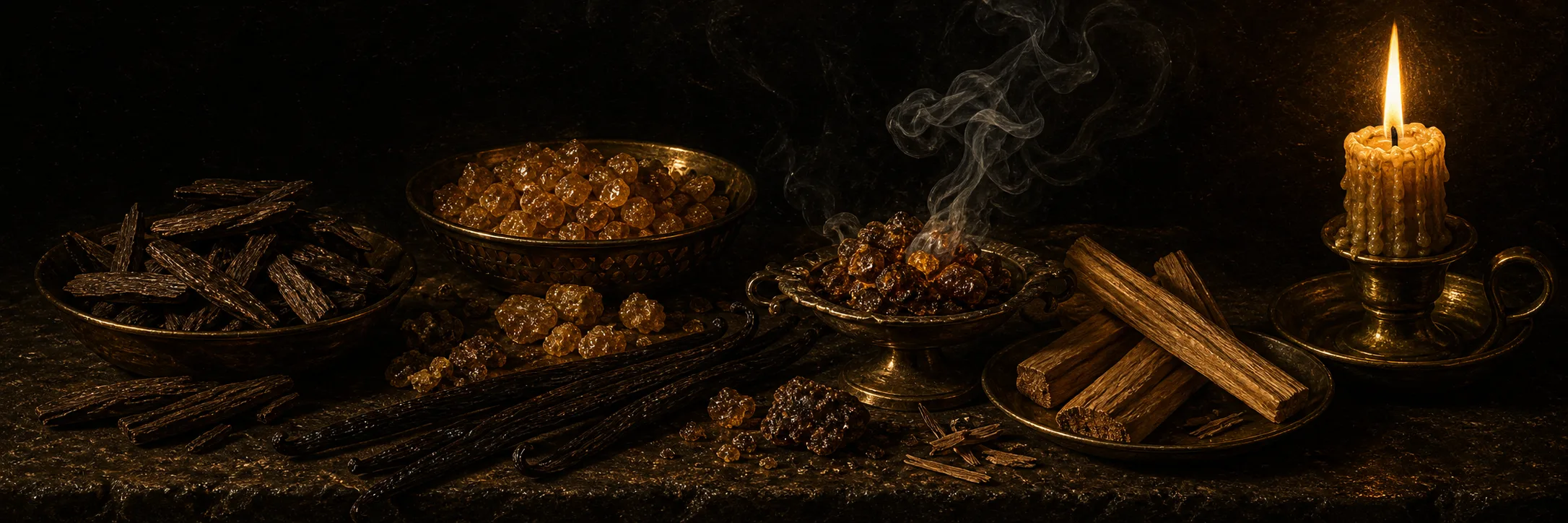
Ameer Al Oud Intense represents the quintessential Middle Eastern adaptation of the smoky-gourmand genre, defined by a stark duality between carbonized, resinous agarwood and a viscous, caramelized vanilla-sugar heart. Often termed the “Prince of Oud,” the composition functions less as a traditional Western woody fragrance and more as an olfactory recreation of high-grade bakhoor being heated over charcoal, eventually yielding to a dense, balsamic sweetness. Its distinctiveness lies in its massive structural density and its “roasted marshmallow” signature accord, which provides a heavy, opulent trail that eschews the medicinal or “barnyard” facets of raw oud in favor of a toasty, incense-driven warmth.
Scent Profile
The olfactory progression of Ameer Al Oud Intense is a dramatic narrative of fire yielding to syrupy sustenance. The opening phase, encompassing the first 15 to 20 minutes, is characterized by a high-impact, industrial-strength surge of synthetic agarwood and “woodsy notes” that many users describe as sharp, acrid, or even slightly chemical. This is not a “fresh-cut” wood scent; it is the smell of wood that has already been set ablaze, dominated by a dry, resinous smoke that mimics a campfire. The agarwood here is presented in its “burnt” form, providing a rugged, masculine foundation that commands immediate attention. While a “medicinal” quality is often noted in the first sprays, this acridity is a functional precursor to the sweetness that follows. As the fragrance moves into the heart stage (1 - 3 hours), the initial carbonized bite dissipates, allowing the “sugar” and “vanilla” notes to ascend. This transition is the defining moment of the fragrance, where the “baklava” meets the “fireplace”. The sugar note manifests as a dark, balsamic caramel - resembling sugar heated to the point of browning rather than a light confectionery dust. The vanilla is equally dense, providing a thick, creamy counterweight to the lingering smoke. During this mid-stage, the listed “agarwood” note shifts from a primary actor to a supportive, structural role, ensuring the gourmand facets maintain a “noble” and “enchanted” character rather than becoming cloying. The drydown, reaching its peak after 3 to 4 hours, is remarkably linear and focuses on a lingering, smoky-vanilla trail. The base is anchored by a soft sandalwood that provides a “milky” texture, though it remains secondary to the dominant “roasted marshmallow” accord. The “herbal notes” listed in the pyramid are largely submerged, appearing only as a slight, cooling earthiness that some perceive as “wet grass” or “rain-soaked earth” after the fire has cooled. This stage creates a persistent, “huggable” skin scent that retains a slight ashy undertone. Note Manifestation and Perception Analysis
| Listed Note | Manifestation in Wear | Perceptibility Level |
|---|---|---|
| Agarwood (Oud) | Initially sharp/burnt; later smoky/resinous. No barnyard or animalic funk. | High (Opening/Heart) |
| Sugar | Viscous, balsamic, caramelized; provides the “burnt sugar” edge. | Very High (Heart/Drydown) |
| Vanilla | Dark, creamy, and non-powdery; provides the “marshmallow” texture. | High (Heart/Drydown) |
| Woody Notes | Dry, carbonized, and incense-like; distinct from fresh cedar or pine. | High (Opening) |
| Sandalwood | Soft, milky, and structural; prevents the base from becoming too thin. | Moderate (Drydown) |
| Herbal Notes | Faint, earthy, or cooling; often perceived as a “green” or “rainy” undertone. | Low (Drydown) |
Performance
Ameer Al Oud Intense is a performance outlier, even within the context of Middle Eastern powerhouse fragrances. Its longevity is its most lauded attribute, with consistent reports of 10 to 12 hours on skin and near-permanent residency on clothing. Fabrics, particularly winter coats and scarves, can retain the smoky-sweet scent for weeks, even surviving multiple laundry cycles. Projection is extremely potent for the first 60 to 90 minutes, easily radiating beyond arm’s length (2+ meters) and filling a room with a thick, resinous cloud. After this period, it settles into a more moderate but still significant scent bubble that remains detectable to bystanders for the duration of the wear. The sillage - the wake left behind the wearer - is dense and “chewy,” often characterized by others as “burnt sugar” or “flavored hookah smoke”. The fragrance is highly reactive to temperature. In cold, dry environments, the smoke and vanilla notes contract into a “cozy,” radiating warmth that is pleasant and inviting. However, in high heat and humidity, the composition expands aggressively; the sugar and synthetic oud can become cloying, “headache-inducing,” and socially offensive. The best application strategy involves a conservative 2 - 3 sprays, ideally focused on skin to allow for the balsamic development that is often stunted when applied only to fabric.
Wearing Context
This is a specialist fragrance designed strictly for cold-weather utility. Its optimal settings are outdoor evening events, winter festivities, and casual nights spent in high-ceilinged or open-air environments. Because of its “bonfire” DNA, it thrives in autumn and deep winter, where it cuts through the chill and provides a sense of atmospheric warmth. It is widely considered an “anti-office” scent. Its heavy projection and smoky, “Middle Eastern vibe” can be polarizing in professional or confined settings, where it may be perceived as “too loud” or “smelling like a Saudi Arabian sheik”. In a gym or humid indoor environment, it falls flat, becoming a “medicinal mess” that lacks the airy freshness required for such spaces. Socially, it carries a perception of opulence and “mature” sophistication, though its sugary heart makes it accessible to a younger demographic looking for a “beast mode” winter signature. While marketed as unisex, the heavy focus on smoke and charred wood causes it to lean masculine in traditional Western contexts, though it is frequently enjoyed by women who prefer “dark” and “niche-style” gourmands.
Comparisons & DNA
The primary point of comparison for Ameer Al Oud Intense is Maison Margiela’s By the Fireplace. The “delta” between the two is significant: while both share a smoky-sweet DNA, By the Fireplace is drier, more airy, and dominated by a distinct nutty chestnut note. Ameer Al Oud Intense is considerably sweeter, more balsamic, and “thicker” in its construction, with the oud adding a resinous weight that the Margiela lacks. It also sits in the lineage of Lattafa’s own Ameer Al Oudh (2016), which was a much more “medicinal” and “animalic” take on the oud profile, often compared to the “band-aid” scent of real oud attars. The “Intense” version (2021) refined this by pivoting toward the gourmand trend, smoothing out the rough edges with higher concentrations of vanilla and sugar. Comparative Scent Architecture
| Fragrance | Primary Delta vs. Ameer Al Oud Intense | DNA Overlap |
|---|---|---|
| Maison Margiela - By the Fireplace | Drier, features chestnut, less sugary, lighter performance. | Smoky-sweet campfire vibe. |
| Lattafa - Ameer Al Oudh (2016) | More medicinal, animalic, less vanilla, “dirtier” oud. | Woody/Oud foundation. |
| Lattafa - Khamrah | Spicy, cinnamon-heavy, apple pie sweetness, no heavy smoke. | Gourmand amber. |
| Parfums de Marly - Althair | Higher quality vanilla, lighter wood, more spicy/floral. | Sweet-woody gourmand. |
| Montale - Arabians Tonka | More floral (rose), more “perfumey,” less campfire smoke. | Powerhouse oud/sugar. |
Ameer Al Oud Intense has also become a famous “layering master”. It is frequently used as a base layer to add “depth” and “manliness” to sweeter, more feminine-leaning fragrances like Kayali Vanilla 28 or Bianco Latte.
Reception
wearer reception is largely defined by the fragrance’s “value-to-power” ratio. On platforms like wearers and wearers, it holds a high consensus (approx. ) and is frequently cited as the “best bang-for-your-buck” fragrance in existence. Common praise centers on its “expensive, niche-like” quality and its ability to conjure the nostalgic atmosphere of roasting marshmallows by a fire. However, reception is highly polarized due to its opening. A vocal minority of reviewers find the first 10 minutes to be “headache-inducing,” “medicinal,” and “the worst blind buy ever,” particularly those sensitive to synthetic woody molecules. The “blind buy” verdict is generally favorable for enthusiasts of the Eastern style, but a “hard pass” for those who prefer clean, aquatic, or traditional Western designer profiles. Critical authority figures in the niche wearer often note that while it lacks the complexity of high-end artisanal ouds, it is “impossible to beat for the price”.
Versions & Reformulation
Ameer Al Oud Intense is a single composition launched in 2021. While there are no official reformulations, the wearer identifies a significant “maturation” effect. New bottles often present with a harsher alcohol blast and a more “watery” vanilla. Users consistently report that after the initial 10 - 20 sprays, the bottle must sit for 2 to 6 months (incorrectly called “maceration”) to allow the fragrance to reach its full density and for the smoky notes to properly integrate with the sugar.
Acquisition Notes
The fragrance is positioned in the “budget-luxury” or “clone house” pricing tier, typically retailing for $18 to $25 USD for a 100ml Eau de Parfum. It is widely available through Middle Eastern fragrance specialists and major online discounters like Jomashop, FragranceNet, and FragranceX. The decant ecosystem is vibrant, with services like Scent Split often carrying the fragrance for those who wish to sample before committing to a full 100ml bottle.
Notable Facts & Lore
- Ameer Al Oud Intense achieved “viral” status on TikTok and YouTube during the 2022 - 2023 “clone boom,” where it was touted as the ultimate affordable niche-alternative for the winter season.
- One recurring narrative in the lore of this fragrance is its cultural authenticity; a Saudi Arabian perfume shop owner reportedly named this as his favorite “home” scent, stating, “this is what I wear when I want to feel like I’m back in Saudi Arabia”.
- In late 2024, a minor controversy circulated on wearers (r/DesiFragranceAddicts) regarding skin sensitivity, with some users reporting a “burning sensation” on the neck after application, attributed by some to high concentrations of certain aroma-chemicals.
- This led to a wearer-wide recommendation to apply the fragrance primarily to clothing or to test on the wrists first.
- Despite this, it remains a “holy grail” for layering, often described as a “fragrance amplifier” that adds a smoky, Middle Eastern depth to almost any sweet DNA.