Lattafa — Petra
Essence
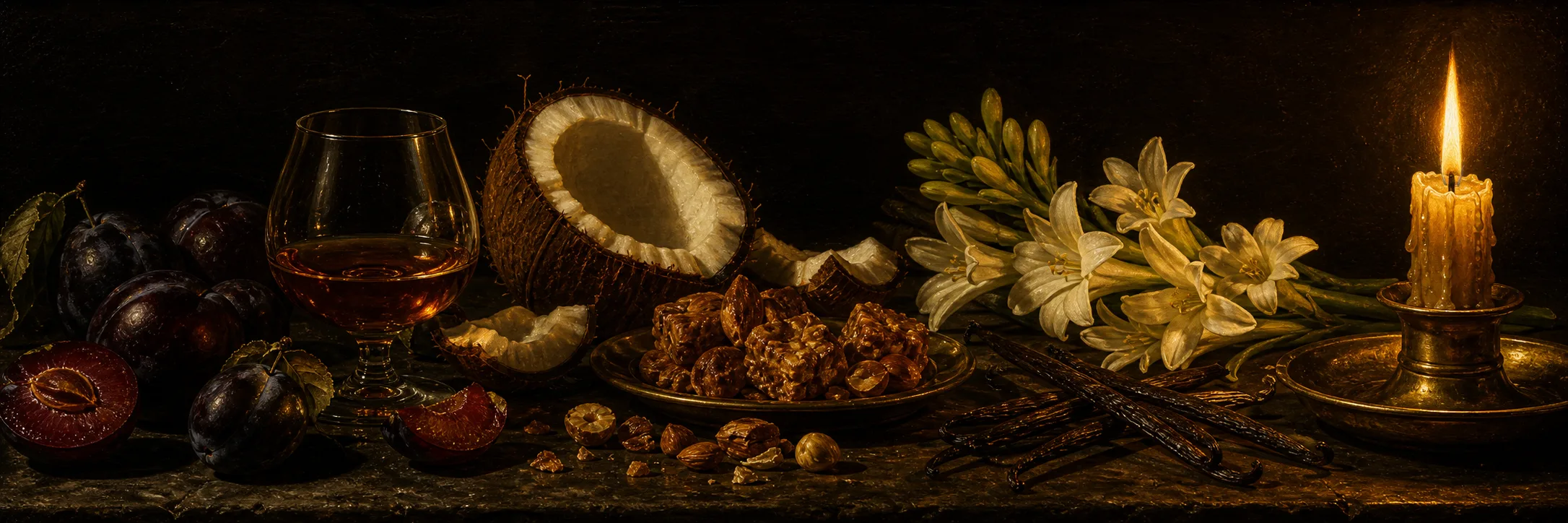
Petra is Lattafa’s 2025 budget-priced “Mediterranean summer” gourmand and, by near-universal wearer agreement, an inspiration/dupe of Xerjoff Casamorati Quattro Pizzi at a fraction of the cost. It runs a boozy rum-and-plum opening into a creamy tuberose-coconut heart and a sweet, nutty praline-vanilla-musk drydown - sunny, sweet and a little boozy. Named after the Greek word petra (“stone/rock”), it’s pitched as capturing and “petrifying” the warmth of a Mediterranean summer. Note that the catalog lists the year as unknown and the listed lattafa-usa.com URL is a brand/retail page; wearer sources (wearers, wearers) confirm a Spring 2025 launch and are the authoritative identity references.
Scent Profile
The opening is the most polarizing stretch: a strong, sometimes pungent boozy rum over a juicy-to-slightly-unripe plum (one reviewer reads the dark sweetness as molasses rather than rum). Many find it harsh or off-putting on first spray and report it improving markedly after a few weeks’ maceration. The heart is the payoff - a creamy, velvety tuberose softened by a sun-warmed coconut, giving a “sunscreen by the pool” tropical-floral feel; reviewers consistently call the coconut-tuberose pairing better than expected. The drydown turns musky and gently spicy with praline, settling into what one reviewer described as a “slightly sweet, dusty-tobacco scent that feels like expensive, intimate suede.” Perceptible: rum, plum, tuberose, coconut. Submerged: praline and vanilla mainly add warmth and a roasted-nutty finish. Signature accord: boozy tropical floral-gourmand. Some reviewers find the tuberose sharp; a few get a generic “lavender/boozy orange” impression instead, suggesting meaningful skin-chemistry variance.
Performance
wearer performance reports are genuinely conflicting. A vocal camp reports strong output - “monster mode,” projecting enough to linger in air and fabrics, with one reviewer citing 6+ hours of good sillage before it became an intimate skin scent after ~4 hours, and a reviewer claiming “longevity of over 7 hours and a decent sillage.” Yet wearers’s aggregated wearer Performance sentiment is modest for many wearers.qualitatively for longevity and about qualitatively for sillage - implying many wearers experience it as moderate rather than beastly, and several note it lasts better on clothing than skin. Best read: a loud, projecting opening that for many softens to a close skin scent within about four hours, with outcomes swinging widely by skin. Reviewers say it can be worn in essentially any weather, though its sweetness suits warm/evening wear. Spraying on clothing extends it.
Wearing Context
Pitched and largely worn as a warm-weather scent - summer days and especially summer evenings and “cool summer night dates” - though several reviewers find its warmth carries it into fall and even early spring. Evening and going-out settings suit the boozy-sweet character best; it’s a “want to be noticed” fragrance rather than an office-discreet one. Marketed unisex and worn by both men and women in the wearer, but the sweet tropical-floral profile leans feminine in practice. Social perception skews “rich, sensual, statement” - loud, seductive, with a luxe presentation that belies the price. Practical reading for the sweetness-averse: this is firmly in candied-boozy-gourmand territory, so it will not read as fresh or minimalist.
Comparisons & DNA
The defining comparison, repeated everywhere, is Xerjoff Casamorati Quattro Pizzi (2024, perfumer Sofia Bardelli) - the fragrance Petra is widely called an inspiration of. The deltas the wearer draws: Quattro Pizzi is creamier, greener (from a davana note Petra lacks) and smoother, with a hay/tobacco-leaf base, while Petra is louder, more boozy/rum-forward, fruitier (plum), a touch harsher in the opening, and - per multiple reviewers - actually longer-lasting. One reviewer summed it: “QP is stronger on the creamy side and weaker on the rum, less harsh than Petra. But after an hour it becomes so close to Petra that I don’t see the point to pay 6-7x money for Xerjoff.” The price gap is dramatic: Quattro Pizzi runs $305 at Xerjoff-direct and $330 at Luckyscent and Osswald NYC for 100ml, versus roughly $25-42 for the same size of Petra - close to a 10x multiple. Other wearer-cited adjacencies: Lattafa Khamrah (shared boozy-sweet Lattafa DNA, with Petra read as a fruitier “summer” cousin), Burberry Goddess (a sweeter, more beast-mode relative), and Penhaligon’s tuberose-driven scents for the floral. Layering with Bellavita Luxury Honey or a vanilla/tuberose body mist is a wearer trick to deepen it.
Reception
Reception is positive-but-polarized and value-driven. Common praise: remarkable quality-for-price (“Lattafa has no business releasing masterpieces like this for these absurdly low prices”), the creamy coconut-tuberose heart, the attractive bottle/presentation, and the boozy complexity that punches above its tier. Common criticisms: a harsh/pungent rum opening that some find headache-inducing; the familiar “syrupy boozy Lattafa drydown” that detractors say recycles the house’s sweeter releases (“did they just dump all the Lattafa leftovers together?”); and the modest aggregated performance scores. Polarization axes: the rum opening, sweetness tolerance, and whether a near-dupe of Quattro Pizzi is exciting or derivative. “Blind buy?” - wearer-qualified yes given the low price and frequent comparisons to a $300 scent, but with explicit warnings that it’s “not for everyone” and benefits from maceration and ideally a sample first. Critical blog coverage is absent; the public record is mostly wearer and influencer discussion plus a launch announcement by editor “Sandrina.”
Versions & Reformulation
Single composition, no known reformulations. (Petra appears to be offered only in a 100ml EDP; the boxed presentation is described as a heavy “bottle within a bottle.”) Be aware that several retailer and aggregator pages publish incorrect note lists for Petra (variously citing citrus, jasmine, rose, cedarwood or pink pepper/frankincense) - these are generic SEO copy, not evidence of a different formulation; the authoritative pyramid is plum/rum, tuberose/coconut, praline/musk/vanilla.
Acquisition Notes
Budget tier. The 100ml EDP commonly sells for about $25-42 (e.g., FragranceX ~$24, Jomashop ~$30, FragranceNet ~$31, with sale prices elsewhere $28-42 against a list MSRP often shown around $50-55); UK street price is roughly GBP30. The single widely-available size is 100ml/3.4oz. Counterfeiting is a brand-level concern for Lattafa rather than Petra-specifically - the heavily-faked items are Yara Pink and Khamrah, not Petra, and a sub-$40 scent is a low-margin counterfeit target. Authenticity guidance that applies brand-wide: genuine boxes now carry a QR sticker that should resolve to lattafa.com (a discussions tip notes the verification URL should contain “genuine/v1,” not just “genuine”), and box/bottle batch codes should match and can be checked via CheckFresh - with the standing caveat, stated by Lattafa-authenticity guides, that “a matching batch code does NOT guarantee authenticity” since codes can be copied. Buy from the official Lattafa site or established retailers; treat unverified marketplace and decant sources with caution.
Notable Facts & Lore
- The name and concept come from the Greek petra (“stone/rock”); Lattafa’s launch copy frames Petra as freezing/“petrifying” a Mediterranean summer into something eternal - “like sun-baked cliffs guarding secret coves.” Beyond that marketing narrative there is little documented lore: it’s a 2025 mass release whose cultural footprint is essentially the viral TikTok/YouTube “Is it a Quattro Pizzi dupe?” conversation rather than any celebrity association or controversy.
- Its identity discrepancy is itself worth noting for an LLM context - the catalog’s “unknown” year resolves to Spring 2025 per wearer sources, and the supplied lattafa-usa.com URL is a brand/retail page, not a wearer reference.