Lattafa — Khamrah
Essence
Khamrah is the single most successful Lattafa release ever - the 2022 cinnamon-dates-praline-vanilla bomb that became the brand’s viral TikTok crossover hit in 2023 and remains the default starting point for anyone exploring affordable Middle Eastern perfumery. The Arabic word “Khamrah” means wine or fermentation, and the composition leans into that boozy-spiced-gourmand identity. What it actually is: a dense, syrupy, masala-spiced gourmand with apple-pie / cinnamon-roll / spiced-date character, presented in a heavy rounded burgundy-and-gold flacon that visually echoes Kilian Angels’ Share. The bottle resemblance and the gourmand DNA overlap are deliberate; Khamrah is widely considered the Lattafa interpretation of Kilian Angels’ Share, though wearer opinion on actual closeness is more split than the marketing suggests.
Scent Profile
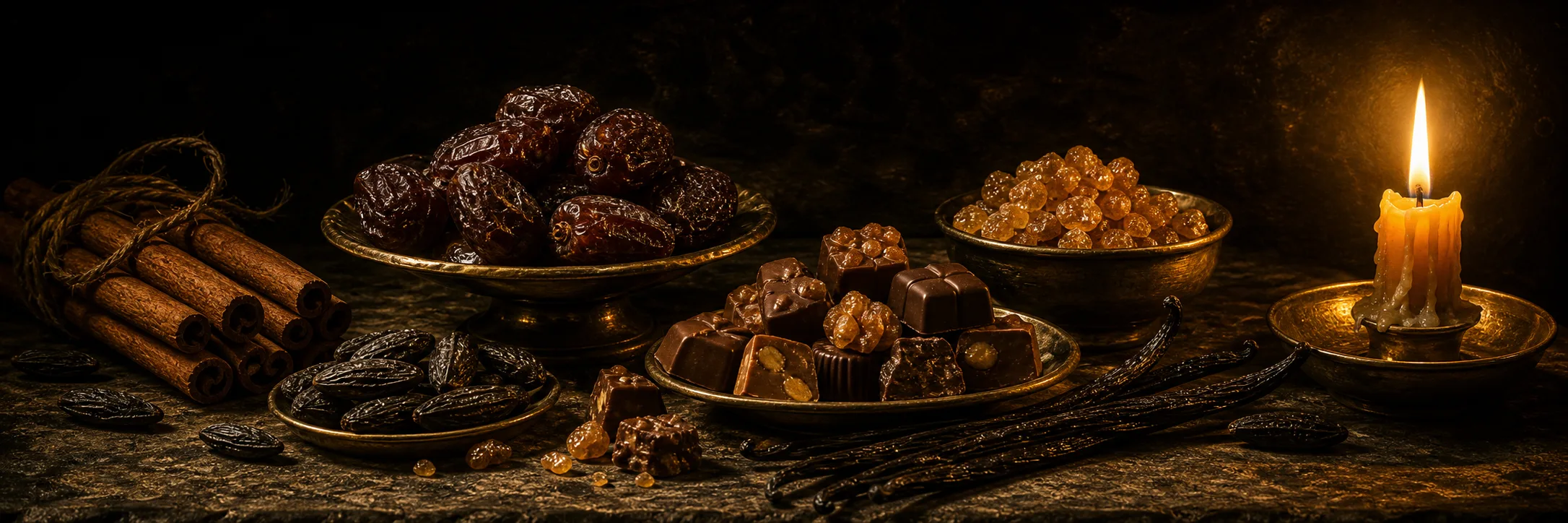
The first fifteen minutes open with bergamot, cinnamon, and nutmeg in a punchy warm-spicy register - the bergamot is functional rather than featured, lifting the spices but not getting its own moment. The cinnamon is the immediate signature: not the harsh red-hot-candy cinnamon of bad gourmands but a softer, slightly powdered, baking-spice cinnamon. Nutmeg adds a darker, drier spice edge. Several reviewers and analytical commentary flag a slightly synthetic Ambroxan-sweet edge in the opening that fades after maceration - wearer language calls this the “shower gel” or “Axe body wash” register, real on fresh bottles but resolved within four to six weeks of rest. From thirty minutes through three hours, the heart unfolds and Khamrah commits to its identity. Dates are the central note - sticky, jammy, caramelized, with that distinctive Middle Eastern dried-fruit register; this is the note that separates Khamrah from its Kilian reference point. Praline sits underneath as a creamy caramelized-nut sweetness, contributing the “praline” character without becoming chocolatey. Tuberose is listed but functions as a tropical-creamy lift rather than as a discrete white-floral - most reviewers don’t perceive it as tuberose and describe a “coconutty” or “creamy” quality instead, which is likely the tuberose lactones reading without the indolic edge. Lily-of-the-valley is essentially undetectable as discrete LOTV; it contributes diffusive lift. The drydown from three hours onward deepens into the base: roasted tonka provides a darker, almost coffee-adjacent sweetness; vanilla rounds the composition into the recognizable gourmand finish; myrrh adds a quiet resinous-smoky thread without ever going incense-heavy; benzoin contributes warm resinous sweetness; amberwood provides projection-extending mineral warmth; and akigalawood (a Givaudan specialty material derived from patchouli oil byproducts) adds a slightly woody-spicy-patchouli edge that’s structurally crucial - it’s the thing that keeps the gourmand from going pure-dessert and roots it in a vaguely oudy Middle Eastern character. Linearity vs evolution: Khamrah is more linear than its complex note list suggests. a recurring wearer description describes it as “in many ways pretty linear” - the cinnamon-dates-praline accord persists from roughly forty-five minutes through eight or ten hours with relatively subtle base-shift. The signature accord is the cinnamon-dates-vanilla-tonka quadrangle, with myrrh providing background depth. Notes that don’t really show up as discrete: lily-of-the-valley, much of the tuberose (perceived as creamy rather than floral), and myrrh (felt rather than recognized).
Performance
This is one of the strongest-performing fragrances in the Lattafa catalog and a meaningful part of its appeal. Projection is strong for the first two to three hours - three to four feet of scent bubble, room-filling indoors - then settles to a generous moderate aura for several more hours. Sillage is loud in the opening. The roasted-tonka / amberwood / akigalawood base architecture is what’s doing this work - these materials are extremely tenacious. Heat behavior: it can become cloying in summer humidity, and wearer consensus pushes Khamrah firmly into cold-weather positioning. The fragrance is at its best in fall and winter, where cool air keeps the spices crisp and prevents the sweetness from compounding. Several reviewers report headache-risk from over-spraying in warm conditions. Best application: one to three sprays is the universal recommendation. Khamrah is one of the Lattafas where less is genuinely more - over-spraying produces complaints from people around you and headache for the wearer. Two sprays maximum to chest/neck is the wearer-tested optimal.
Wearing Context
Fall, winter, and cool spring. Evening-coded but works for daytime in cold weather. Khamrah is heavily associated with cozy / holiday / “fireplace-and-date-night” contexts - date nights, dinner parties, festive occasions, winter weddings, casual evenings out. Office wearability is split: in cooler-climate offices with good ventilation, two sprays work; in warm offices or close-quarters professional settings, projection becomes a problem. Where it shines: any cold-weather social setting where warmth and approachability are valued, gourmand-lovers’ contexts, gift-giving situations (the bottle alone justifies the gift). Where it falls flat: summer wear in humid climates (cloying), professional settings requiring restraint, and any context where the wearer is trying to read as refined-niche rather than comforting-accessible. Social perception is overwhelmingly positive on the compliment metric - Khamrah is one of the most-named “compliment magnet” fragrances of 2023 - 2024 across wearer reports. It skews slightly feminine in default perception despite unisex marketing; male wearers report it works for them but reads warmer/sweeter than typical masculine gourmands.
Comparisons & DNA
The primary reference is By Kilian Angels’ Share ($250 - 350 for 50ml) - the 2020 Calice Becker composition (cognac, cinnamon, oak absolute, tonka, vanilla, praline, sandalwood) from Kilian’s Liquors collection. Side-by-side, the relationship is more “inspired by” than “clone.” Both are warm-spicy-boozy-gourmand winter projectors with cinnamon-praline-vanilla DNA, but the deltas are real: Angels’ Share has a featured cognac note (boozy, slightly oak-aged) that Khamrah doesn’t replicate; Khamrah has a featured dates-praline character that Angels’ Share doesn’t have; Angels’ Share is more refined in blending while Khamrah is sweeter, denser, and louder. Analytical side-by-side reviews and wearer comparisons converge on roughly 50 - 70% similarity, with the bottle resemblance amplifying the perceived closeness. Other comparables: Maison Margiela Replica By the Fireplace (smokier, less sweet, more chestnut-than-dates); Mancera Cedrat Boise (different DNA entirely, but adjacent gourmand-amber); Initio Side Effect (boozier, more leather-tobacco - frequently cited alongside Khamrah but actually distinct); Xerjoff Erba Pura (fruity-gourmand, not spice-gourmand); YSL Black Opium (coffee-vanilla-floral, lighter); and at the budget tier Al Haramain Amber Oud Gold Edition (different but adjacent). Within Lattafa, the Khamrah line has become a multi-bottle rotation: original Khamrah (the universal-appeal masala-vanilla anchor), Khamrah Qahwa (2023, the coffee-cardamom flanker - louder, more masculine-coded, polarizing); Khamrah Dukhan (2025, the smoky-incense-tobacco evolution - most niche-feeling, evening-coded, monstrously performing); and Khamrah Maliky / Khamrah Karaz / various extensions. The flanker strategy is one of Lattafa’s most-deliberate line extensions and reflects how successful the original became. Khamrah Waha (2026, with Jordi Fernandez credited as nose) is a separate aquatic-fresh fragrance that controversially uses the Khamrah name despite having unrelated DNA - wearer reception has been mixed-to-negative on that line decision. The lineage: Angels’ Share established the cinnamon-praline-vanilla luxury gourmand template in 2020; Khamrah translated it for the budget Middle Eastern aesthetic in 2022 with dates and akigalawood; multiple competitors (Armaf, Maison Alhambra, Afnan) subsequently released their own Angels’ Share / Khamrah interpretations. Khamrah is one of the few cases where the budget interpretation arguably influenced the broader trend rather than just chasing it.
Reception
wearers wearer sentiment is similarly strong with stronger volume. Common praise: the cinnamon-apple-pie / cozy-spiced character, the beast-mode performance, the bottle presentation, the unisex flexibility, and especially the price-to-quality ratio. Common criticisms cluster around the synthetic Ambroxan edge in fresh bottles (resolved by maceration), the polarizing sweetness level (cloying for non-gourmand-lovers), headache reports from over-application, and the recurring “is it really an Angels’ Share dupe” debate. A small contingent of wearers find it grating and “instant headache” - chemistry sensitivity to the dense gourmand base is real for some wearers. Polarization axes: (1) gourmand tolerance - non-gourmand lovers dismiss it as cloying regardless of execution; (2) clone-discourse - wearers who blind-bought expecting an Angels’ Share replica feel let down by the actual delta; (3) the “TikTok hype overrated vs. genuinely good” debate, which crops up in every wearers Khamrah thread. Blind buy verdict: among the safest Lattafa blind buys for anyone who likes warm-sweet-spicy gourmands and wants cold-weather wear. Risky for non-gourmand lovers, anyone in hot climates, and Angels’ Share owners who already have the reference. influencer signal is the heaviest of any Lattafa release: Jeremy Fragrance, Curly Fragrance, Wilberto Mejia, Sebs Fragrances, Demi Rawling, and effectively every major fragrance YouTube channel produced sustained Khamrah content through 2023 - 2024.
Versions & Reformulation
Single composition for original Khamrah, no known reformulations of the core juice. The flanker family is extensive: Khamrah Qahwa (2023, coffee-cardamom flanker); Khamrah Dukhan (2025, smoky-incense flanker); Khamrah Maliky (saffron-rose-deeper amplification); Khamrah Karaz (cherry variant); Khamrah Waha (2026, the aquatic-fresh outlier with Jordi Fernandez credited as nose); and Khamrah Zanqam plus various format extensions (body mists, oils, travel sizes). Each flanker takes the original masala-vanilla DNA and adds a distinct character - coffee for Qahwa, smoke/tobacco for Dukhan, cherry for Karaz - though Waha breaks the pattern entirely. The original Khamrah remains the line anchor and most-recommended starting point.
Acquisition Notes
100ml EDP at $30 - 50 USD typical retail, with the $35 price point being the most common. Body mist and oil/concentrate extensions widely available. Decants run $5 - 10 for 5 - 10ml on split sites. Buy from Lattafa USA direct, FragranceNet, FragranceX, Jomashop (with verified seller status), or established perfume specialty retailers.
Notable Facts & Lore
- No documented perfumer credit - Lattafa does not credit perfumers, and Khamrah is no exception.
- Launch context: Khamrah dropped in 2022 with deliberate bottle-design echoes of Kilian Angels’ Share, positioned as the brand’s first major push into Western-niche-adjacent territory.
- The 2022 launch was a slow burn; the breakthrough happened on TikTok in 2023.
- The TikTok virality is the central cultural moment for Khamrah and one of the defining fragrance-marketing stories of the early 2020s.
- The #Khamrah hashtag has accumulated over 50 million views, with some related-tag counts reaching 100 million+, and thousands of “perfume that smells expensive” / “best $35 fragrance ever” / “Kilian Angels’ Share dupe” creator videos driving the discovery cycle.
- Major influencer wins include Jeremy Fragrance’s coverage (which alone moved meaningful units) and a sustained 2023 “Khamrah season” content wave each fall.
- The fragrance was repeatedly sold out at major retailers through late 2023 and early 2024.